
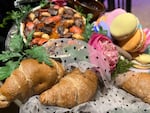
This undated, provided photo shows fake food props of croissants, macarons and beef bourgignon that were made by Olivia Vavroch for Profile Theatre's production of "Samsara" in 2025. Vavroch is a Portland-based artist, teacher and theater designer who specializes in making realistic-looking fake food using styrofoam, clay, acrylic paint and other materials.
Courtesy Olivia Vavroch
A course at Portland Community College is currently being taught where students use styrofoam, clays, paints and their imaginations to create “haunted” charcuterie boards adorned with fake moldy cheeses, unappetizing crackers and rancid-looking slices of deli meats.
Olivia Vavroch, a Portland artist, teacher and theater designer, is teaching the Halloween-themed class. The Portland Mercury recently profiled Vavroch in its Fall Arts issue, describing the career transition she made into the world of theater several years ago after contracting long COVID-19.
Vavroch designs and dresses sets, specializing in making custom theater props that include fake foods like cake or lasagna that can help bring depth to performances and layers of authenticity to the story. She is also one of dozens of artists whose work is being featured in “Inconvenience Store,” an interactive art exhibit currently taking place inside a former 7-Eleven in downtown Seattle.
Vavroch joins us to share more details about the delicious art of making fake food.
Note: The following transcript was transcribed digitally and validated for accuracy, readability and formatting by an OPB volunteer.
Dave Miller: This is Think OutLoud on OPB. I’m Dave Miller. Do you want to learn how to make fake moldycheeses, unappetizing crackers and rancid looking slices of deli meat? There isa course for you. Olivia Vavroch, who was recently profiled in the PortlandMercury, is teaching the haunted charcuterie class at Portland CommunityCollege. This fits into her larger work that she’s been pursuing in recentyears as an artist and a prop designer, with a focus often on food.
Olivia Vavroch joins us to talk about all this. It’s greatto have you on the show.
Olivia Vavroch: Hi, thank you.
Miller: You have a background in education.You’ve also worked as a stained glass restorer. How did you end up making propsfor plays?
Vavroch: That’s a wild ride. Well, we had the [COVID] shutdown, soall of my stained glass operations closed. I was teaching stained glass anddoing art markets, and none of those things were happening. And then I got longCOVID. When I got long COVID, I couldn’t lift the stained glass anymore. Thenthe teaching kids, that stopped before the shutdown. I was doing a little bitof literacy support by Zoom, and then when the kids went back to school, thatsupport wasn’t needed anymore.
Miller: So in a variety of ways, COVID just completely upendedyour life, physically, professionally, socially.
Vavroch: In all the ways, yeah. For sure.
Miller: OK, so that made it so you couldn’t dowhat you had been doing, but how did you end up doing what you’re doing now?
Vavroch: Yeah, so I am an artist and one of my former teacherfriends had some experience with puppetry. I was trying to think of differentways I could work through and create art to say different things. And one ofthe things that came up was puppets, which is a very specific, weird thing. AndI asked her if she had any suggestions for where to start with that, and sherecommended a couple of things online and then also pointed me to a theater intown that was doing auditions. They were looking for a shadow puppeteer, whichI had never done. She was like, “you should just reach out anyway and see whatthey say.” And I did and told them I had no experience, and they were like,“that’s great, we’ll train you how to do it.”
So I was able to rest all day leading up to two hours ofrehearsal, go home, and rest all night up until the next day of two hours ofrehearsal…
Miller: And you needed that time.
Vavroch: And I needed that time to be able to do the two hours ofrehearsal, which was literally just sitting and sometimes doing puppetry. Thenat some point they needed a fake lasagna. They were asking someone if a stagemanager wanted to make it, and they were like, “yeah, maybe.” And I was like,“I want to do it, I want to do it!” So I made them a lasagna.
Miller: Why did youraise your hand so quickly?
Vavroch: I was bored [laughs]. I was sitting home, I was sick and Ijust wanted something to be able to make with my hands. I couldn’t quite figureout where to start with the puppetry, but I knew that I’d made some sculpturalthings when I was working with kids before. So I was like, I’ll make thelasagna. I’ll figure it out. I’ll find some clay. And I did.
The show was like an absurdist show, so the lasagna was theonly real looking experience in the whole show. And when I brought it in, theywere very surprised because it looks real. They were really excited about it.
Would you like to see it? I brought it.
Miller: Please, yeah.I’m a fan of lasagna in general.
Vavroch: Look at this!
Miller: It is fantastic. It’s big … one, two,three, a good five layers of the crinkled-at-the-edges sheets, some meat sauce,some cheese. It’s amazing. So this was the lasagna from the play?
Vavroch: Mm-hmm. And it’s a little cracked. I’ve taken it to all ofmy fake food classes, and shown and told it to so many people. But it’s theoriginal.
Miller: But real lasagna can cracktoo sometimes. How deep do you go in research, in terms of being periodspecific or place specific, if you’re doing something for a play?
Vavroch: Research is one of my favorite things. So I go very deepinto my research. I did props for a show called “Witch” last year, with ProfileTheatre here in town – a year ago actually. And it took place in medieval-ishtimes in English area-ish. I don’t know, we figured out it’s theater magic. ButI researched what kind of foods would be available that time of year; what kindof foods, historically, would be prepared based on the types of cookingmechanisms that were available; or what foods and spices might not have beenavailable in that region of the world yet. And then [I] developed a menu andmade the leftovers, because you see the feast at the very end of it. So todevelop the feast based on that, like whatever foods were there. So a lot offish bones, breads, cheeses and stuff like that.
Miller: How do you think the props that you’redesigning impact the experience of the actors? Because I have a sense for if Isaw that lasagna from the audience, it would just look like a lasagna and Iprobably might not even think much about it. I might think, gosh, they made alasagna for this. That’s amazing. But I’m curious about the actor’s perspective.
Vavroch: So I think that if I’m doing a really good job, the actorsare able to bring more to the work that they do on stage, right? It doesn’ttake them out of the storytelling that they’re doing. It actually can bringmore to the story that they’re doing. I’ve had actors tell me that my propshelp them stay in the story, ground themselves if there’s something that’s … ifthey’re distracted by something in the audience or themselves, to ground themin the moment so that they can slow down and bring some more nuance to theirlines. It’s just such a great compliment.
Miller: What are thedifferent materials you use to make fake food?
Vavroch: I use a lot of recycled materials. So the lasagna has astyrofoam core and I’ve built around it with clay and carved it. I use a lot offoam clay, like Model Magic, which is a lighter clay. And I use a lot ofdifferent kind of paints. I recently was making foods for an installation inSeattle called “Inconvenience Store,” and I learned the hard way that a certainkind of clay I was using has a reaction with spray paint. So everything wassticky and I had to problem-solve a little bit, and now I get to remake all ofthe things that I took up there [laughs].
Miller: In a description of work that you showedin Seattle last year, you wrote this: “As a food-motivated neurodivergentperson, my body craves food to self-soothe and regulate myself throughdissociation to ground myself in the present.” “Ironically,” you wrote, “thissame neurodivergence has given me a lifetime of disordered eating andever-evolving dietary sensitivities that’s now amplified and exacerbated by mylong COVID.”
There’s a lot in there. What is it like to make food thatyou love that you cannot eat now?
Vavroch: It’s a mixture of grief and almost reverence. It’s similarwith my props too. Like I love being able to process what’s coming up with it,and also bring a love and a gentleness to what I’m making. So, for the foodsthat I can’t eat anymore, I really appreciate and have a lot of nostalgia andcare for how those foods have comforted me in the past. So I just really take alot of care in how I’m working with the materials, to be really intentional andas mindful as I can, to bring love and a part of myself to appreciating thosefoods.
Miller: But wrapped up with some element ofgrief.
Vavroch: Oh, so much grief. So much grief.
Miller: What is afood you’ve made a prop of, or artistic version of, that you don’t eat yourselfnow?
Vavroch: I keep coming back to cake, yeah. I have, however, found acake. But the thing is … so, it’s sugar, it’s dairy, it’s flour. And what kindof cake doesn’t have those things that you actually want to eat? So I make cakethat doesn’t have those things, but it looks really pretty, and it looks reallydelicious.
And cake is a lot of nostalgia for me. We had cakes atbirthdays growing up or special events. Cakes can mean celebrations. Cakes canjust be because it’s a Tuesday. But cake is like a thing that really representsjoy for me, and also, there’s a lot of memories connected to that.
Miller: What’s a particularly hard food to getright?
Vavroch: Oh, pizza.
Miller: So you can dolasagna, but pizza is harder.
Vavroch: Yes, because it’s thin. I’ve been trying to figure out howto make a New York pizza, and I’ve been using a cardboard core and buildingclay around it. But the thing is, the clay dries at a different rate than thecardboard does, so it’ll crack when it’s drying. And there are ways of coveringthat up. There’s always ways of covering up things that look like mistakes, asan artist. That’s one that’s hard.
Then also, things that need to be brothy or liquidy, likesoups, I think I’m gonna start to work with resin. I have a kit to experimentwith. I wanna talk with someone through it so that I … or deep dive on someYouTube videos on it. That, I think, is the next step in the work I’ll be doing.
Miller: I mentioned the haunted charcuterieclass at the beginning. Can you tell us about it? What are you actuallyteaching?
Vavroch: [Laughs] OK, so I made food for a haunted house a couple ofyears ago. And then I was telling people about it and people seemed reallyinterested in it. So I started teaching this class. It is literally to makefood like that you would find on a charcuterie board. We do a whole brainstorm,like what kind of foods are on a charcuterie board and what would make ithaunted? And let the class decide what that would be. It might be that it’sslimy or moldy, or maybe it’s got critters coming out of it, or teeth, or, Idon’t know, just weird, gross things.
And then, actually, we just had our second class for thissession last night, so last night was the building. I sent home somestorytelling questions for my students to think about, like where in time wouldtheir charcuterie board have existed? Who would be eating it? Who would haveprepared it and for what purpose? And where in the world, or not this world,would they be consuming it?
So they each came up with these stories about the foodsthey’re making. Like one was a bog witch influencer. And I was just picturinglike the nails on some sort of food. And another was like a witches book group.So what kind of foods would be served at a little book group that like an oldwitch in olden times would have or something. It’s just the stories that peoplebring to the class, it’s fascinating.
Miller: You brought abox here, and before we went live, you offered to show me some of the otherprops you made. And I said, “no, I want to be surprised.” So if you’re gonnapick one other favorite thing there before we say goodbye, what else do youhave there?
Vavroch: I will give you a croissant.
Miller: A croissant.It’s fantastic. Nice lamination. I do want to try it.
Vavroch: I wouldn’t recommend it [laughs].
Miller: I want to go back to your entry into this sort of newchapter of your life, which was done sort of under duress, done because itseems like all these other windows were closed. How do you think aboutresilience in your own life?
Vavroch: That’s a really good question, because I used to teachresilience to kids all the time, but when you face that as an adult, it’sdifferent, right? My backup was always to be a substitute teacher, and thatisn’t something that I would be able to do anymore. I think a lot of it ishaving supports. I have really good supports in my friends, my partner, mytherapist, some family. And just being able to talk through stuff, being ableto voice the things that are hard and feel supported.
And then also, in that support, that opens up a little bitof room for curiosity, and being able to observe in the world and seepossibilities again, and think about, what if? Like if I hadn’t reached out tothat friend about shadow puppeting, there’s no way I would have ended up makinglasagna and there’s no way that I would have ended up continuing to work intheater. Well, I mean, maybe there would be a way, but I don’t know.
Then continue to meet other people in the theatercommunity, and to continue to ask them about what they do, and continue to justput my name out there and say, “Hey, I’m really interested in the work that youdo. Can we have a conversation about that?” It’s worked out really beautifully.And everyone in the theater community that I’ve worked with has just been sofantastic and really appreciative of and championing my work and sharing itwith people.
Miller: Olivia, itwas wonderful meeting you. Thanks so much.
Vavroch: Yeah, thank you so much.
Miller: Olivia Vavrock is an artist, a teacherand a theater designer.
“Think Out Loud®” broadcasts live at noon every day and rebroadcasts at 8 p.m.
If you’d like to comment on any of the topics in this show or suggest a topic of your own, please get in touch with us on Facebook, send an email to thinkoutloud@opb.org, or you can leave a voicemail for us at 503-293-1983.
