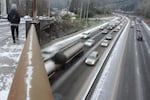
Traffic into the city slows with the dusting of snow.
Michael Clapp / OPB
The insurance industry is questioning a decision by the Clark County Sheriff’s Office to no longer respond to “non-injury, non-blocking vehicular crashes.”
“It’s a colossally bad idea,” said Kenton Brine, president of the NW Insurance Council, an industry group that represents insurance companies in Oregon, Idaho and Washington.
Clark County made the announcement this week, blaming a combination of personnel shortages and an increase in calls for service.
“What we're talking about it is the fender-benders,” said Clark County Sheriff’s Sgt. Fred Neiman. “Our service demands are so high and our staffing levels are so low that this is one of the areas that were going to have to curtail at this time.”
Brine said it’s a trend he’s seeing in a few places around the country, and one that raises several potential problems, from public safety to the accuracy of driving records.
“It’s a concern to a driver if they are involved in an accident with another driver who is not insured,” Brine said. “It’s hard to exchange insurance information with someone who doesn’t have any insurance and there’s no way to hold that person accountable if they leave the scene.”
Brine said there’s also a public safety element law enforcement provides: to referee against road rage. He said having a third party at an accident helps reduce fraud and keep insurance rates accurate.
“This is only the newest response to tightening budgets that we’ve seen really even before the economic downturn,” Brine said. “It’s just the latest idea.”
In Clark County, it appears for now to be more about staffing than budget cuts. The agency currently has 14 openings in a department with 126 sworn peace officers.
Sgt. Fred Neiman said the hiring process for new officers in Clark County takes more than a year and requires both physical and mental evaluations.
Neiman acknowledges it’s helpful to have a law enforcement officer at any accident, and said the agency may reconsider its position in the future.
“Of course we're still going to injury crashes,” Neiman said. “We’ll still respond to crashes if there appears that one of the drivers is under the influence or impaired in some way.”
Even though fewer sheriff’s deputies will respond to fender-benders in Clark County, Washington state law requires drivers involved in an accident with more than $1,000 in damage to complete a motor vehicle collision report.