Public media stations across the Pacific Northwest are bracing for financial cuts after the U.S. Senate voted early Thursday morning to claw back federal funding for the Corporation for Public Broadcasting.
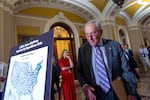
Senate Minority Leader Chuck Schumer, D-N.Y., arrives to speak with reporters about Senate Republicans' efforts to claw back $1.1 billion of funding authority from the Corporation for Public Broadcasting and about $8.3 billion from foreign aid programs targeted by DOGE, at the Capitol in Washington, Tuesday, July 15, 2025.
J. Scott Applewhite / AP
In rural communities and on tribal lands, these funds often pay for the only local reporting available and for broadcast equipment for the Emergency Alert System.
(Editor’s note: Oregon Public Broadcasting also receives about 9% of its funding from the Corporation for Public Broadcasting.)
KWSO, a radio station owned and operated by the Confederated Tribes of Warm Springs, could lose 40% of its operating budget if the rescission package is approved.
“We would continue to exist, but our operations [and] our offerings would be significantly cut back,” said station manager Sue Matters.
KWSO is one of the only sources of local and culturally-specific radio programming on the Warm Springs Reservation.
“All our content for our programs that we produce locally are local, and so a good portion of that is specific to Warm Springs and the Warm Springs tribes,” Matters said. “Three distinct cultures. Three distinct languages.”
Related: Federal funding for OPB and public media is at extreme risk. Here’s what you can do.
Two of the six staff members at KWSO are funded by the Corporation for Public Broadcasting, and Matters said the station’s first priority, if funding is rescinded, would be to find money to continue their positions.
KWSO also provides the Emergency Alert System for the Warm Springs area, informing the community about school and road closures and wildfire and snow events.
“We definitely play a critical role even in small things,” Matters said.
KWSO is part of a broader Indigenous public media ecosystem at risk of losing funding. Programming from Native Voice One — like daily news shows Native America Calling and National Native News — could be canceled or might become unaffordable to smaller stations like KWSO.
Ahead of Thursday’s vote, Sen. Mark Rounds, R-South Dakota, said he had reached a deal to pull money intended for environmental programs to help backfill cuts to some Indigenous serving stations, according to NPR.
Matters said the implementation of money specific to tribal stations could be complex because of licensing.
“Some tribal stations are licensed by their tribe. Some tribal stations are nonprofits. And so what’s the definition of who that is?” Matters said, adding that not all small stations are licensed to the tribe exclusively. “I feel bad for other small public radio stations in rural America..I don’t think that’s fair to them. Although I would totally take the money.”
Native Public Media, a network of dozens of stations across the country, called the Corporation for Public Broadcasting’s funding “irreplaceable” to its mission, and said the cuts would be “devastating” for their members.
“Diverting those funds risks undermining both climate goals and the stability of Tribal media,” CEO Loris Taylor said in a statement. “Unlike CPB, which was explicitly created to support public broadcasting, (Green New Deal) programs come with barriers that make them inaccessible to the very stations this proposal hopes to help.”
Taylor said small stations do not have grant writing staff capable of handling complex funding requests for environmental related programs.
Northwest Public Broadcasting, or NWPB, operates radio and television across Washington state and pockets of Oregon and Idaho. About 20% of NWPB’s budget comes from federal funding.
Sueann Ramella, the broadcaster’s director of audience, said losing $2 million in Corporation for Public Broadcasting funding could hurt the NWPB’s ability to reach remote areas with emergency information during natural disasters like wildfire.
“No matter what, we are here to serve local rural communities that don’t have access to trusted information.”
She said NWPB’s leadership is prepared to make changes to programming.
“What I do see is, we’re going to need to be making some very strategic cuts and just about everything is on the table,” Ramella said.
“We have to make changes in order to protect the overall signal for local news, local content as much as possible,” she said. “If that means I have to make some programming changes and adjustments, maybe find cheaper shows or different programs, then that’s what we’re going to do.”
Kate Riley, the CEO of America’s Public Television Stations, called the side deal for Indigenous station funding a “half-measure” that will still result in deep cuts at stations it aims to protect, as well as many others.
“Simply providing a one-time payment to Tribal stations will not ensure they can continue their current service or even survive,” Riley wrote.
Compounding the challenges that NWPB would face if it lost federal support, it is also affected by ongoing budget cuts at its parent organization, Washington State University, which provides about 40% of its funding.
“The university itself is looking at budget reductions. We are part of that,” Ramella said. “I know of no emergency funds as far as contingency plans. I do know that the future of this station and all public media is changed.”
Matters at KWSO said what’s most troubling isn’t just the short-term scramble for funding — it’s the long-term risk of dismantling an information ecosystem built over decades. “Public media and this circumstance is just an example of you don’t know what you’ve got until it’s gone. And sadly, I’m afraid if it does get gone, people are going to miss it.”
The package to pullback funding now heads to the U.S. House for another vote. Republicans there overwhelmingly approved similar cuts in June and are expected to send the package to President Trump’s desk this week.
Editor’s Note: This story has been updated to reflect the latest Congressional actions around funding for public media and the responses to those actions as of 7 a.m., Thursday, July 17.