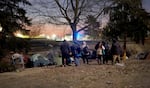
The Point-in-Time Count is required by the federal government and the state of Washington. Surveyors gathered data on Jan. 30, 2025 to help people connect to resources.
Dave Miller / OPB
Rates of homelessness in Clark County continued to rise in early 2025, according to new numbers released Thursday by Council for the Homeless. The nonprofit conducted a one-day count of people experiencing homelessness on Jan. 30.
The snapshot shows a deepening problem in Clark County, a region experiencing a housing crisis and where homelessness has been deemed an “emergency” by Vancouver, the largest city in the metro area around Portland.
Council for the Homeless conducts the annual point-in-time count as a reporting requirement for the U.S. Department of Housing and Urban Development and the Washington State Department of Commerce.
The 2025 PIT count showed homelessness among seniors age 62 or older increased 21% in Clark County. The overall number of people experiencing homelessness went up 12% from the previous year. People identifying as Black, Indigenous or a person of color accounted for 38% of all the people counted, despite the BIPOC community making up just 25% of Clark County.
Numbers like that are unfortunately not surprising to Sesany Fennie-Jones, CEO of Council for the Homeless.
“It’s changed slightly, but it’s still a huge discrepancy,” Fennie-Jones said of the overrepresentation of BIPOC individuals recorded in the survey.
Fennie-Jones said the increase in senior citizens is likely due to more shelters similar to those Vancouver operated over the winter being available. She said seniors are increasingly falling into homelessness because their income is usually fixed but rents increase.
“If you are receiving Social Security and your rent is increasing by 30%, you know that Social Security is not increasing by 30%,” Fennie-Jones said. “They don’t have the ability to increase their income. They’re not going out to get a second job, a third job.”
Clark County continues to struggle with a housing affordability crisis. Despite Vancouver’s efforts to relax building codes to develop more affordable housing, there’s still a major gap in what’s needed.
“In a 10-year period from 2011 to 2021, rents here went up 70% while incomes rose less than 20%,” said Andy Silver, CEO of the Vancouver Housing Authority, which builds affordable housing in the region.
The city of Vancouver is struggling to build even half of the 2,000 housing units needed in its current annual goal, according to the Columbian. Headwinds to building more housing include high interest rates and construction costs, limited lending for construction projects and the looming threat of tariffs increasing costs further.
The overall number of people identified in the 2025 Point-In-Time count in Clark County was 1,530. Still, Fennie-Jones said the PIT count numbers are assuredly an undercount. While some people experiencing homelessness are easier to locate at shelters during freezing temperatures in January, others stay with friends to escape the cold.
Correction: A previous version of this story misstated the total number of people experiencing homelessness in the 2025 PIT count. OPB regrets the error.