Kourtney Shreve remembers a student from when she started teaching at Bridges Program last fall. Despite everything the student was going through, they made a point to come in every day and check on her.
“Every other setting I’ve been in, it was always like, you gotta get academics done, you gotta grade … which is all important,” Shreve said. “But you can’t do those things if you don’t have that connection and that relationship with those kiddos.”
Bridges Program is an alternative school in the Corvallis School District. It’s for students in grades 6-12 who have experienced trauma or have severe behavioral challenges. Many have been expelled or have needs that other schools can’t accommodate.
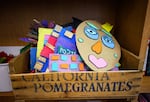
Art projects sit in a classroom at Bridges Program in Corvallis, Ore., on July 15, 2025. Bridges serves students in grades 6-12 who struggle in traditional school settings.
Victoria Garduño-Tran and Brennea Atchley-Roberts / High School Journalism Institute
Shreve, the new principal, said Bridges is often seen as “a last resort.”
The program’s goal is to give students a sense of belonging and support their mental and social-emotional needs so they can go back to their neighborhood school when they’re ready.
It’s a newer program for the mid-Willamette Valley school district, starting its third year this fall. This is the first year of its summer program.
Bridges came about after Senate Bill 819 passed in 2023. It’s a state law that requires students with disabilities to receive the same number of instructional hours as other students.
Corvallis administrators and educators wanted a school to help students struggling in traditional education settings — Bridges was born.
Shreve said there’s a misconception that “bad kids go to Bridges.” She’s been working to correct that narrative.
“It’s wonderful,” she said. “These kids are great.”
There will be 18 students this fall, more than double the school’s enrollment from two years ago when it first started. The program initially served middle schoolers, but added high schoolers last year.
A full day at Bridges is six class periods. Two are for community building and the others are for core academics and electives.
Students can attend Bridges for the full day or part-time. Teachers divide students by grade level but also split them by needs. Each student learns in a way that best suits them, such as one-on-one tutoring or computer work.
“Every student can learn if they can access (school) when they’re ready,” Shreve said, adding that educators have to meet the students where they’re at.
Bridges is funded by local, state and federal money. School officials fundraised and received in-kind donations, accumulating $20,000 in grants last year.
Bridges serves a vulnerable population. Though neither factor is required for eligibility, officials said that nearly all program students receive special education services and 100% are experiencing poverty.
Ultimately, the goal is to return students to their original school. Bridges has implemented a credit recovery program for its high schoolers to make sure they don’t fall behind while there, or in case they can’t go back. The program also helps students pursue alternative diplomas.
“Every student has a different story and a different path that got them here,” Shreve said.
The program has some out-of-the-box ideas, too.
Staff take students on field trips and outings to acclimate them to the community. They visit restaurants, the Humane Society, grocery stores and more, which helps students gain a sense of purpose and find activities they enjoy.
The garden is a new addition. There, students grow corn, tomatoes, beets and other produce.
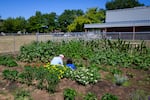
Dean and teacher Jill Snell, center, pulls weeds with a student in the Bridges Program garden in Corvallis, Ore., on July 15, 2025.
Victoria Garduño-Tran and Brennea Atchley-Roberts / High School Journalism Institute
“I knew from the beginning, coming into this world, that these kids need the earth, and they need a purpose and an intentional connection,” said Jill Snell, the school’s new dean and a special education teacher.
The garden provides sustainably grown food, which the students and their families can take home. Extra food is donated to the community when possible.
Students learn how to cook with the food, a skill they can teach their families. Staff often send the students home with extra ingredients or gift cards. They also allow the kids to use Bridges’ kitchen if needed.
While Snell discussed teaching cooking skills, she remembered a moment with a student.
They were harvesting zucchini in the garden. The student previously talked about how her mom made egg drop soup with the vegetable.
When Snell told the student they were harvesting the same plant she ate at home, the student lit up with joy and asked if she could take some back. She brought the soup the next day to share with everyone.
“It’s not just about the growing,” Snell said of the students. “It’s about actually caring about their worlds.”
This story was produced by student reporters as part of the High School Journalism Institute, an annual collaboration among The Oregonian, Oregon Public Broadcasting, Oregon State University and other Oregon media organizations. For more information or to support the program, go to oregonhsji.org.
This republished story is part of OPB’s broader effort to ensure that everyone in our region has access to quality journalism that informs, entertains and enriches their lives. To learn more, visit opb.org/partnerships.