The Portland Police Association criticized city leaders and staff on Tuesday, accusing them of trying to pit police and behavioral health first responders against each other in the wake of a man’s recent death in police custody.

An officer with the Portland Police Bureau attends the National Night Out in Maywood Park, Ore., on Saturday, July 27, 2019.
Bryan M. Vance / OPB
Aaron Schmautz, president of the police’s rank-and-file union, called Damon Lamarr Johnson’s death June 28 a tragedy as he rebuked unnamed officials for creating a “false binary” between police and groups like Portland Street Response.
“The false choice narrative must end and our city employees and public service servants must be allowed to work together to solve our community’s deepest needs,” Schmautz said.
The comments came during a hearing for the city of Portland’s years-long legal settlement to reform police tactics, particularly in how police interact with people in experiencing a mental health crisis.
The settlement dates back to 2012, when the U.S. Department of Justice found that Portland officers had a pattern of using excessive force against people with behavioral health issues. The city and the DOJ meet regularly to discuss how the city and police bureau are changing policies to improve.
Tuesday’s hearing frequently invoked Johnson’s death last month. Johnson, 52, died when three Portland police officers tried to arrest him at his apartment.
According to bureau officials, 911 callers had reported that Johnson had flooded his apartment and hung knives out of the window of his apartment. The flooding had reportedly led building staff to evacuate the entire apartment floor.
Three officers entered the apartment that night and attempted to restrain Johnson, who is Black. Officers forced Johnson onto his stomach as they arrested him and held him in place for several minutes.
Johnson lost consciousness before paramedics arrived, the footage showed, and later died at a hospital.
An investigation into the events is still ongoing.
Johnson’s death quickly prompted public outcry and has been at the center of renewed questions over which calls police should respond to by themselves and which should include mental health crisis workers.
Last week, an independent city board called the Portland Committee on Community-Engaged Policing held a listening session on Johnson’s death. Many attendees said Portland Street Response staff — who are unarmed and educated on behavioral health — should handle 911 calls like the one involving Johnson.
Schmautz echoed some of those sentiments Tuesday in court but emphasized that the two should be supported together.
“Just because a call requires police at the outset does not mean that additional resources, including PSR, cannot assume responsibility and care on a call once a situation is rendered safe,” Schmautz said. “This is no different than how we currently operate with fire and medics.”
But Schmautz criticized multiple, unnamed city officials for contributing to a “shifting narrative” to blame police rather than foster new services.
One city councilor, he said, recently posted to social media an image of a fake invoice of large police-related expenses of taxpayer dollars. The invoice also included a fake ID number of 1312. That number is code for A-C-A-B, Schmautz said.
“With respect to the court, I’ll edit slightly: all cops are bad,” Schmautz said.
OPB confirmed the social media post belonged to Councilor Mitch Green. When reached for comment, Green said the fake invoice was an art installation from a recent exhibit on Juneteenth and was one of several artworks he posted. He said neither he nor his staff noticed the fake ID number.
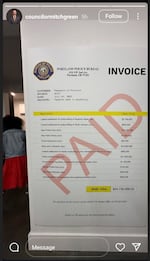
A screenshot of story post from Portland City Councilor Mitch Green's Instagram that was provided to OPB. Aaron Schmautz, who leads the Portland Police Association, referred to posts like this as an attempt to "shift the narrative" to blame police rather than provide more services to people experiencing mental health crises.
Screenshot provided to OPB
“The important part of that story was not the fake invoice, which we didn’t notice, but uplifting this art exhibit,” Green said.
Schmautz also named Andre Miller, a top city staffer for councilor Angelito Morillo, for leading chants during a demonstration saying police are “too stupid” to respond to mental health calls. Miller declined to speak on Schmautz’s comment.
“The same people who trumpet personal hate, vitriol, and abolition present a false binary, an either-or, of PSR or police,” Schmautz said.
Johnson’s death also coincides with a time of expansion for Portland Street Response.
The city bolstered its funding in the latest budget cycle, which will allow the agency to add more staff and expand their hours. Currently, Portland Street Response can’t respond to calls after 10 p.m. In June, councilors also passed a resolution that aims to put Portland Street Response on equal footing with police, fire and medics in the city’s organizational chart. The resolution underscored that it would be its own entity, not a direct report to police or fire.
Miller disagreed that advocates for Portland Street Response want to supplant police.
“We’re not saying that there should be situations or times where police or Portland Street Response can’t both go to a scene. We’re not saying that isn’t a possibility,” Miller said. “What we’re saying is there should never be an instance where someone in crisis should only get a police response.”
Green, likewise, said he viewed public safety as a “holistic system.”
“Portland Street Response and the Portland Police Bureau are part of that system,” Green told OPB.
That the conversation around police and behavioral health occurred in a court hearing for a settlement that is more than a dozen years old wasn’t lost on many in the room. Several speakers noted it’s a reason to keep federal oversight in place for the police bureau.
The Trump administration is attempting to wind-down consent decrees across the country. In an April executive order, President Donald Trump told the U.S. Attorney General to review consent decrees and “modify or rescind any that impede the performance of law enforcement functions.”
U.S. District Judge Michael Simon noted during the hearing that Portland hasn’t yet fully complied with the settlement. It will only end once the city has reached full compliance and remained that way for an entire year.