Oregon’s Congressional leaders are paying attention to the water emergency in the Mid-Willamette Valley.
The Salem City Council unanimously approved an emergency declaration Monday night to help it prepare for a potential drinking water shortfall next year.
The declaration is tied to an upcoming deep drawdown of the Detroit Lake Reservoir — which is set to take place that fall — by the U.S. Army Corps of Engineers.
“My staff is working with local and federal officials to strike a balance that recognizes the importance of protecting endangered salmon, but that puts the top priority on safe and clean drinking water for Oregonians,” Sen. Ron Wyden said in an emailed statement to OPB.
“I’m pushing the Army Corps to use every available option and potential resource to engage with the community and develop plans that achieve those goals.”
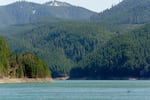
Looking southeast on Detroit Lake, April 14, 2021.
Kristyna Wentz-Graff / OPB
There are two major infrastructure challenges facing Salem. The first is developing alternative drinking water sources. The second is making improvements at the treatment facility itself, which includes resanding filters to be able to keep up with the increased sediment released by the drawdown.
Officials with the city’s Public Works Department at Monday’s meeting estimated the cost to prepare and upgrade the city’s water system in response to the drawdown would be $8 million. This would include building new groundwater wells as well as an additional pump at the city’s emergency water supply station in Keizer.
Improvements would be paid for using the city’s utility funds, but it’s not yet known whether this will result in increased rates for utility users. Salem Public Works Director Brian Martin said at the meeting Monday that their office will have to look during the next rate proposal, but “it could very well lead to that.”
He also said the city has the money in its five-year Capital Improvements Plan, commonly referred to as CIP. However, Martin told councilors they have to move things around to prioritize the overall water improvements quicker because of the drawdown timing.
“There’s a lot of infrastructure needs,” Martin said. “This forced our hand to try to make these improvements, so we’re making it work within the current CIP, but what that means is other projects are not getting done.”
The reservoir supplies water to the North Santiam River, which is the city’s primary source of drinking water. About 200,000 residents across Salem and its surrounding areas would be affected by the potential shortage next year. It could also affect firefighting resources.
The drawdown will bring the reservoir’s water to its lowest level since the Detroit Dam was built in the early 1950s. The measure is being done to improve downstream passages for endangered salmon.
Earlier this year, Congress ordered the Corps of Engineers, which operates the dams, to study how to avoid causing problems downstream with its drawdowns. That could include helping cities below the dams engineer alternative water systems. There may be more of a push after Monday night’s meeting to get answers — and maybe more money — from the feds.
Some alternatives for Salem include potentially tapping into its emergency supply from the city of Keizer or using its groundwater wells on Geren Island. The city also has an Aquifer Storage and Recovery system in south Salem, which could provide up to 5 million gallons per day.
But even with all those water sources combined, the city said it still doesn’t provide enough water to meet the daily demand of about 24 to 25 million gallons for its residents and businesses. It will still need to develop other water sources.
Molly Prescott, a spokesperson for Sen. Jeff Merkley, said Merkley’s office is tracking and actively engaging with stakeholders and the U.S. Army Corps of Engineers on this complex issue to ensure community concerns are heard.
“As a member of the Senate Committee on Environment and Public Works,” she wrote in an emailed statement, “the Senator and his staff are exploring the possible need for solutions to issues that may arise from any potential USACE actions next year.”
Previous reporting by OPB’s Amanda Linares and Tony Schick contributed to this article.
This is a developing story and may be updated.