UPDATE: The city announced on Oct. 1 that all parking meter enforcement hours will revert to 7 p.m., except during event district hours, effective on Oct. 15.
Original story below:
Starting Friday, Portland’s transportation bureau will extend parking meter hours from 7 p.m. to 10 p.m. in the Central Eastside.
The extension adds three hours of enforcement for on-street parking from Monday to Saturday. The changes come a month after a citywide parking rate increase took effect July 1.
The Central Eastside — which runs from Interstate 84 to Powell Boulevard and from 12th Avenue to the Willamette River — is the first of Portland’s five parking districts to see expanded hours. The city plans to roll out similar changes each month through the end of year.
Parking changes are coming to the Central Eastside. Pay-to-park hours for on-street parking is expanding to 8 a.m. to 10 p.m., Monday thru Saturday, starting on Aug. 1.
— Portland Bureau of Transportation (@PBOTinfo) July 28, 2025
Details: https://t.co/6Zlg24qNa9
Portland Bureau of Transportation spokesperson Hannah Schafer said the phased approach will allow the city to gradually update its signage across the city.
“Parking management is a really important tool for cities, especially when things are busy,” Schafer said. “[It] helps manage flow and keeps parking spots turning over so customers have the access to the business they want to reach.”
According to Schafer, PBOT data collected over the past year found more evening demand for parking near restaurants and shops.
She also noted that the increased revenue from meters will help the agency recover from seven straight years of budget cuts — a financial strain worsened when the state legislature failed to pass Gov. Tina Kotek’s transportation funding bill in June, leaving the bureau $11 million short.
In an email statement to OPB, Carolyne Holcomb, the executive director of the Central Eastside Industrial Council, said the district understands the importance of parking turnover and is supportive of businesses but also called the changes “premature.”
“For these changes to be effective and equitable, they must be accompanied by increased enforcement for all vehicles and consistent curb zone management,” Holcomb said. “Without those critical pieces in place, expanding pay-to-park hours feels premature and risks placing additional burden on businesses without delivering the intended benefit.”
Others see the new policy as a necessary evolution in Portland’s growth and a source of much needed transportation funding.
Andrea Haverkamp is the land use and transportation chair for the Kerns Neighborhood Association. She said the funds raised from increased hours are crucial for funding road construction, public transportation and safer crosswalks for pedestrians.
“Parking for private personal vehicles cannot be both free and abundant,” Haverkamp said. “The cost of free parking is potholes. The cost of free parking is no bike lanes. The cost of free parking is streets that are so unsafe that we have neighbors killed.”
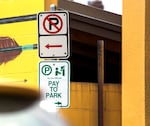
A parking sign on Hawthorne Blvd. in the central east side of Portland, Ore., on July 2025. Signs around the city are being updated with new times, stating that drivers must pay for parking until 10pm on most days of the week.
Morgan Barnaby / OPB
Haverkamp and others point to the fact that much of Portland’s parking revenue goes back towards transportation initiatives such as road repairs but also for public transportation and safer infrastructure for the 30% of Oregonians who don’t drive.
“Doing nothing is actually more expensive than increasing parking fees,” she said.
Zachary Lesher, a Buckman neighborhood resident, agrees.
“What a lot of people don’t understand is that a lot of the revenue from parking meters actually is used to benefit residents, visitors and employees in the parking district,” Lesher said.
Portland has long had lower parking regulations and costs compared to other major West Coast cities leaving room for increases, PBOT says.
Schafer said the need for increased parking management is a positive sign for the city. She said longer parking hours reflect how busy a city is.
“This is a little bit like Portland growing up into a big city,” she said.