
City of Vancouver Real Estate Project Manager Chim Chune Ko stands at the site of a new 95-unit affordable housing complex on July 17, 2025. The city's new parking ordinance will guide how many parking spaces are included.
Erik Neumann / OPB
On a recent day in downtown Vancouver, Washington, planes passed overhead from Portland International Airport and Vancouver’s Pearson Field. A coal train trundled through downtown, between shiny multi-level condo buildings lining the waterfront.
In a large parking lot for Vancouver’s city hall, construction crews were getting ready to break ground on a 95-unit apartment complex.
With so many signs of growth and commerce, it’s hard to tell that housing production in the city has reached a historic low.
The planned apartment complex, known as West 6th Street, will be the only affordable housing complex in Vancouver’s waterfront district. And it will be the first development to follow a new rule aimed at removing extra parking to make room for more affordable housing.
“There tends to be an excess in parking in small towns and in large towns. It’s pretty consistent,” said Chim Chune Ko, a real estate project manager with the city.
Related: Clark County leaders debate future growth and how to balance saving farmland with building housing
Earlier in July, the Vancouver City Council voted to remove parking minimums on any development where at least half the units are affordable housing.
In the past, affordable housing projects in Vancouver needed 0.75 parking spaces per unit. Now, developers can decide for themselves how much parking is needed. City officials hope that cutting excess parking and building more units in its place will make such projects more cost effective.
“In our current day and current market, construction costs are escalating at a huge rate, so anything we can do to reduce costs of delivering new housing is very impactful for any projects that are on the margins,” Ko said.
While not especially exciting, parking codes are a surprisingly important tool for helping cities address the housing crisis, according to supporters of the changes.
“Parking reform is kind of a small policy that has a big impact,” said Catie Gould, a senior transportation researcher with Seattle’s Sightline Institute.
Gould advised Washington lawmakers on a parking requirements bill that was signed into law in May. The state’s law won’t take effect for 18 months, so the Vancouver City Council passed their own ordinance in July to speed up the process.
Related: Washington state Legislature greenlights parking rollback to spur housing growth
There are major obstacles when it comes to building affordable housing right now in Vancouver and around the nation, including high interest rates, elevated construction costs and the ever-present threat of tariffs. Changing local ordinances is one strategy to encourage growth.
“Parking reform is one of the tools that cities actually have control over, and they can give builders flexibility through that,” Gould said.
In one land-use study from Colorado, authors showed that dropping minimum parking requirements and letting developers set their own parking needs translated to 40% more homes that would be financially feasible to build in the state.
Political divide over parking reform
Rewriting parking codes is one way that progressives are advocating for growth. The so-called “abundance agenda” marks a shift from past liberal values that sought to reign in development.
Now, progressive policy makers want to see zoning changes that help build infrastructure such as transit, alternative energy sources and housing.
Some Republicans see the parking changes as a threat.
“I think where they’re trying to go right now — and this is all this legislation — is they’re trying to get rid of cars,” said state Rep. David Stuebe, R-Washougal.
Stuebe amended the Washington law during the past legislative session to exempt small cities with less than 30,000 people. That translates to all other cities in Clark County besides Vancouver.
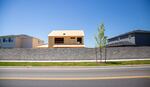
A single-family home being built in a development in Ridgefield, WA near the city's urban growth boundary on June 9, 2025.
Erik Neumann / OPB
Eliminating parking minimums could lead to congestion in cities like Washougal, where he is also mayor, according to Stuebe.
“We definitely have an affordable housing issue,” he said, “but we’ve got to make sure we’re doing it the right way and we’re not hurting the businesses and the community.”
With the exemption for small cities, Clark County’s Battle Ground, Camas, Washougal and Ridgefield would each have to pass their own ordinance to remove their current parking minimums.
For those looking for solutions to the affordable housing shortage, the clock is ticking.
On a recent day, Vancouver Housing Authority CEO Andy Silver stood in the parking lot of the Highland Park Apartments in northern Vancouver. The lot was about three quarters full.
“When you look at this lot, the parking takes up just as much if not more of the land as the building does,” he said.
The Vancouver Housing Authority develops affordable projects and helps low-income people find housing in Clark County.
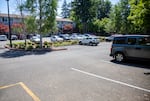
The parking lot at Highland Park Apartments, an affordable housing complex for seniors, on July 15, 2025.
Erik Neumann / OPB
The Highland Park Apartments are mainly one-bedroom units for seniors. If the complex was designed today using the new parking standard, Silver estimated the number of affordable housing units could be increased by a third, from 56 to around 75.
“If we were building this building today, we’d be able to put more apartments on it to serve very low-income seniors which is a huge need in the area,” he said.
Housing construction hits post-recession low
Regulations and constructions costs have slowed housing production in Vancouver to levels not seen since the 2008 Great Recession, according to Silver.
And there’s one more reason city residents should care about something as seemingly boring as parking rules.
A housing shortage in Vancouver over the past decade drove rents up significantly, Silver said. While an influx of new apartments has brought rents down in the past year, that stabilization is temporary.
“If nothing new gets built over the next couple years, we’re going to be headed into another major rent spike,” he said.