Listen to a discussion about how Oregon pays to fight and prevent wildfires:
Wildfires are getting more catastrophic and expensive. For the last decade, Oregon policymakers haven’t been able to agree on how to pay for them.
And while lawmakers emerged from this year’s legislative session with a plan to fund wildfire prevention, there’s still no dedicated funding to fight large fires like the Cram Fire, which has burned nearly 100,000 acres in Central Oregon.
The total wildfire budget for the next two years is less than the state spent last year alone. And in some cases, costs that used to be borne by a state wildfire insurance plan and private landowners are now the responsibility of all Oregonians.
A similar phrase cropped up during multiple interviews with policymakers: The consensus lawmakers reached this year is a good “first step.” What’s less clear is if it’s enough.
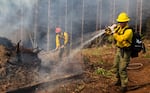
FILE - Oregon Department of Forestry crews work on a blaze outside Sweet Home, Ore., in 2022.
Oregon Department of Forestry
Consensus and compromise
Last year, wildfires grew so large and racked up so many unpaid bills that lawmakers had to convene a special session in December to fast-track funds to the Oregon Department of Forestry.
During the regular session the following month, legislators set out to find a dedicated source of wildfire funding to ensure that it wouldn’t happen again. Their goal was to raise about $300 million for the next two years — a modest target, considering last year’s fires alone cost the state a record-breaking $350 million.
They fell short. In all, lawmakers cobbled together $271 million through the state’s budget bill and House Bill 3940. Most of that is one-time funding from the state’s all-purpose general fund. That means in two years, lawmakers will have to go through another round of bill drafting, debates and hearings to find money for fighting wildfires.
That’s if the state doesn’t run out of wildfire money before then.
“Unless everybody’s wrong about this wildfire season and it’s much, much milder than everyone expects, we’ll be back in short session building a second-year budget for wildfire,” predicted Sen. Jeff Golden, a Democrat from Ashland.
House Bill 3940, the “Zyn tax bill,” creates a new tax on nicotine pouches and directs those funds toward wildfire prevention — like burning brush near communities to prevent future fires, or helping homeowners make their homes more fire resilient with new building materials and landscaping.
House Bill 3940, signed into law by Gov. Tina Kotek last week, doesn’t dedicate funding to fighting large fires.
Even so, Golden and other policymakers say the state’s new $60 million allocation to wildfire prevention is promising. It’s not easy convincing people to invest money into preparedness, especially during a tight budget year. Some wildfire groups and researchers have been pleading with Western policymakers to redirect money away from expensive fire suppression, and instead to focus on strengthening communities through fire mitigation, like prescribed burns and home strengthening.
“Fire suppression is not enough,” Kotek wrote in a statement after signing House Bill 3940. “To protect our forests, homes and public health for the long-term, we must build more resilient, fire-adapted communities across our state.”
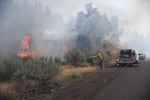
FILE - In a photo provided by Oregon State Fire Marshall, firefighters fight the Cram Fire east of Madras in July 2025.
(Courtesy of the Oregon State Fire Marshal)
Landowners no longer pay for large wildfires
In addition to raising money for fire mitigation, House Bill 3940 restructured how landowners pay for fire protection.
Most of the land the Oregon Department of Forestry protects — about 83% of 16 million acres — is privately owned, much of it used for logging or cattle grazing.
For decades, taxpayers have subsidized half the cost of basic fire protection on those private lands. The other half had been covered by landowners through land assessments.
Landowner assessment rates are set by ODF fire districts and are based on firefighting costs in each area. As wildfires have gotten bigger and more expensive, districts have had to raise these rates to cover their increased costs.
These higher assessments have been harder for rangeland owners to absorb, since they can’t make as much money per acre off grazing cattle compared to logging trees. They also own a lot of land compared to timber owners.
“You can’t grow corn, you can’t grow hay, you can’t irrigate it to get better grass,” said Matt McElligott, president of the Oregon Cattlemen’s Association. “It’s just rocks and sagebrush. The best use for that is livestock grazing, but it takes a lot of acres to run one cow.”
In addition to covering half of basic firefighting costs at the district level, landowners pay into the Oregon Forest Land Protection Fund. Timber companies also contribute to the protection fund through taxes on trees logged in the state. Until this legislative session, the protection fund contributed $10 million per year toward the state’s large wildfire costs.
House Bill 3940 changes the formula, so taxes from timber sales will pay a little more into the protection fund. And the protection fund will no longer pay any amount into Oregon’s large wildfire fund. Instead, the protection fund will primarily be used to pay for equipment and labor at individual ODF districts.
That means landowners are no longer directly helping the state pay to fight large wildfires, even if those fires burn through their lands.
“Oregonians writ large, whether it’s through the general fund or some other source, are going to be the ones to pay for it,” said Casey Kulla, forest policy coordinator for the environmental nonprofit, Oregon Wild.
Landowners got temporary help from a state budget bill: The Legislature put $9 million toward landowner rate relief, so they don’t have to pay as much in assessments for one year. In some cases their assessments will go up later.

FILE - The ShoeFly Fire burns north east of Mitchell, Ore., on Sep. 2, 2024.
Kathryn Styer Martínez / OPB
An ‘all-Oregonian’ solution
The way things were going before House Bill 3940, landowners say they were getting stuck with the rising costs of increasingly catastrophic wildfires.
“People couldn’t afford to pay it, or had to sell some properties to pay it,” McElligott said.
Landowners had to pay those costs even if fire never touched their land, or if a fire started on public land and spread to theirs.
“It was becoming so expensive for each individual to stay in the system. They were at a point where they were being forced into having to sell those lands,” said Kyle Williams, deputy director of fire operations for the Oregon Department of Forestry. “All of that threatened to erode that large pool that we have to collect from.”
If costs become too high, Williams worries landowners could leave ODF’s fire protection system and create their own association with neighbors. Oregon would lose whatever money those landowners would have paid into state firefighting.
But the solution lawmakers reached, a mix of one-time payments and changes to how Oregon pays to fight large fires, will shift about $19 million in costs to taxpayers over the next year.
“Wildfire is an all-Oregonian issue,” Williams said. “That deserves an all-Oregonian solution, right?”
When the Oregon Department of Forestry fights fires on private land, landowners aren’t the only ones who benefit, Williams said. Surrounding homes and businesses are also protected from the fire and its choking smoke.
“It’s always been a foundational core component of our funding system that there is a shared responsibility between the private landowners themselves and the general public who also receive those benefits,” Williams said.
It may not solve all of the challenges Oregon faces when it comes to fighting fires. But it’s a step.