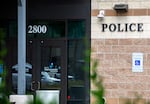
Vancouver Police Department, West Precinct, in Vancouver, Wash., June 29, 2024.
Anna Lueck / OPB
The Vancouver City Council unanimously approved a plan Monday night that would ask voters for more money to pay for police. The November property tax levy would fund up to 13 full-time Vancouver Police Department officers, vehicles and equipment, and city administration and prosecution costs.
It’s a significantly scaled-down proposal from the city’s 2024 law enforcement tax measure, which voters rejected during the general election. That levy sought to add 80 new officers and support staff. It was based on a $0.41 per $1,000 property tax increase that grew by 5% annually over six years.
The city is now proposing a tax increase of $0.15 cents per $1,000 of assessed value that would become permanent and grow with the base tax rate. It would translate to a $75.00 annual increase on a home assessed at $500,000, according to city staff. The levy would raise up to $6 million per year.
“Simplicity, clarity, wanting to be able to put it out to the public really with just one singular ask,” said Vancouver City Manager Lon Pluckhahn on Monday night as he described the proposal.
The 2026 levy includes an exemption for qualifying low-income seniors and veterans.
Clark County has grown rapidly in recent years. According to the city, Vancouver police call volume has increased by 24% since 2017. Both the Vancouver Police Department and Clark County Sheriff’s Office say they are among the lowest staffed agencies per capita in Washington state.
This scaled-back levy is a more methodical way to increase staffing, according to Vancouver Police Chief Troy Price. While the previous plan would have allowed the department to hire 80 officers, that was expected to take place over six years. This proposal will address more short term staffing needs, he said, but their hiring timeline would be similar to the 2024 proposal.
“I don’t see us actually taking a loss on this in the immediate,” Price said.
Vancouver City Councilors described two reasons for putting forward a public safety tax increase now: cues from voters with the current library levy and less competition for money with Clark County.
Officials with the city and the Police Advisory Committee plan to gauge how voters are feeling with the results of a Fort Vancouver Regional Library District special election levy that wraps up Tuesday.
“I think there was a strong sentiment that it would be instructive to see how that initiative does across Vancouver, just as a measure of how voters in general are feeling about whether or not they’re willing to approve property tax measures,” Pluckhahn said.
If that proposal is easily voted down, the city has a week to retract the public safety levy.
The November election also has less competition when it comes to law enforcement funding. In late 2024, as the city was promoting its proposed police levy, staff at the Clark County Sheriff’s Office floated the idea of a competing tax measure in early 2025 to fund 40 new sheriff’s deputies.
Clark County officials warned that by increasing officers in the Vancouver Police Department, additional arrests would swamp county-run services like the courts, prosecutor’s offices and the jail. Ultimately, the Clark County Council was unable to agree on a measure for the February 2025 ballot. No similar county proposal has been announced this year.
“I was considering this tonight,” said City Councilor Sarah Fox during Monday’s meeting, “if it’s better to go forward this November because we know that it would just be one question before the voters on safety and our policing staff, versus having to compete against the county.”
The levy proposal is just one piece of a three-pronged funding approach for more police in Vancouver, according to the city. In May, Gov. Bob Ferguson signed state House Bill 2015, which created a $100 million fund for local law enforcement positions over the next two years.
The legislation also allowed cities and counties to pass a 0.1% public safety sales tax without first getting voter approval. In time, Vancouver hopes these combined funding mechanisms will allow it to hire up to 25 full-time officers and 10 support staff.
“I think this is a great step in the direction of making sure we have the funding to staff for our current needs,” Price said. “We’re also looking to the future with the additional funding sources.”