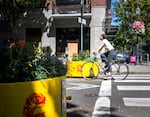
A Portlander rides their bike past traffic diverters on Aug 9, 2025. Multiple Portlanders chose to protest the removal of multiple diverters for the sake of civilian safety, some of which even arriving at the scene as early as 6am.
Morgan Barnaby / OPB
Over 50 Portland residents packed a conference room inside the Portland Building downtown Tuesday night, while over 50 more joined online, to protest the city’s planned removal of three traffic diverters.
The yellow flowerpot barriers have restricted vehicle access on select Northwest Portland neighborhood streets for years, providing cyclists a safer space for biking. A surprise announcement from the city two weeks ago, saying they would remove three diverters, caught many off guard.
Some viewed the move as another step back for a city once hailed as the nation’s most bike-friendly. But the move not only raised concerns about bike safety, it also prompted public concerns from politicians and residents alike about how the government communicates with the public. Ultimately, public pushback appears to have put the project on hold.
The directive to remove the barriers came from Portland’s Public Environmental Management Office.

A car drives past traffic diverters on Aug 9, 2025. Multiple Portlanders chose to protest this diverter removal for the sake of civilian safety, some of which even arriving at the scene as early as 6am.
Morgan Barnaby / OPB
The office is a part of Portland Solutions, a city effort established by then-Mayor Ted Wheeler to address growing livability issues such as visible trash and graffiti in the city. The broader program also provides resources to reduce homelessness and oversees camp removals.
After years of reported planning from PEMO to remove the diverters, city councilors were only informed via email on Aug. 1 that PEMO had directed the city’s transportation bureau to remove traffic diverters in Northwest Portland.
PEMO said that the Portland Police Bureau wanted the barriers removed to effectively address crime in the area. They cited complaints from business owners and PPB, which reportedly claimed that the barriers were aiding drug dealing and other crime while also impacting officers’ response times by creating numerous one-way streets.
PPB declined to comment on how the diverters impact drug dealing.
In a memo to Portland Mayor Keith Wilson on Aug. 11, City Administrator Michael Jordan pointed to increased crime in Couch Park, which is near one of the diverters.
“For years PPB has documented persistent public safety and liability issues in and around Couch Park, driven by a concentration of criminal behavior,” Jordan wrote.
Jordan argued that removing the barriers would allow PPB to drive through the area more easily for “routine patrols.”
The memo also mentioned numerous businesses in the area, including Chipotle, Dutch Bros Coffee and Banfield Pet Hospital, that had reportedly closed or relocated because of crime in the area.
Jordan outlined numerous recommendations for the area that included reopening the streets to two-way traffic and replacing diverters with additional stop signs.
Portland bikers ‘Occupy’
When Portland residents learned of the planned removal — set to occur as soon as Aug. 7 — they launched an emergency “occupation” of the diverters.
Connor Lennon stood guard over the diverter on Northwest 20th Avenue and Northwest Everett Street all day on Aug. 7. Standing next to a sign that read “neighbors love this greenway,” Lennon talked to pedestrians and cyclists about the dangers of removing the barriers.

Connor Lennon, NW Portland resident and protester discusses the importance of traffic diverters in Portland, Ore., Aug 8, 2025. Multiple Portlanders chose to protest this diverter removal for the sake of civilian safety, some of which even arriving at the scene as early as 6am.
Morgan Barnaby / OPB
At first, the occupation was a one-person show consisting of Lennon and their bike. Later that afternoon, dozens of residents came out for a rally to save the diverters.
The next day many residents were back out at the diverters continuing their occupation. Many, including Lennon — who one social media user dubbed “The Diverter Occupier” — said they would attempt to stop the removal of the barriers in any way possible.
“If someone comes to remove these today, they will have to physically remove me as well,” Lennon said. “I’m not going anywhere.”
Concerns over transparency
The anger over the proposed removal carried over into an evening meeting of the city’s volunteer, citizen-led Bicycle Advisory Committee, which advises the city on bike-friendly policies.
Dozens of people eagerly waited to be selected during public comment. As the comment session began to wind down after nearly an hour and a half, residents grew visibly emotional as they clamored to comment — some of those not selected to speak walked out of the meeting in frustration.
Speakers covered a wide range of arguments — all of which opposed the removal. Many recounted their own experiences of close calls and accidents while biking in the city. One common theme among most speakers was what they deemed to be a lack of transparency from the city and specifically PEMO.
City councilors Mitch Green, Tiffany Koyama Lane and Sameer Kanal all attended the meeting. Each of the three politicians represents a different geographic swath of the city. Their presence highlighted the role of increased council representation after the city established a 12-member city council earlier this year. Koyama Lane said that she had been “begging” with PEMO representatives to come to the meeting to hear from concerned residents.
The agenda published prior to the meeting said PEMO Director Anne Hill would be there to explain the agency’s reasons for removing the barriers.
When the meeting began, PEMO was nowhere to be seen, angering attendees.
“I’m disappointed, I was hoping that they would be here,” Green said after the meeting. “It worries me as a councilor representing this district that we have got a body in this city that is making decisions related to transportation without much public process and public input.”
Koyama Lane called on the mayor’s office to present data to back up PEMO’s claim that the diverters contributed to crime in the area.

(Left to right) Protesters Connor Lennon, Sven Gunvalson and Nick Levin shake the hands with a person after discussing the importance of traffic diverters to the local community in Portland, Ore., Aug. 9, 2025. Multiple Portlanders chose to protest this diverter removal for the sake of civilian safety, some of which even arriving at the scene as early as 6 a.m.
Morgan Barnaby / OPB
“It is absolutely reasonable for Portlanders to expect data-driven decision making, open communication and transparency around changes to our streets which impact our lives,” Koyama Lane said. “I really wish there were city staff leadership here to answer questions.”
Kanal also questioned whether PPB had in fact advocated for the removal.
“I have seen no evidence that PPB actually asked for this at all,” Kanal said. “I hear people talking about it but like we haven’t seen it directly [or] personally and I am the co-chair of the Public Safety Committee.”
PPB spokesperson Mike Benner declined to comment on the potential removal, saying it was a Portland Solutions initiative.
In an email statement to OPB, Portland Solutions spokesperson Cody Bowman declined to comment on why PEMO representatives did not appear at the meeting but said that the decision to remove the barriers was an “operational one” that involved “close coordination between multiple city bureaus.”
Committee moves for resolution
After over an hour of public comment, the committee passed a resolution calling on the city to stop the removal of any diverters.
Bowman confirmed Wednesday that the city leaders had paused the changes.
Green also said he was working with Koyama Lane to amend the city code to clarify the role the city administrator has in changing or removing City Council-approved infrastructure such as bike diverters.
It was not immediately clear how long the pause would last, but Green said reaching a resolution to the controversy could be a lengthy process.
“This process could take eight weeks, which feels painfully slow,” Green said. “But we do want to research it, we do want to have a city attorney look at it, we need to bring this through a committee, and then it would be referred to the full council for a vote.”
Green credited the new city council system in Portland with forcing Wilson and PEMO to take a step back.

A traffic diverter that is scheduled for removal by the city of Portland on NW 20th Ave and NW Everett St in Portland, Ore., Aug 7, 2025. Multiple Portlanders chose to protest this diverter removal for the sake of civilian safety, some of which even arriving at the scene as early as 6am.
Morgan Barnaby / OPB
“The new form of government is working right now,” Green said. “What had happened is that the mayor and the city administrator had made a decision. They didn’t tell anyone, they decided to do a thing and tell people later, but then a couple of your council members raised some red flags, we reached out to press … and the community vocalized.”
RJ Shepherd is an organizer with Bike Bus, a local group that gathers hundreds of students in Portland to ride their bikes to school together. He said the barriers are crucial to keep kids safe.
“This has been an absolutely incredible outpouring of support for a community that really just wants to see an improved public process throughout all of this,” Shepherd said.
Correction: A photo caption in this story mistakenly identified a person as a city councilor. OPB regrets the error.