OPB followed 25 students from first grade through high school as part of the Class of 2025 project to track the state's progress toward 100% high school graduation starting in 2025.
The project’s final documentary is now available on YouTube, and will air on OPB-TV on Thursday, Nov. 13 at 9 p.m. You can also attend a free screening and discussion at Mt. Hood Community College on Sunday, Nov. 16 at 3 p.m. Register here.
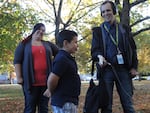
Rob Manning interviews Class of 2025 student Logan while mother Angelina looks on. Manning is the creator of the Class of 2025 project, serving as the project's main reporter through elementary and the beginning of middle school.
Michael Clapp / OPB
In 2012, Oregon schools embarked on a goal that by 2025, the state would achieve a 100% high school graduation rate, sparking the creation of OPB’s “Class of 2025” project. The project followed 25 students from kindergarten through graduation to see if they would meet Oregon’s goal.
Now 13 years after Class of 2025 launched, the project’s creator OPB Editor Rob Manning joined OPB’s Jamie Hershman to reflect on the assignment and his experiences covering this story with OPB Education Reporter Elizabeth Miller.
Jamie Hershman: What was the most unexpected challenge you faced throughout this long-term reporting project?
Rob Manning: The obvious answer to this is the COVID-19 pandemic. It both changed the trajectory of whether the state of Oregon had a remote chance of reaching its 100% graduation goal and upended how OPB actually conducted the project. As for the goal, the learning losses that mounted during distance learning would create barriers for countless students and put the brakes on graduation rates. Any thought that Oregon might reach the goal, or get close, pretty much ended with COVID.

OPB’s education reporter, Elizabeth Miller, at work on a story at Cedar Park Middle School, Feb. 22, 2023. Miller assumed the role of lead reporter on OPB's Class of 2025 project in 2019.
Kristyna Wentz-Graff / OPB
As for running the project, what had been an effort that was primarily focused at school suddenly had to pivot toward the home front for all of these students. That meant Elizabeth Miller, who became the primary reporter on the project when she joined OPB in 2019, had to make a big shift: from visiting a handful of schools to setting up visits with individual families. That shift occurred, of course, in the middle of a generational health emergency as it wreaked havoc on the economy, the healthcare system and other societal institutions. Many families didn’t want to be visited for fear of the virus; others were overwhelmed by having lost a job or by having to care for ailing family members. The project became enormously harder, just as teaching and learning and countless other aspects of society got more difficult at the height of the pandemic.
There were other difficulties along the way before and after the pandemic, certainly. Logistical challenges included keeping in touch with families – most of whom were low-income and very busy – as they moved, changed phone numbers, had health issues or other life difficulties, etc. Weeks or months would sometimes go by, and we would worry about what happened to a particular family. Then we’d catch them at the right moment and we’d celebrate rekindling the relationship.
There also continued to be challenges around the content of the stories themselves. Children’s lives are more complicated than the policy debates and story narratives that the public tends to associate with education journalism. Reflecting the humanity of these children and parents (who entrusted OPB with telling their stories) was a high priority. At the same time, the project’s purpose was always to connect the students’ experiences with more universal issues in our schools. That balance was a constant challenge that I thought would get easier as the project went on, but it was always tough.
“— Rob Manning/OPBReflecting the humanity of these children and parents (who entrusted OPB with telling their stories) was a high priority. At the same time, the project’s purpose was always to connect the students’ experiences with more universal issues in our schools. That balance was a constant challenge.”
Hershman: What changes in Oregon’s education system have you observed over the course of this project?
Manning: We will dig into this in the Class of 2025 final documentary, but the education system was supposed to be different. The announcement of 40-40-20 – the 100% graduation goal in 2025 that inspired OPB’s project – coincided with a set of proposals to overhaul the education system. But only a few years into the project, the goal’s creator, Gov. John Kitzhaber resigned from office. Over the next few years, new institutions like the Oregon Education Investment Board were abandoned. The Chief Education Officer’s role was eliminated. School administration requirements like “achievement compacts” meant to hold school districts accountable, were shelved. And emphasis on the 100% high school completion goal was greatly minimized.
The state made some advancements in spending on K-12 schools. In 2016, Oregon voters passed Measure 98, creating a new funding stream for high school programs aimed at career-technical education, dropout prevention and college preparedness. In 2019, the Legislature approved the Student Success Act, which created a new business tax to help fund specific school initiatives. But with mounting costs in the education system, it was hard to see what difference they made. In addition, tax collections under the Student Success Act were limited by the economic problems of the pandemic.
At the same time, schools struggled to keep up with big social changes – such as the smart phones in the hands of younger and younger children, the proliferation of social media and the rise of artificial intelligence in academia. Oregon’s graduation rate went up substantially, but leveled off since the pandemic, raising questions about whether even Gov. Tina Kotek’s new, less ambitious goal is achievable – to graduate 90% of students by 2027.
Hershman: Can you describe a pivotal moment in the project that affected your perspective on the state’s education system?
Manning: The pivotal moment, honestly, lasted a couple of months – Spring 2025. During that time, it was pretty clear that the education system isn’t built to meet students where they are. It’s up to students to find their way through. For many students, it’s difficult to maintain momentum as challenges prop up inside or outside of school. As one of the teachers we interviewed told us, “life keeps kids from graduating.” Several students found themselves derailed on their journey toward graduation and didn’t feel that anyone at school really missed them. They didn’t miss anyone or anything at school, either – and avenues outside of school simply felt more attractive. We hear words like “engagement” and “relationships” a lot when it comes to connecting students to school. By senior year, the importance of those things became obvious. The students who graduated were the ones who wanted to graduate, and had adults at school who cared about them and would guide them to the finish line. The students who didn’t graduate – one or the other was absent (or both).

OPB followed 25 students throughout their journey in school for its Class of 2025 reporting project.
Sarah Nairalez / OPB
Hershman: What do you believe was the most significant impact this project has had on public understanding of Oregon’s educational challenges?
Manning: Education challenges have been widely studied – from attendance to curriculum, learning styles to the effect of social media, from the relative impact of teachers and parents, to what you can and can’t learn from test scores. Rather than uncovering something entirely new, the Class of 2025 project gives a deeper, more three-dimensional view of the education challenges facing Oregon by illustrating them through the entire school careers of a diverse set of students.
We show how difficulties students had in middle school showed up as problems later on. Listeners, readers and viewers can see for themselves how a student may be led, or misled, onto various paths. We can see how positive factors at school – like having a team or activity a student is excited about can make a student feel more connected to school, leading them to work harder. And we can see the opposite – how a lack of support in times of difficulty can turn a student off from school and set them back. The consumers of education, in the end, are young people and the context for their learning is a world that is full of problems. The Class of 2025 project shows how educators work to connect with students, while challenging them, all while outside forces can undermine a student’s progress at school at any time. And the rigid education system — relying heavily on overworked teachers and a stretched social safety net — is not up to the challenge.
“— Rob Manning/OPBThe Class of 2025 project shows how educators work to connect with students, while challenging them, all while outside forces can undermine a student’s progress at school at any time. And the rigid education system — relying heavily on overworked teachers and a stretched social safety net — is not up to the challenge. ”
Hershman: Now that the Class of 2025 has graduated, what are your hopes for how this project will influence education policy or public opinion moving forward?
Manning: I hope this project can help move the discussion about education beyond buzzwords and high-level politics and ideology into a more realistic understanding of the experiences of students, families and teachers. The system is complicated and stretched to a breaking point at a time it’s more important than ever, as jobs are getting more demanding and our society’s challenges are getting tougher. This project allows our audience – whether they’re decision makers, parents, or someone who’s been out of high school for 40 years – a unique insight into the educational experience as they occur today, not how it was five, 10, or 20 years ago.
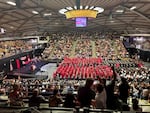
Over 500 students graduated from David Douglas High School on June 5, 2025, including 10 students in OPB's Class of 2025 project. The graduation was held at University of Portland’s Chiles Center in front of family and friends.
Elizabeth Miller / OPB
Hershman: How did this project either reflect or challenge the broader narrative around educational equity and systemic barriers in Oregon’s schools?
Manning: The Class of 2025 hopefully helps complicate the narrative around equity debates in the education system in a helpful way. Education reporting often lumps students together into groups such as “Latino students” or “students with disabilities” without acknowledging that there can be vast differences among students within any one group as well as significant similarities across groups. What the students have in common is they all want to succeed – but what that looks like and what they need to get there can look vastly different from one student to another. At the same time, the experiences of the students in this project do reflect some of educational equity challenges that we are already aware of, like how teachers often do not reflect the racial background of the students they teach. What we hope to bring to that conversation are the voices of the students and parents, sharing how these challenges affect them directly.
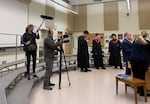
Kate McMahon, left, and Dan Evans, right, filming for OPB's Class of 2025 project at David Douglas High School. The project includes filming in student's homes, at school, and during events like choir concerts.
Elizabeth Miller / OPB
Hershman: What is one behind-the-scenes moment from filming that sticks with you to this day?
Manning: There are so many. I got to attend a first-grader’s birthday party at a bowling alley. I spent a day visiting the students at four different Outdoor School sites, where the kids were so excited to show me the bugs they were studying, the plants they’d learned about and the great food they were eating. I remember going to the first day of middle school with one student who wasn’t sure he would have any friends there. I was his friend for about ten minutes until he recognized someone. After Elizabeth Miller was on the project, we visited with one student who’d been through a really difficult period, in which he’d given up on a career goal that he and his parents had long had – and he was candidly struggling with how to come up with a new life goal. That visit in particular reminded me that Class of 2025 is a “coming of age” story, as much as a work of education journalism.
A defining moment occurred for me toward the end of elementary school, when I interviewed one of our students with his grandmother. The boy had experienced domestic violence and been pulled out of the family home, moving miles away to live with grandma. It was our first interview after all that happened. He was at times annoyed and frustrated by my questions. Finally, he said quietly, “I don’t want to do this anymore.” It was clear he didn’t mean just that interview – he intended to leave the project altogether. In that moment, I had to shift from being primarily a journalist to a caring adult who has known these kids almost all their lives. We turned off the camera and microphone, set aside the notebook, and I told the student, “You don’t have to do this. We can stop. It’s up to you.” He did leave the project for a few weeks. I didn’t reach out. With encouragement from his grandma, he came back. I’ve visited him a few times since then. Liz and I interviewed him at his house this past spring. He’s going to be just fine.
“— Rob Manning/OPBThe other thing that meant a great deal to me was hearing from a number of parents who told Liz and me that being part of the Class of 2025 project helped their kid graduate. ”
The other thing that meant a great deal to me was hearing from a number of parents who told Liz and me that being part of the Class of 2025 project helped their kid graduate. They told us that having their school experience documented, responding to the questions we asked about how they were doing and making them think about their futures served as motivation and opportunities to reflect. I initially expressed doubt that the project had much effect, but the parents insisted, it truly did help. I was worried all along that the cameras, microphones and questions would create a nuisance or distraction. I’m happy to hear that for the students and families, OPB was more help than hindrance.
Editor’s note: A shortened version of this interview appeared in the August 2025 edition of OPB’s quarterly member magazine, OPB Connect.