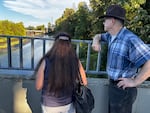
Steve Cameron, right, looks out at the Moore and Wright Island Natural Area within the Columbia Slough in Portland, Ore., on July 29, 2025.
April Ehrlich / OPB
At first, Steve Cameron didn’t think there was much to the Columbia Slough, a waterway running parallel to the Columbia River in Multnomah County.
This was in the 1990s, when Cameron was working at a wood products factory nearby, turning lumber into lattice and trellises.
“My friends were from Southeast Asia at the factory, and they came down to fish in the slough,” Cameron said. “I had heard about it, but I didn’t know anything about it, so I went down to warn them that I’d heard that fish were not safe to eat.”
Cameron was surprised to discover a verdant wetland teeming with wildlife. Herons stepped gingerly through the shallow water, scanning for fish. A bald eagle screeched in a distant tree top.
“It was actually rather pretty,” Cameron recalled.
But Cameron was right about the fish. They were sick, filled with toxics from decades of industrial waste. State health officials issued a fish advisory in 1994, warning people to limit how much slough fish they ate.
Now, 30 years later, the Oregon Department of Environmental Quality is wrapping up a project that could significantly reduce toxics in one of the slough’s most polluted areas.
The agency has reached more than two dozen legal settlements with companies responsible for polluting the slough with cancer-causing chemicals, including polychlorinated biphenyls (PCBs) and and polyfluoroalkyl substances (PFAS). DEQ uses settlement funds and grants to do what it can to remove pollutants.
Or in the case of the Moore and Wright Islands Natural Area, to trap toxics underground indefinitely.
On a late July afternoon, Cameron joined DEQ’s walk-through of the area alongside other volunteers with the Columbia Slough Watershed Council, a nonprofit that helps restore the slough with cleanup and planting events.
DEQ staff explained how workers will blanket the underwater soil with a permeable mat layered with sand and gravel. The process is called capping.
“The contamination actually increases as you go farther down in depth to about 5 feet,” said Sarah Miller, DEQ Columbia Slough project manager, standing on a bridge overlooking the slough. “We decided that capping was likely the best option, because once you get that far down deep, there are real concerns with bank stability.”
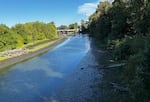
The Moore and Wright Islands Natural Area within the Columbia Slough in Portland, Ore., is undergoing construction that will alleviate some toxins in fish. July 29, 2025.
April Ehrlich / OPB
The mat has a minimum 50-year lifespan. Miller said she expects it to last longer, since the water moves slowly and the slough is too narrow for anything larger than a kayak. In the end, this mat could reduce PCB levels in fish by about 86%.
The Columbia Slough is a 19-mile chain of waterways and ponds running from Kelley Point Park in North Portland, eastward to Fairview Lake. It’s part of a watershed that used to regularly flood, creating wetlands and marshes for wildlife.
European settlers changed the landscape in the early 1900s, constructing levees to control flooding and building industrial factories and slaughterhouses alongside waterways. The new landscape brought different species of fish and wildlife. Now, more than a quarter of fish in the slough aren’t native, and degraded areas host few native bird species.
Related: Portland celebrates a year of not polluting the Willamette River with sewage
Those non-native fish, particularly carp, have been a food source for some of North Portland’s immigrant communities. Since carp can live a long time — an average of 20 years — they tend to accumulate more toxics in their bodies.
“We’ve been surveying a lot of the folks that fish out on the slough over the course of a few years,” said Andrew Davidson, Portland’s Columbia Slough program manager. “There are definitely a lot of immigrant and refugee communities that are fishing out here for sustenance, as well as the houseless community.”
Davidson has worked with community liaisons to create an outreach program that educates people about how to safely prepare fish caught in the slough.
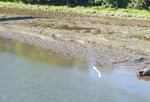
An egret takes flight within the Columbia Slough in Portland, Ore., on July 29, 2025.
April Ehrlich / OPB
Once DEQ is done installing the underwater soil mat, workers will start planting native shrubs and plants alongside the riverbank around late fall. It’s the type of planting work Cameron has been doing with the watershed council since the 1990s.
“I’ve seen a lot of things change over that time,” Cameron said. “We planted some stuff back there about 20 to 25 years ago. Seeing some of the trees that were little twigs now be trees with their own little baby trees around them is pretty cool.”
He’s hopeful these new changes — capping the slough’s underwater soil, planting native plants, educating people about the fish — will help the slough become healthier for the wildlife and people who use it.