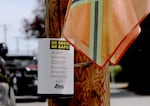
At a crosswalk on Northeast Fremont Street, a container holds several bright orange flags and lists safety tips for pedestrians, Sept. 1, 2025. The flags were set up by the Beaumont-Wilshire Neighborhood Association to increase visibility on the busy street.
Riley Martinez / OPB
For years, Al Ellis, the president of the Beaumont-Wilshire Neighborhood Association, has been trying to get the Portland Bureau of Transportation to address pedestrian safety on Northeast Fremont Street.
Low visibility — especially at night and when it rains — and speeding vehicles have made it unsafe to safely cross the street in some places.
“It’s a fatality waiting to happen,” Ellis said.
But, according to PBOT, there are other, more dangerous streets that take priority over Fremont.
Seeing they were on their own, Ellis and other community members took what he called a grassroots approach to the problem.
With funds and supplies from a local hardware store, they set up cans by several crosswalks along Fremont, and in them they put neon orange flags for pedestrians to wave as they cross.
The flags haven’t stopped drivers from speeding, Ellis said, but they have increased visibility.
“You see these canisters with flags — and they’re bright orange flags — and so at least there’s some indication that there’s a crosswalk there, and I think that really helps,” he said.
Some research suggests flags are moderately effective at getting drivers to yield to pedestrians. But the existing evidence is thin, and much of it anecdotal.
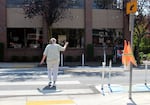
A pedestrian waves to oncoming traffic while crossing Northeast Fremont Street, Sept. 1, 2025. Pedestrian safety flags have been attached to several crosswalks, like this one, to alert drivers when people are crossing.
Riley Martinez / OPB
The neighborhood association took inspiration from pedestrian flag programs in other cities, like Kirkland, Washington. In Kirkland, the program is run by the city. But in Portland, it’s entirely a community effort.
According to PBOT Communications Director Hannah Schafer, there isn’t any city funding behind the BWNA flag program.
“[BWNA] reached out to us, and we were unable to support their effort,” Schafer said. “But, we didn’t say no.”
She said that’s partly because PBOT diverts more resources to streets with more traffic deaths, and Fremont sees less deadly crashes than, say, Northeast Marine Drive or Southeast Powell Boulevard.
“The reality of our funding is that because we are so limited, we have to prioritize our resources into the highest needs and kind of the biggest spaces,” Schafer said.
But PBOT also considers how risky a potential safety improvement would be.
For example, Ellis and Schafer both said that flags sometimes “disappear.” That’s less likely to happen with street lights or speed bumps, which Schafer and Ellis agree would be more effective improvements anyway.
Still, Ellis said the BWNA understands PBOT’s budget constraints.
“We don’t have an adversarial relationship with PBOT,” he said. “We understand what their situation is, and they understand what our situation is.”
Ellis and Schafer also agree that the flags are only a partial solution.
Ellis hopes for a stronger public messaging campaign that encourages drivers to pay more attention to pedestrians. Likewise, Schafer emphasized that pedestrians and drivers should take more responsibility for safety.
“Every intersection is a crosswalk according to Oregon law, so whether there’s a marked crosswalk there or not, you, as a pedestrian, have the legal right of way,” Schafer said. “Of course, it still means you need to make sure that people are stopping for you and take that personal responsibility.”