Washington State Standard is part of States Newsroom, a network of news bureaus supported by grants and a coalition of donors as a 501(c)(3) public charity.
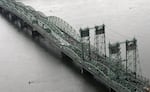
FILE--This June 29, 2012, file photo shows the Interstate 5 bridge spanning the Columbia River between Oregon and Washington states, near Vancouver, Wash.
Rick Bowmer / AP
The torturously slow pace and increasingly expensive price to replace the Interstate 5 bridge across the Columbia River have some Oregon and Washington lawmakers growing uneasy and frustrated.
After years of planning and lining up billions of dollars in state and federal funding, it continues to be an educated guess when construction will start, how much the project will cost and what the new bridge will look like when traffic finally drives over it.
Project planners had estimated the price tag for replacing the bridge would range from $5 billion to $7.5 billion, with a likely figure of around $6 billion. But legislators said last week that they now expect the total could reach $10 billion as costs have escalated 30% on transportation projects in the Seattle and Portland regions in recent years.
None of this sits well with members of a bi-state and bipartisan committee tasked with keeping tabs on the megaproject’s progress. Meeting last Monday for the first time in 10 months, several didn’t hide their pique as they pressed the administrator of the Interstate Bridge Replacement Program for answers.
One Washington lawmaker is even suggesting that the project may need to be ended or dramatically narrowed, and has contacted the Trump administration to suggest pulling back previously awarded federal funding.
In the meantime, the existing bridge is in danger of collapse in a major earthquake, and one of its spans is over a century old. Supporters of the project predict fewer crashes, faster commutes and more transit options when the new bridge is done.
A final environmental review for the project was supposed to conclude this year, Oregon state Sen. Khanh Phạm, D-Portland, told the committee. Completion is now expected in 2026.
“I’m just concerned because this is driving up costs for Oregon and Washington taxpayers, and when we miss our deadlines, it really does have an impact on our transportation budget as we try to find the funding to make up for the increased costs,” she said.
Program administrator Greg Johnson acknowledged the timeline slipped, noting the environmental analysis must be finished before required federal permits can be obtained. He estimated it could be the middle of next year before initial work begins.
“There are complex issues we are dealing with. We cannot skip steps,” Johnson said.
If required approvals are in hand in 2026, as planners anticipate, cars could begin driving across a new bridge in 2032 or 2033.
Ever-changing price tag
Project planners now say that an updated cost estimate for the project should be completed before the year’s end, as staff examine “100 risk factors,” including inflation and tariffs.
Oregon lawmakers are in special session and expected to pass a major transportation package to raise $4.3 billion over the next 10 years for maintenance and operations of the state’s roads by the end of the month, pending one Democratic senator leaving the hospital. Nothing in the legislation is dedicated to covering increased costs for the interstate bridge.
In Washington, the Legislature enacted a six-year, $3.2 billion package for its transportation system earlier this year. It also contained no money for any escalation of the bridge’s costs.
At this point, financing is coming from several sources. Each state has committed about $1 billion. Tolls — which will be imposed in both directions on the existing bridge starting in 2027 and managed by Washington — are relied on for a minimum of $1.2 billion. Oregon has a moratorium on any tolls other than the bridge.
Federal grants totaling $2.1 billion were awarded last year under the Biden administration. Planners are pursuing $1 billion from the Federal Transit Administration’s Capital Investment Program. This would help pay for a 1.9-mile extension of light-rail from North Portland to a future station near Evergreen Boulevard in Vancouver, Washington. A decision on that funding isn’t expected until the project is further along.
Joe Cortright, the chair of the Oregon Governor’s Council of Economic Advisers, testified in opposition to the project during last week’s meeting. He said federal funding isn’t guaranteed as the Trump administration cracks down on federal grants.
“It’s reckless to embark on this project before you know whether you’re going to get some or any of the billion dollars you’re counting on from the federal government,” he said.
Washington state Sen. Marko Liias, D-Edmonds, in an interview afterwards, preached patience.
“I’m not thrilled,” he said of the slowdowns and unresolved issues. “This is a big, complicated project. There are going to be complicating factors. It’s the way these things go.”
Responding to concerns the Trump administration or the U.S. Coast Guard could make decisions that reduce federal support and add costs, Liias said, “We’re in the figure-it-out stage.”
Resources will be there to replace the bridge, Liias said, even if it means other pieces of the sprawling project are delayed. There are nearly 30 separate items — from new bus shelters to off-ramp improvements — in this endeavor.
Fans, foes and the future
Because the height of the bridge could affect ship traffic on the Columbia River, the U.S. Coast Guard is one of the federal agencies with sway over permitting. And the bridge’s final design may hinge on the Coast Guard’s input about accommodating vessels.
There are two main configurations under consideration for the replacement bridge. One design is for a single-level bridge with fixed spans, and the other is a single-level bridge with a movable span, similar to what exists today.
If the new span is a drawbridge, the vertical clearance will be 178 feet, as it is today. But the other potential design of a fixed span would have only 116 feet of vertical clearance. That would prevent vessels with clearance requirements greater than 116 feet from traveling under the bridge, absent some kind of mitigation.
Johnson, the program administrator, said a movable span would add roughly $400 million in costs.
Khanh Tran, an advocate for Oregon businesses owned by people of color, told the committee that replacing the bridge would benefit communities that have historically been left out of projects at this scale.
“A new bridge strengthens Oregon’s ties with Washington, supports interstate commerce and ensures we remain as a region a competitive global economy,” he said.
But Washington state Rep. John Ley, R-Vancouver, an ardent opponent for years, said the lack of answers supplied as of last week solidified his stance that the project needs to be sharply scaled back — or even ended.
He said he reached out to U.S. Transportation Secretary Sean Duffy to encourage him to scrutinize the project and consider clawing back the $2.1 billion in federal grant dollars — almost all of which has yet to be sent to the states.
That could force leaders of the two states to reset expectations. Oregon and Washington could go it alone, he said, but it would mean ditching light rail and other bells and whistles.
“I think this is so far gone that the only way to stop this eight to 10 billion dollar boondoogle is to kill it,” Ley said.
Liias, the Washington senator, remains optimistic about the bridge replacement. “We are going to get to the finish line,” he said. “Leadership in both states are committed to getting it done.”
This republished story is part of OPB’s broader effort to ensure that everyone in our region has access to quality journalism that informs, entertains and enriches their lives. To learn more, visit opb.org/partnerships.