While the Port of Morrow is on track to complete a project intended to reduce nitrate pollution in the Lower Umatilla Basin, it’s not stopping Oregon environmental regulators from issuing penalties on the port for violating its wastewater permit.
The Port of Morrow will again have to pay a fine for violating a permit that outlines how it can apply nitrogen-rich wastewater from food processing plants and other manufacturing facilities as fertilizer on irrigated farm fields near Boardman, Oregon.
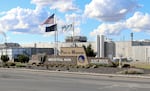
Port of Morrow's East Beach Facility in Boardman, Oregon on April 15, 2022.
Monica Samayoa / OPB
On Sept. 23, the Oregon Department of Environmental Quality levied an $11,700 fine on the port for violating its permit six times between May 2024 and January 2025.
This round of violations dwarfs in comparison to other fines DEQ has issued to the port on previous occasions.
Last year, DEQ issued a $727,000 penalty on the port for 800 violations. And the year prior, the Port of Morrow reached a $2.4 million settlement agreement with the state for repeated wastewater violations that contributed to a decades-long groundwater crisis in the Lower Umatilla Basin — where many residents rely on private wells for drinking water.
As of September, the Port of Morrow has violated the land application limits in its wastewater permit over 2,000 times since 2015, according to Antony Sparrow, a DEQ spokesperson.
In this most recent penalty, the port was cited for applying wastewater on farm fields during the non-growing season.
“These applications were caused by a misunderstanding regarding which irrigation circles were eligible to receive reuse water,” said Brandy Warburton, an executive assistant at the Port of Morrow, in an email. “The Port took steps to eliminate these misunderstandings and will also no longer apply any reuse water during the non-growing season.”
DEQ also cited the port for pipeline leaks and runoff from irrigation circles.
Earlier this year, Gov. Tina Kotek issued an executive order declaring a state of emergency, allowing the port to temporarily apply wastewater on fields in February.
A press release said rainy weather conditions were threatening to overwhelm the port’s wastewater storage capacity. DEQ didn’t fine the port for that application because “certain restrictions in their permit were waived,” Sparrow said in an email.
He added that, despite this recent round of violations, the department has issued fewer violations over the last winter, compared to previous years. It’s worth noting the port is not the sole polluter in the basin; runoff from other irrigated farms, livestock operations and from manufacturing facilities has also contributed to the water crisis.
Both DEQ and Port of Morrow officials maintain the port is on track to finish construction on two massive storage lagoons that will hold an additional 1.5 billion gallons of water the port receives from local food processors, manufacturers and data centers.
Those lagoons are set to be operational later this fall, by Nov. 1.
For years, environmental justice groups and some residents have called on the governor to declare a public health emergency in the area. They’ve also called on legislators to give state agencies more authority to rein in the sources of nitrates in the drinking water.
Recent reports from DEQ showed the nitrate problem in the Lower Umatilla Basin has become worse over the past decade, even as Kotek has introduced efforts to reduce nitrate levels in the area.