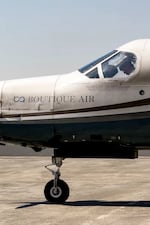
For the Boutique Air flight between Pendleton and Portland, passengers are weighed before boarding the eight-seater plane. The plane is seen on Sept. 2, 2025.
Lillian Karabaic / OPB
From Pendleton, Oregon, it’s a three-hour drive to Portland — or a 55-minute hop on an eight-seat plane.
That flight exists thanks to the federal Essential Air Service program, a subsidy created after airline deregulation to keep small communities connected.
But as the program’s cost soars — more than $500 million a year nationwide — Congress is debating whether taxpayers should keep picking up the tab. Earlier this week, flights nearly stopped altogether when the program ran out of money during the partial government shutdown.
To understand how Pendleton ended up with such a cheap flight — and why buses disappeared — we have to rewind a century.
As commercial passenger transit expanded in the early 20th century, the federal government tightly regulated when, where and how trains, buses — and later planes — could travel around the country, ensuring even small towns had access to transportation.
“The regulations were creating what we call cross subsidies, that people were paying higher rates to ship or travel between big cities, partly to offset the losses in serving small markets in rural areas,” said Fred Fravel, principal at KFH Group, a transportation planning firm that works primarily assisting states and regional governments with rural transit.
Fravel was there in the late 1970s and early 1980s, when Congress deregulated nearly every form of transportation — rail, trucking, airlines, and eventually intercity buses.
“When you lifted the regulation, the companies all said, ‘Well, we’re going to drop all of that rural service. It’s not profitable,” Fravel said.
That left the federal government to step in with new subsidies: Amtrak for trains, Essential Air Service for flights, and grant programs for rural buses.
Which brings us back to Pendleton — and a man named Ken “Buck” Buckley.
In September, Buckley ended up stranded in Eastern Oregon with a broken truck and a literal ton of antlers piled in his truck.
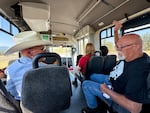
Ken “Buck” Buckley, right, speaks with another rider on the Kayak bus operated by the Confederated Tribes of the Umatilla Indian Reservation on Sept. 2, 2025.
Lillian Karabaic / OPB
“Two thousand four hundred pounds, about a month’s worth of buying,” said Buckley, who buys and sells deer antlers across the western United States which later get turned into dog chews.
Buck called a tow truck and once the driver saw the trailer filled with antlers, he made an offer. “He said, ‘Give me an additional $500 and I’ll get your antlers to market instead of leaving them on the side of the road.’ I said, ‘Done deal,’” said Buckley.
After selling the antlers, he still needed a new truck. He located one secondhand in Portland and planned to take the bus the 300-odd miles to fetch it.
But when he got to the La Grande Bus Station, he discovered there was no Greyhound in Eastern Oregon anymore. The route had been cancelled eight months earlier.
His best option was to instead take the local Kayak bus 90 miles to Pendleton, then catch the 55-minute flight from Pendleton to Portland.
Boutique Air flies three round trips from Pendleton to Portland every day. “It’s the only essential air service activity in the Pacific Northwest,” said Dan Bandel, manager of Eastern Oregon Regional Airport.

Boutique Air operates three round-trip flights a day between Portland and Pendleton, as seen on the wall of their hanger outside the Portland International Airport as seen on Sept. 3, 2025.
Lillian Karabaic / OPB
EAS funding ensures people in remote communities can get to family engagements and medical appointments. That’s increasingly important as rural health care facilities face closures and medical care often requires hours of travel.
A one-way ticket runs about $59 — but only because the federal government covers almost 80% of the cost. The Pendleton-to-Portland flight gets $4.2 million in annual subsidies, to serve just under 8,000 passengers a year.
“If it was $250 a person, then it wouldn’t be cost effective. But [it’s] less than half of that for a family of four to fly,” Bandel said.
On the tiny aircraft, passengers are weighed before boarding. The pilots help load and unload bags. And there’s no Transportation Security Administration checkpoint. “We like to say your boots and belt stay right where they belong,” Bandel said.
Without the greyhound service, the bus ride is much longer: nine and a half hours, four transfers, and the ticket cost is about the same.
Joseph Schwieterman, a professor of transportation and urban development at DePaul University in Chicago, argues that rural intercity buses, properly subsidized, could outperform some essential air service for less money and less emissions.
“There really is a mismatch … Sadly, we’re seeing now places that have essential air service that have no bus service and that’s really a dysfunctional situation,” Schwieterman said.
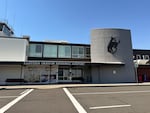
The Eastern Oregon Regional Airport in Pendleton has the only essential air service flight in the Pacific Northwest, a thrice-daily 55-minute flight between Pendleton and Portland.
Lillian Karabaic / OPB
Without more investment, Schwieterman said rural buses will keep disappearing — like they already have in Eastern Oregon.
“It’s a labor of love for these small rural transit agencies, but they have a lot stacked against them. And when commercial services disappear, they carry these people to towns where there’s nothing to connect to,” he said.
With debates ongoing over EAS funding, Schwieterman emphasizes that bus subsidies can reach more people per dollar. “We feel that a bus is just a bargain,” he said, “it’s just a fraction of what, of course, an air service would cost.”
For now, the quickest option to travel is still Pendleton’s eight-seater plane — kept alive by an infusion of federal dollars.
But federal money could also keep buses rolling, say transit advocates, linking dozens of towns instead of just one airport.
“Boosting subsidies by two- or threefold? It’s still a small amount, but you probably could get a national route system that’s covered,” Schwieterman said.
Oregon is already testing that approach, with plans to subsidize a replacement bus where Greyhound has pulled out with a combination of state and federal money. It will be similar to the POINT buses they already subsidize in other parts of the state.
Oregon Department of Transportation said it aims to begin operation by the end of the year, depending on federal funding status.
The hope is that tickets eventually cover the cost — something unlikely to happen for planes.