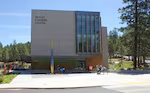
FILE - Undated picture of the Health Careers Center at Central Oregon Community College in Bend, Ore.
Central Oregon Community College
Central Oregon Community College received a $1.3 million TRIO Student Support Services grant last month for the first time ever.
TRIO programs are a group of services aimed at helping low-income, disabled and first-generation students make it through higher education.
COCC, with its main campus in Bend, is hosting the second TRIO program available in Central Oregon and one of three new TRIO programs in the state. Now the community college plans to to help 140 eligible students, over the life of the five-year grant, graduate or transfer to a four-year university.
“This will really substantively make an impact on students that are low-income and first-generation college students in terms of their success,” said Andrew Davis, COCC’s dean of student engagement.
Related: OSU-Cascades celebrates first-generation students in Bend
The federal government disbursed funds last month. The Department of Education delayed funding that typically arrives before the school year starts. A bipartisan group of 34 senators, who were mostly Democrats, petitioned the education department and the federal Office of Management and Budget to release the funds. Bipartisan efforts to release the funds also took place in the U.S. House of Representatives.
U.S. Sen. Jeff Merkley, D-Ore., led an effort with Georgia Sen. Raphael Warnock to get the money released.
OPB reached out to the Department of Education for an interview, but got back an automated response stating the office is closed due the current government shutdown.
In Central Oregon, the cost of living is higher than state and national averages, according to numerous trade websites, and access to educational opportunities is limited.
About 13,000 students attended COCC campuses in Redmond, Madras, Prineville and Bend during the 2024-2025 school year. COCC also serves students with satellite labs and centers, including programs at Deer Ridge Correctional Institution.
TRIO programs served 12,021 students across Oregon in the 2023-2024 school year. The national program started in 1964 under President Lyndon B. Johnson.
Davis said COCC had been eyeing a TRIO program for some time. Application cycles don’t open every year.
“So, we were prepared to apply when the next cycle opened and submitted our application a little over a year ago,” Davis said. The money arrived Sept. 26.
Related: Trump proposes cutting TRIO program that helps 12,000 low-income, disadvantaged Oregon students
COCC received the full amount of money it requested. Now the college is currently hiring staff for the forthcoming TRIO office, intended to serve 105 students in its first year.
Oregon TRIO Executive Director Matt Bisek said hiring staff and getting students enrolled can be the biggest barrier but, “I do think that COCC is well positioned because they’re small enough that (TRIO programs) can be pretty quickly integrated.”
The community college received help with its grant application from Oregon TRIO, a statewide organization that lobbies the federal government on behalf of TRIO programs and students.
They “provided us great insight into writing our application,” Davis said. Oregon TRIO also helped the college with coaching, peer review and data analysis, he added.
The school received a portion of its grant, $272,364, through Sept. 30, 2026. Congress will need to re-approve the grant for the program to continue next year, according to the college.
This year’s funding for TRIO programs came months behind schedule, said Bisek. All the programs in Oregon were eventually funded, he said, but programs in some in other parts of the country were not.
TRIO is a part of the 1965 Higher Education Act, and getting rid of it would take an act of Congress, Bisek said.
“It feels like there is a directive to do whatever they can to try to get rid of TRIO on a federal level, but they can’t because we’re codified into law,” he added.
Bisek said TRIO programs help students who aren’t able to access intergenerational knowledge about how to attend and succeed in higher education.
“At its core foundation, it is just providing a more level-playing field and providing more equitable opportunities for the students,” he said.