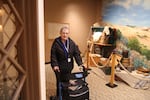
Connie Robin tours the Columbia Gorge Discovery Center in The Dalles, Ore., on Oct. 16, 2025.
Kristian Foden-Vencil / OPB
Connie Robin lives in a retirement community in California, and at 89 years old, she isn’t sure how many more vacations she’ll take. When she travels, accessibility is a high priority.
“I decided we’re taking this trip come hell or high water,” she said on a recent trip to the Columbia Gorge Discovery Center in The Dalles.
Robin is one of a busload of visitors arriving from a cruise along the Columbia River. Because cruisers tend to be older, several visitors are dealing with disabilities, like walking with a cane, or as in Robin’s case, pushing a walker.
“Museums are not always easy to get into,” she said. “This museum seems to have buttons on the doors to open the heavy-duty doors.”
Robin appreciates that there are no stairways to navigate at the Discovery Center, and she likes it that the exhibits have wide aisles so she can easily push her walker through.
“I think Oregon has been very good to people with disabilities,” Robin said.
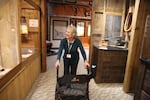
Janet McNeil appreciates the wide aisles at the Columbia Gorge Discovery Center so she can easily get her walker through on Oct. 16, 2025.
Kristian Foden-Vencil / OPB
Her travel companion, Janet McNeil, has osteoporosis and also needs a walker. She’ll spend about $6,000 on this vacation, so she says making places accessible is not just about doing the right thing.
“Considering the aging of the population, there could be money involved,” McNeil said. “I also think it’s the right thing.”
The nonprofit Wheel the World helps people with disabilities find accessible tourist spots. It just designated Oregon as its first “Accessibility Verified” state.
To make the designation, the nonprofit’s members visited 750 spots around Oregon, measuring things like the number of wheelchair ramps, the height of toilets and hotel beds, how many disabled parking spaces were available, and the ease of recreating outdoors.
“Oregon, it has everything,” said Jennifer Allen, a travel writer for people with disabilities. “You’ve got the ocean, with the mountains, and you can have a city or country, and it seems like it’s all kind of right there.”
Allen lives in Pennsylvania and is a member of Wheel the World. She also has a 9-year-old son who uses a wheelchair.

Nella, Jaden and Jennifer Allen on their 2025 vacation at Mt. Hood.“Oregon, it has everything,” said Jennifer Allen, a travel writer for people with disabilities.
Courtesy: Jennifer Allen
Allen was thrilled with all the accessible activities she found on a recent vacation to Oregon, especially at Multnomah Falls. From experience at other outdoor spots, she did not assume it would be accessible.
“I thought it would be pretty limited,” Allen said. “Like, maybe we could get to a distant point where we could see it off in the trees, like from a parking lot. I did not realize there would be a ramp that goes up to the base where everybody else is able to view, which was fabulous.”
Where Oregon really stands out, said Allen, is its ability to get people with disabilities out into the great outdoors. She was also surprised by how accessible Mt. Hood was.
“We were in the forest and they have paved paths!” she said. “Getting into the woods is not something we’re very often able to do, with a wheelchair user. The deep greens and the lush overhangings. It felt like we were in a fairy tale.”
But it’s not just Oregon’s museums and iconic outdoor tourist spots that are more accessible than ever.
At the Kiyokawa Family Orchards near Hood River recently, Tom Shrader was pleased to see that mobility mats had been laid down in the fields, so that he could get outside in his wheelchair without fear of getting stuck in the mud or tipping over.
“You need to be in an environment where you feel safe,” said Shrader. “Just the slightest things can send you atwitter and akimbo-ing down a hill.”
Shrader was pleased to see that many of Oregon’s coastal towns have also put out mobility mats, meaning that for the first time in years he was able to get out onto the beach.
“It allows me to become more of the Oregonian that I grew up being,” Shrader said.
Tom Shrader was pleased the Kiyakawa Family Orchards had mobility maps stretching out into the field for his visit, on Oct. 7, 2025.
Kristian Foden-Vencil / OPB
The Oregon Tourism Commission said the new designation follows a coordinated statewide effort to improve access to tourism businesses.
“Earning the distinction of being the first ‘Accessibility Verified’ state reflects Oregon’s deep and ongoing commitment to welcoming all travelers,” said Kevin Wright with Travel Oregon. “We’re building a tourism landscape where inclusion is meaningful and central to the visitor experience.”
Alvaro Silberstein, a co-founder of Wheel the World, said traveling with a disability often means facing the unknown.
“Our vision is to remove uncertainty and establish trust by helping every destination verify, improve, and promote accessibility,” Silberstein said.
Travelers can find accessible tourist destinations across Oregon at the Wheel The World and Travel Oregon websites.