
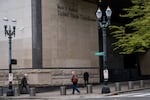
The Mark O. Hatfield United States Courthouse on Friday, Oct. 3, 2025, in Portland, Ore.
Saskia Hatvany / OPB
A federal trial in Oregon that could determine whether President Donald Trump can legally deploy the National Guard to the city of Portland began Wednesday.
For the past month, the courts have largely blocked the president.
In fact, the judge at the center — U.S. District Court Judge Karin Immergut, who temporarily blocked any federal troop deployments to the state earlier this month — will preside over the three day trial.
Immergut will examine whether the Trump administration followed the statute that outlines when a president can federalize the National Guard and what the U.S. Constitution says about the authority of the executive branch to deploy members of the National Guard — or whether those efforts in Portland infringed on the state’s rights.
In late September, Trump announced on social media he would send the military to Portland, calling the city “war-ravaged” and authorizing full force against what he described as “domestic terrorists.” He said the deployment was necessary to protect a U.S. Immigration and Customs Enforcement building in South Portland that has been the site of protests throughout the summer. Those demonstrations peaked in June when the building was damaged, but they had been waning in the months since and were typically small and uneventful.
On Sept. 28, Trump officially federalized 200 members of the Oregon National Guard to protect federal functions. The city of Portland and the Oregon Department of Justice quickly sued to stop the deployment, saying the protests did not warrant military intervention.
The proceedings Wednesday will establish a factual record of the federal and local response to those protests. Witnesses are expected to include members of the Portland Police Bureau, leaders at the U.S. Department of Homeland Security and the military, who in addition to testifying under oath can expect to face cross examination.
Presidential authority vs. states’ rights
Attorneys for the Trump administration argue the president has the authority to federalize and deploy the Oregon National Guard.
“The President’s determination was amply justified by the facts on the ground,” attorneys for the U.S. Department of Justice argued in a trial memo filed this week that described assaults on federal officers and damage to the federal building. “For their part, local authorities have been unhelpful and at times hostile.”
Attorneys for the Trump administration described in the filing how state law and city policy prevents officers with the Portland Police Bureau from assisting with any immigration enforcement, saying the agency held an “extraordinarily capacious understanding” of the tasks they were blocked from undertaking.
“Among other things, the evidence at trial will show that PPB has refused to assist [the Federal Protective Service] in protecting the ICE facility, has not intervened when agitators attempt to access the ICE facility or block the facility’s driveway, and has not assisted federal officials when agitators attempt to block detainee transport and officer movement to and from the ICE facility,” the Justice Department’s trial brief states.
Federal officials have also pointed to a three-week closure this summer at the Portland ICE facility as evidence of their inability to carry out federal laws. Reporting by OPB shows despite the closure, immigration arrests hardly slowed.
For their part, the city of Portland along with the states of Oregon and California — who all have sued to block the deployment — argue the facts on the ground do not meet the legal threshold for the president to federalize and deploy the guard. (California joined the lawsuit after the Trump administration sent California National Guard members to Oregon. Their deployment was also blocked by Judge Immergut.)
Rather, they describe the issues the Trump administration has encountered in Portland as the challenges of governing a democracy.
“First-Amendment-protected assemblies — even when combined with limited, sporadic episodes of unlawful conduct — do not constitute a ‘rebellion’ or an inability ‘to execute the laws of the United States,’” the city and states argue in their trial memo. “Put another way: unlawful conduct, while inexcusable, is properly managed by regular law enforcement; its existence does not justify federalizing and deploying military forces in an American city.”
Staffing challenges and budgets also cannot lawfully justify the use of the military, they argue, also writing, “Congress made clear that it intended for Presidents to call up a state’s National Guard only as a last resort.”
The city and state have argued the president’s announcement to deploy the military to Portland “inflamed the situation” and grew what had for the most part been a dwindling protest scene outside the Portland ICE building, following a handful of larger and more destructive protests primarily in June.
According to court filings, Portland Police made their first two arrests since June on September 28, the day Trump federalized 200 Oregon National Guard members.
Since then, protesters who oppose the Trump administration’s policies and counter-protesters who say they support Trump have created the most problematic interactions, the attorneys for the city and states argue, rather than altercations with local or federal law enforcement.
“Communication between PPB and federal officers also worsened as the federal law enforcement deployment surged without a clear command and control structure,” the city and states argue in their trial memo. “To list just one illustrative example, at one point pepper balls were shot in the direction of a PPB officer. When confronted, federal officials responded, ‘help or get out of the way.’”
Changing facts
During the past several weeks, the Trump administration has walked back a fact underlying a key argument their attorneys made for deploying guard troops.
Initially, Department of Homeland Security officials reported they’d sent 115 officers with the Federal Protective Service, an agency tasked with securing federal property. Justice Department attorneys stated it was “undisputed that nearly a quarter of the agency’s entire FPS capacity had to be redirected over a relatively short period to a single location in one medium-sized American city due to the unrest there.”
But newer court filings show those numbers were not accurate.
Late Tuesday night, just hours before trial was set to begin, the U.S. Department of Justice filed a “supplemental declaration to correct a factual error” from Robert Cantu, a regional deputy director with the Federal Protective Service.
“The number of individual officers who deployed to Portland as of September 30, 2025 is approximately 86 not 115,” Cantu said in his corrected declaration, but maintained that “FPS is unable to sustain having its officers deploy to Portland” and that the agency “requires additional assistance.”
The city and states argued the Federal Protective Service “deployed relatively few resources to this effort” despite having more than 1,300 employees.
“FPS moved only a small fraction of those to Portland to supplement the four officers assigned to the Portland ICE facility, and never more than 31 at a time,” they note.
FPS has hardly been alone. Officers from other law enforcement entities under Customs and Border Protection were also sent to the ICE building, but those deployments were in June and in late September.
