
Recorded American Sign Language interpretation is provided for the interview audio in the short documentary above. Justin Coleman and Ellie Purvis conducted the ASL interpretation.
The year of 1975 was a groundbreaking one for the American film industry.
The release of Steven Spielberg’s “Jaws” that year forever shaped the psychological horror genre (and instilled global fear of a certain two-note score).
Some 1975 blockbusters had Oregon connections. "One Flew Over the Cuckoo’s Nest‚" often regarded as one of the greatest and most financially successful movies of all time, was filmed in Salem and based on Oregon author Ken Kesey’s novel.
The state can claim another superlative, though likely less known: The first full-length feature film, performed entirely in American Sign Language and shot in Portland in black-and-white 35mm, premiered at the old Broadway Theater to a large Deaf audience.
“— Gary Holstrom, "Deafula" producer and actorThere’s only going to be one first, and we did it 50 years ago, and we’re all proud of it.”
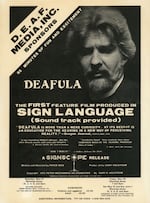
A movie poster for "Deafula" (1975).
Courtesy of Gary Holstrom/Signscope
A film for the Deaf, by the Deaf
ASL interpreters are common today, providing accessibility for deaf and hard-of-hearing individuals during sports events, in health care and legal settings as well as on television.
The language came out the American School for the Deaf in Connecticut in the early 19th century, developed by educators Thomas Gallaudet and Laurent Clerc.
They blended a combination of older French Sign Language and signs native to the historic Deaf community of Martha’s Vineyard. ASL is now used by over half a million people in the United States.
In the 1970s, however, during the Golden Age of Cinema, ASL hadn’t arrived in theaters and Deaf cinephiles bemoaned the subpar screening experience.
“Deaf folks were sitting in auditoriums that projected feature films but had captioning,” said “Deafula” producer Gary Holstrom. “The excitement of cinema was lost in the time it took for them to read the captioning.”
Holstrom is not himself deaf but was taught by the director and lead actor of his future film, Peter Wechsberg, when they were both employees of US Bank creating internal training films. Wechsberg is a deaf individual with experience from the National Theatre of the Deaf and KRON TV in San Francisco as an ASL news presenter.
Both men felt the creative itch and desire to serve the Deaf community in the media space. “I decided that I would quit my job and that he would go along and we would make the first full length entertainment feature in sign language,” Holstrom said.

Gary Holstrom produced and starred as Dracula in the 1975 "Deafula," the world's first feature-length film performed entirely in American Sign Language.
Courtesy of Gary Holstrom/Signscope
Their shared vision was as bold and uncompromising as their career move: total audience immersion in Deaf culture and language.
“We didn’t want to have any lip movements in that film. We didn’t want any captioning,” Holstrom said. “Our concentration was strictly to make it as real and as original and as focused for the Deaf population as possible.”
The Oregon Historical Society has preserved and digitized “Deafula,” making it part of the OHS Moving Images collection — one of the largest film archives in the Pacific Northwest.
Access the collection online through the OHS Digital Collections website or visit the OHS Research Library to browse the full catalog.
Explore Oregon’s rich history in disability rights:
- Watch—“In the Shadow of Fairview”