Attorneys for the city of Portland, the states of Oregon and California, and the U.S. Department of Justice returned to court Friday. It’s the final day of a trial examining whether the Trump administration’s efforts to send in the National Guard are lawful.
The hearings began with a startling revelation: Some Oregon National Guard members were deployed to the U.S. Immigration and Customs Enforcement building in Portland’s South Waterfront neighborhood on Oct. 4. That’s the same day that U.S. District Court Judge Karin Immergut, who’s presiding over the trial, issued a restraining order blocking the deployment.
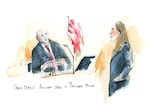
Portland police Assistant Chief Craig Dobson, left, is questioned by Senior Deputy City Attorney Caroline Turco, about the bureau’s crowd control policies during the second day of a trial over the legality of domestic military deployment to Portland, Oct. 30, 2025 in Portland, Ore.
Illustration by Rita Sabler / Special to OPB
The first two days of hearings focused on how different law enforcement agencies view the ongoing protests outside the ICE facility. Staff from the Portland Portland Bureau, the Oregon State Police and the Federal Protective Services all testified, sharing divided perspectives and different conclusions about whether a domestic military deployment was necessary.
Immergut is tasked with determining if the demonstrations outside the building were significant enough to warrant the federalization of the Oregon National Guard.
Here’s a recap of some highlights from court this week:
Revelations about troop deployment
Minutes before opening statements got underway Wednesday, a Justice Department attorney confirmed to the judge that members of the Oregon National Guard were deployed to the ICE building in Portland at the beginning of the month.
“At 11:35 PDT today,” Col. Jeff Merenkov wrote in an email sent at 3:28 p.m. on Oct. 4, “a force of nine MPs arrived at the ICE facility in downtown Portland, Oregon where they assumed their first support mission.”
The email, which was submitted to the court as a trial exhibit, included a schedule that showed the “shift conclusion” for the Oregon guard members was set for midnight.
Immergut issued a restraining order at 3:40 p.m. on Oct. 4, barring the president from federalizing the Oregon National Guard and blocking their deployment.
“We’ll talk later about whether that’s contempt,” the judge told the Justice Department attorney Wednesday.
The following day, the subject came up again.
“I’ve been informed it was about seven to 10 guards. They were sent to the building at about 11:35 in the morning,” Jean Lin, special counsel for the Justice Department told Immergut Thursday. “Those Oregon National Guardsmen were pulled back sometime that night after the court entered the temporary restraining order.”
The attorneys couldn’t answer questions about who ordered the deployment and how long they were stationed at the building.
Immergut wondered aloud whether the government acted in “bad faith” by deploying the troops while she was actively deliberating the case. She did not make a decision on the issue by the conclusion of court on Thursday.
The evening of Oct. 4, federal law enforcement officers escalated the tactics used on protesters in the city.
Competing views on Portland protests and crowd control tactics
One of the central issues surrounding the Portland protests has been the response of local police, who have taken a more hands-off approach to the demonstrations. Portland police have arrested 60 people since June. But unlike in years past, they’ve rarely declared riots and have avoided using chemical munitions.
Several Portland police officials testified that riot control tactics can aggravate crowds. The chaotic scenes of 2020, when the city experienced more than a hundred nights of protests, were frequently invoked Wednesday. PPB officials said their current approach is built on lessons learned during that time.
“When protest crowds or any crowds experience what they perceive as illegitimate or unjust actions, including the use of force, that can change normative behavior and collective identity in a crowd,” Cmdr. Franz Schoening said. “And so they become more resistant to exercises of authority, including by the Portland Police Bureau, to try and get compliance or deescalate events.”
Police records, made public as part of the case, describe protests outside the ICE building as “low energy” until recently, when Trump’s attention once more turned back to Portland. Portland police made zero arrests between late June and late September.
During Thursday’s testimony, city attorney Caroline Turco questioned PPB Assistant Chief Craig Dobson about the bureau’s crowd control policies, and she asked him to review video footage of federal officers firing chemical munitions into protest crowds.
One video showed a Portland police officer on a bicycle who was exposed to tear gas near the building on Oct. 18. Dobson, who was there that night and also gassed, testified that he wouldn’t have trained Portland police to fire the way federal law enforcement did.
“Does the behavior of the crowd as seen in this video justify the deployment of force?” Turco asked.
“In my training experience — from what I saw — I did not see indicators that would indicate that we as PPB would be able to deploy those munitions into the crowd,” the assistant chief responded.
Federal officials, however, offered a different view.
Justice Department attorneys on Wednesday laid out police records that document alleged crimes at the protests they say local police didn’t act upon. They brought up people breaking windows, flinging rocks from slingshots and throwing commercial-grade fireworks.
A deputy regional director with the Federal Protective Service, an agency tasked with providing security on federal property, testified Thursday that his officers are spread thin and cannot rely on local police for help.
The deputy regional director, who was only identified as R.C. during testimony, contended that they are besieged by “agitators” who demonstrate outside.
He also testified that the facility endured extensive damage during the first “No Kings” protest on June 14. R.C. said the building was “under siege,” according to reports filed by federal officers on the ground, and officers that day prepared to use lethal force — though they never did.
Final day in court and what comes next
Friday is expected to be the last day of trial. According to a witness list filed by Justice Department attorneys, they plan to call ICE Seattle Field Office Director Cammilla Wamsley and Major Gen. Timothy L. Rieger, the acting vice chief for the National Guard bureau, for testimony.
It’s unclear when Immergut will make a ruling, or what it might be. She has twice temporarily blocked the National Guard from deploying. While those actions were preliminary and preceded this week’s detailed testimony, part of Immergut’s consideration when issuing her temporary orders included who is likely to prevail at trial. If she sides with the Trump administration, Portland could see troops quickly deployed to the streets.
No matter the outcome, Immergut’s decision will likely be appealed to the 9th Circuit Court of Appeals. Meanwhile, a related case that has not yet gone to trial, stemming from the deployment of the National Guard in the Chicagoland area, is currently before the U.S. Supreme Court.