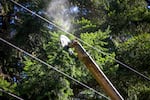
Consumers Power Inc.’s crew uses a Jarraff tree trimmer to trim back branches that pose a risk to their company’s power lines in Blodgett, Ore., July 23, 2025.
Morgan Barnaby / OPB
On a summer morning earlier this year, a metallic shriek echoed through a forested area of Benton County, and small branches tumbled to the forest floor.
Contract crews were “making salad,” using massive tree-trimming equipment to shred branches that inched too closely toward electrical wires.
“The equipment’s not cheap,” said Kevin McMillan, who oversees vegetation management for the local electric utility, Consumers Power Inc. “But in the grand scope of things, it can get more work done than your tree crew at the same cost.”
Western Oregon has a lot of trees, and thousands of miles of power lines running between them. It’s expensive keeping those lines clear so they don’t spark a fire. That’s the big fear looming over electrical utilities in recent years, particularly as they look at companies like PacifiCorp and Pacific Gas & Electric, which have paid out billions of dollars in wildfire litigation.
But leaders of small, rural utilities like Consumers Power say they wouldn’t have such deep pockets to pull from if they were hit with similar lawsuits. Many of these utilities are cooperatives, meaning they are owned by their members, not capital investors. Many major decisions like rate increases are made by boards of ratepayers.
“We know our system,” said Consumers Power chief operating officer Billy Terry. “We know what we have.”
That on-the-ground knowledge may have helped Consumers Power over the 2020 Labor Day weekend. Weather forecasters warned about a windstorm and extreme wildfire risk in Oregon’s Santiam Canyon. Terry’s team didn’t just read about the weather — they could see and feel it. They decided it was too dangerous to keep their lines charged, so they turned the power off.
Their electrical grid was later consumed by flames.
“We had crews up there that had to leave,” Terry said. “The system was burning around them.”
But another utility with powerlines running through the same area, Pacific Power, kept its power on. Now its parent company, PacifiCorp, is expected to pay out billions of dollars from lawsuits accusing it of starting multiple wildfires that weekend. A jury found PacifiCorp grossly negligent in 2023, concluding the investor-owned utility was to blame for much of the wildfire damage.
In emailed statements, PacifiCorp said it has invested heavily in wildfire prevention, including advanced risk forecasting and wildfire sensing equipment.

Justin Height, employee of Consumers Power Inc., uses a Jarraff tree trimmer to trim back branches that pose a risk to their company’s power lines in Blodgett, Ore., July 23, 2025.
Morgan Barnaby / OPB
Rural cooperatives are not immune to starting wildfires. A co-op is among multiple utilities accused of starting the Holiday Farm Fire in Lane County that same weekend, when wildfires burned across the state. The world is getting warmer and drier because of fossil fuel-induced climate change, leaving electrical equipment vulnerable regardless of the utility’s funding model. That’s partly why cooperatives have sided with investor-owned utilities in lobbying state legislatures for legal protections against wildfire lawsuits.
Still, many of these consumer-owned utilities have something large, investor-owned utilities don’t: deeper connections to local communities and landscapes. That can give them an advantage when making major decisions, like knowing when to protect people against wildfires by turning the power off.
‘Nobody else is coming’
The electric cooperative model came out of the 1930s, when companies were electrifying urban cities across the country but ignored rural areas because they wouldn’t gain a profit. Running lines through vast, remote regions with few customers just didn’t pencil out. It took President Franklin D. Roosevelt’s New Deal to jumpstart funding with low-cost loans, so farmers and ranchers could form their own electrical cooperatives.
“They were like, ‘Hey, we have to do this, because nobody else is coming,” said Ted Case, executive director of the Oregon Rural Electric Cooperative Association.
Now about 10% of Oregonians get their electricity from rural cooperatives, which are run by boards made up entirely of ratepayers.
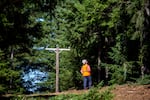
Jon Kloor, a member of Consumers Power Inc., walks along trees that have been trimmed back from some of their company’s power lines in Blodgett, Ore., July 23, 2025. Electric cooperatives such as Consumers Power have different business models than shareholder companies, which allows them to be more local and community driven.
Morgan Barnaby / OPB
That comes with its challenges — it’s not easy raising electricity rates on your neighbors, particularly in areas with high poverty rates. It’s also difficult to maintain equipment in vast, often mountainous areas with fewer people paying into it.
But Case said there are also benefits to having a say in something as integral to daily survival as electricity.
“If you don’t like the way things are going, you can change it,” Case said. “And there’s something very empowering about that sort of local control.”
Eric Macomber, a Stanford University researcher who studies utilities, says community connectedness can give cooperatives and other small utilities an advantage in decision-making.
“If the people who are making decisions about whether or not to turn off the power are living in the community, they have a better sense of where risk exists on the ground,” Macomber said. “I think they’re going to be able to make better choices.”
In the past, electrical utilities across the board may have been reluctant to turn power off during storms for multiple reasons. It’s expensive to pay workers to inspect equipment before re-energizing lines. It’s also bad publicity: Customers pay utility bills so they can have electricity, not blackouts.
But the 2020 wildfires and subsequent lawsuits have shifted how many utilities think about power shutoffs.
“It seems like they were operating by the 20th-century playbook of, you operate the infrastructure until something breaks, then you go and fix it, as opposed to you proactively manage it,” Macomber said. “Now you’re seeing that a jury is willing to find a utility not just negligent, but grossly negligent.”
Now power shutoffs have become a near-regular occurrence when high winds and dry conditions increase fire risk during West Coast summers. Most utilities in this region have wildfire prevention plans, which outline how a utility will prepare its equipment for wildfires, and when it will turn off power. Oregon law requires both investor- and consumer-owned utilities to have these plans in place.

Billy Terry, Consumers Power Inc. chief operating officer.
Morgan Barnaby / OPB
Electrical utilities large and small are also heavily investing in hardening their equipment against wildfires, mostly by burying electrical lines.
Burying power lines is the most surefire way to prevent them from sparking a wildfire, but it requires expensive and intrusive trenching through forests and mountains, or around homes and businesses.
That can be easier after a wildfire, when communities rebuild. Federal disaster funds have helped Consumers Power bury its power lines in the Santiam Canyon, where it is rebuilding its electrical grid.
Terry, the cooperative’s chief operating officer, said his staff are getting ready to pull up its above-ground power poles soon. They’re not needed by the new homes and businesses that people have rebuilt over the last five years.
“It’s unbelievable what that community has done,” Terry said. “It is awesome. As tragic as it was, it’s a success story.”