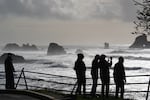
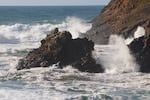
Crowds gather to watch the king tides at Indian Beach in Ecola State Park, Ore., on Friday, Nov. 7, 2025. The king tides were visible on the Oregon Coast from Nov. 5-7 and will return in December and January.
Saskia Hatvany / OPB
The first round of king tides for the 2025-26 season surged along the Oregon Coast late this week.
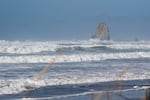
The popular spectacle features massive waves breaking dramatically over rocks and jetties, attracting tourists to many cities along the Oregon Coast.
While the first swells of this king tide season only last through Friday, there will be two more opportunities to see them, Dec. 4-6 and Jan. 1-4.
King tides occur when the moon is at the closest point in its orbit to the Earth, and the Earth, sun and moon are in alignment. This creates a stronger gravitational pull on the planet’s waters, leading to exceptionally high tides that push waves further upshore.
In some places, like Newport, Oregon, tides can surge several feet above average levels. Last week, tides there rose to just over 10 feet.
The elevated tides can lead to erosion and coastal flooding in some places, making them of interest to scientists studying the future impacts of rising sea levels.
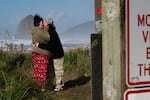
Skylie Steringer and Tyler Nelson kiss as the king tides crash at Tolovana Park in Cannon Beach, Ore., on Friday, Nov. 7, 2025. The king tides were visible on the Oregon Coast Nov. 5-7 and will return in December and January.
Saskia Hatvany / OPB

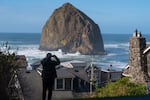
Rhiannon Bezore is the coastal shores specialist for the Oregon Coastal Management Program. She said king tides could become more damaging to roads and infrastructure as sea levels rise, and that agencies can observe the tides now to prepare for the future.
“Helps us plan for how we might mitigate some of those impacts, if there’s infrastructure projects or different erosion techniques that can be implemented,” Bezore said. “It gives the state agencies and local planners and researchers all a really good idea of what we might need to pay more attention to and plan for in the future.”
The Oregon King Tides Project is one of the groups documenting the impact king tides have on the Oregon Coast. They accept photo submissions from visitors who capture instances of dune and cliff erosion and flooding.
Bezore also said storms can compound the effects of the tides, like the atmospheric river that brought wind and showers to northwest Oregon earlier this week.
David Bishop, a meteorologist with the National Weather Service, said that’s because wind from such storms can cause the water to swell, which intensifies the waves.
On top of bigger waves, “you throw in higher-than-normal high tides, you can get water going even further up and impacting other low-lying areas,” he said.
Those areas include parts of Highway 101 in Seaside and Tillamook, where tides can overflow onto the road and affect travel.
“If you see water over the road, it’s not worth it,” he said. “Just turn around, find another way, because it doesn’t take a lot of moving water to start moving a car.”
Likewise, Bezore said people visiting the coast to see the king tides should follow safety recommendations.
“It’s really important not to turn your back on the water, make sure that you’re viewing the king tides from a really safe distance, you’re not going on any logs or rocks that can move in the water,” she said.
Waves can travel over 20 miles per hour and crash with thousands of pounds of force.