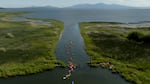
Aerial stills capture a group of kayakers as they attempt a source-to-sea journey along the Klamath River.
Brandon Swanson / OPB
In the summer of 2025, a group of young Indigenous kayakers set out to paddle the entire Klamath River after the removal of four dams. OPB producer and Karuk tribal member Jessie Sears filmed their historic journey for a new “Oregon Field Guide” special. She recently joined OPB’s Jamie Hershman to reflect on the assignment and share her experiences covering this story.
Jamie Hershman: What drew you to develop a story on the first descent?
Jessie Sears: As a Karuk tribal member and a filmmaker who filmed the Klamath dam removal, the first descent was something I knew about for years before the youth set out for this journey. As an Indigenous person reconnecting with my roots — knowing that the river was reconnecting with itself, and that the Indigenous youth who call that river home were taking this journey — everything in me wanted to follow this story.
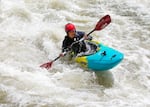
To’nehwan Jayden Dauz from the Hoopa Valley Tribe, 15, braces himself in a rapid on the Klamath River near where the Copco 1 and 2 dams once stood, June 22, 2025. Dauz is a participant in Paddle Tribal Waters, a program that trained Indigenous youth for several years to be the first group of people to paddle the free-flowing Klamath from source to sea.
Anna Lueck for OPB
Hershman: How did your background and ongoing lived experiences as an Indigenous person affect the way you approached this story?
Sears: Like all my work focusing on Indigenous communities, I will always put respect as the top priority, even above “getting the shot.” My mission and top goal are always to film within Indigenous communities in a non-extractive way, ensuring everyone participating is comfortable, feels seen and is understood. This always requires extra time communicating with the community before and after the cameras are off and quadruple checking facts, tribal affiliations, name spelling, etc.
When approaching this story, I knew that this was more than an adventure story about young kayakers. I knew that this journey meant so much more to them than just kayaking, and that kayaking was simply the means and form of making a statement.
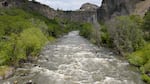
Brandon Swanson / OPB
Hershman: “First Descent: Kayaking the Klamath” seems to not only be about kayaking the newly flowing Klamath River but also about sovereignty. What themes of reclamation or resistance came through to you?
Sears: The nonprofit group that organized the trip, Ríos to Rivers, has multiple programs, all focused on protecting rivers and investing in the next generation of Indigenous river stewards. While filming with the youth on the first descent down the Klamath, they spoke passionately about how dams are a worldwide problem and how they’d also like to see other tribes and communities get their rivers back. While there was joy and celebration during those 30 days on the river, there was also resistance against dams worldwide.
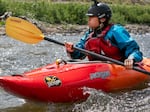
Tasia Linwood, Karuk, kayaks the Klamath River upstream of the former Iron Gate dam site, June 22, 2025. Linwood is a participant in Paddle Tribal Waters, a program that trained Indigenous youth for several years to be the first group of people to paddle the free-flowing Klamath from source to sea.
Anna Lueck for OPB
Hershman: What was a typical day-in-the-life like for you while joining the kayakers on their journey?
Sears: The first descent was a 30-day journey, and “Oregon Field Guide” was able to follow the kayakers for ten of those days. Cinematographer and editor Brandon Swanson and I would start our days early to prep cameras, GoPro’s, drone, microphones, and get settled in either a canoe or raft. We would check in with the kayakers, ask how they were doing, then gear their kayaks up with GoPro’s before filming them on the water.
Some days on the water were short, with us only going a few miles, but others were long. Long days required us to attempt to keep up with the fast kayakers from a heavy canoe or raft and send a drone out to film what we couldn’t reach with the camera. We had to get out and go around low bridges, also known as “portaging.” For a few nights, we camped alongside the group, getting time around the campfire hearing about what this journey truly meant for everyone.
The youth kayakers inspired me to drink more water and wear more sunscreen!
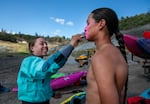
Ruby Williams of the Quartz Valley and Karuk tribes (left), uses a zinc sunscreen stick on ‘ A:de’ts-Nikya:w Rogers (right) of the Hoopa Valley Tribe alongside an old dam construction site on the banks of the Klamath River, June 22, 2025.
Anna Lueck for OPB
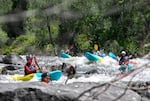
At far left, ‘A:de’ts-Nikya:w Rogers of the Hoopa Valley Tribe pauses at the beginning of a rapid on the Klamath River while other paddlers wait behind him, June 22, 2025. Rogers and the other kayakers are participants in Paddle Tribal Waters, a program that trained Indigenous youth for several years to be the first group of people to paddle the free-flowing Klamath from source to sea.
Anna Lueck for OPB
Hershman: What was the biggest challenge you faced while reporting on this story?
Sears: The logistics of this story were layered and complicated. The biggest challenges came up in preproduction when I had to plan which days Brandon and I would join, trying to lock in canoes, rafts and food/water plans. Additionally, there was no cell service for most days, making it difficult to find the group when we returned in the middle and end of the journey.
Hershman: If you could carry forward one thing you learned from this first-hand experience, what would it be?
Sears: Non-extractive journalism will always win. You may not “get the perfect shot” and it may take longer to finish but parachuting in and out of a community will hinder trust, relationships and your story overall.
Editor’s note: A shortened version of this interview appeared in the Winter 2025 edition of OPB’s quarterly member magazine, OPB Connect.