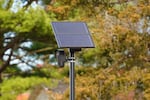
Flock safety police law enforcement license plate reader setup outside to help catch vehicle speeders in an unknown location.
Aaron of L.A. Photography / Shutterstock
Skamania County Sheriff Summer Scheyer announced this week that her office would discontinue using Flock Safety cameras over concerns that a recent Washington state court decision could make it easier to weaponize the data they collect.
An early November state court decision found that data collected by the traffic cameras would be available through public records requests.
“This recent court decision is a threat to public safety, allowing access to anyone and extending far beyond the policy parameters set forth by the Skamania County Sheriff’s Office for their own personnel,” the sheriff’s office said in a statement Wednesday.
At least six Flock cameras were set up in the Southwest Washington county in December 2024. The sheriff’s office planned to use the system’s license plate readers to apprehend stolen vehicles and to assist with warnings about child abduction and missing persons, known as amber and silver alerts.
But the cameras have faced scrutiny because their data is stored on the privately-owned company’s servers.
On Thursday, immigration advocacy groups in Oregon applauded the city of Woodburn for turning off its Flock cameras over concerns that they could be used to assist with immigration arrests.
An October report by researchers at the University of Washington showed that at least eight Washington state law enforcement agencies “enabled direct, 1:1 sharing of their networks with U.S. Border Patrol at some point during 2025.”
According to Scheyer, worries in Skamania County were more related to the cameras being used for unreasonable searches and seizures.
“At this point, I’m just done with the cameras,” Scheyer said. “It’s been tumultuous to say the least.”
The Washington state court decision that caused the sheriff to deactivate the cameras took place Nov. 6 in Skagit County Superior Court.
In it, a judge determined that data collected by Flock cameras are subject to the state’s public records act. The court rejected arguments from the cities of Stanwood and Sedro-Woolley that claimed Flock data should be protected from public disclosure.
“Flock camera images are created and used to further a governmental purpose. The Flock images created by the cameras located in Stanwood and Sedro-Woolley were paid for by Stanwood and Sedro-Woolley and were generated for the benefit of Stanwood and Sedro-Woolley,” Judge Elizabeth Neidzwski wrote in her decision.
Sheriff Scheyer said her office began using the camera system to stretch its limited public safety resources further.
The vast majority of Skamania County is managed by the U.S. Forest Service, which limits the available tax base for services like law enforcement. Simultaneously, the region’s growth as a recreation destination has led to a record number of requests on the sheriff’s office to do search and rescue operations on top of other duties.
“Utilizing Flock cameras was one caveat to be able to limit some of that time in trying to narrow down where these people are located,” Scheyer said.
At this point, she said, the cameras have been turned off and the county is not planning to renew its contract with Flock at the end of 2026.