A sagebrush sea straddles the Oregon-Nevada state line in the McDermitt Caldera, where mining companies are looking to drill for lithium, a metal that is among the critical minerals needed to make batteries.
Cassandra Profita / OPB
The Bureau of Land Management on Monday announced its approval of a controversial lithium mining exploration project in southeast Oregon’s Malheur County near the Nevada state line.
The decision allows HiTech Minerals Inc., a subsidiary of Australia-based Jindalee Resources, to do exploratory drilling for lithium at up to 168 sites across 7,200 acres of BLM land. The company is also cleared to build more than 20 miles of access roads for the project.
The project has drawn criticism from wildlife advocates who have documented the area as a stronghold for sage grouse, a ground-dwelling bird that has dozens of mating sites nearby. They’re also concerned about impacts to threatened Lahontan cutthroat trout. Ranchers who lease BLM land in the area for grazing say the project will hurt their operations by impacting critical grazing land.
But others, including the Trump administration and the Biden administration before it, point out the importance of lithium for the nation’s economic independence and the move away from fossil fuels that contribute to climate change. Lithium is a valuable metal that is used to make all kinds of batteries, including those for electric vehicles and for storing renewable energy.
Jindalee Resources CEO Ian Rodger told OPB in an interview earlier this year that the exploratory drilling project is designed to help his company gather data on the lithium deposit in Malheur County and determine what a full-scale mine might look like.
The company has not yet proposed building a full-scale lithium mine.
“A lot of folks get confused about that,” he said. “Ultimately, if we’re successful, that’s the way it would look to go. But at the moment we’re actually only looking to do exploration to basically prove up our future plans.”
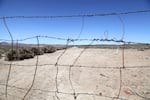
A barbed wire fence blocks access to one of the roads built by Jindalee Resources, an Australia-based mining company that has applied to do exploratory drilling for lithium in the McDermitt Caldera in Southeast Oregon near the Nevada state line. Photograph taken April 4, 2025.
Cassandra Profita / OPB
Rodger said a lithium mine would be “years away” and would require “extensive community engagement, regulatory approvals and a full environmental impact assessment.”
The project site is on the Oregon side of the McDermitt Caldera, an ancient supervolcano that holds one of the largest deposits of lithium in the world, according to Rodger.
Lithium Americas has already started developing the Thacker Pass lithium mine on the southern end of the McDermitt Caldera in Nevada.
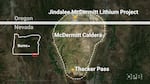
A map of the McDermitt Caldera on the Oregon-Nevada border.
MacGregor Campbell / OPB
Rodger said the U.S. is highly dependent on China for its supply of lithium.
“These large deposits that can potentially decouple the supply chain and produce battery-grade lithium chemicals in the U.S. are really important from an energy security point of view,” he said.
A full-scale mining project could last many decades and provide thousands of “well-paid family-supporting jobs in the region,” he said.
The exploratory drilling project would involve drilling 4-inch diameter holes that would be reclaimed afterwards, Rodger said, so they would have “relatively little disturbance.”
Rodger said the company has designed the exploratory drilling project to avoid impacts to sage grouse and threatened Lahontan cutthroat trout. A future mine, he said, could have major benefits to the local economy.

A drill hole plugged with cement and capped on the Jindalee lithium claim site on the Oregon-Nevada border, Friday, April 1, 2022.
Bradley W. Parks / OPB
“The prize is big here in terms of potential benefit for the region in terms of jobs, broader economic development if it’s done in a responsible way,” he said. “We’re focused on this reasonably small-scale drilling program and designing that to have the minimal footprint and impact.”
Mark Salvo, a program director with the Oregon Natural Desert Association, said in an interview earlier this year that the Jindalee Resources project would undermine a decade of conservation work to help recover the greater sage grouse, whose populations have declined by about 80% since the 1960s.
“The McDermitt Caldera has long been recognized as one of the most important habitats for greater sage grouse in all of the West,” he said. “This is one of the really special places in southeastern Oregon and Northern Nevada that would be harmed permanently and irreparably by a mining operation.”
Under the Obama administration, the Department of the Interior identified the caldera as a Sage Grouse Focal Area with high densities of breeding sage grouse populations and high-quality sagebrush habitat.

A male sage grouse inflates the air sacs on its chest to attract females in a video still taken on April 4, 2025, in Southeast Oregon's McDermitt Caldera. Wildlife advocates are concerned that a lithium exploration plan by Australia-based mining company Jindalee Resources will disturb the sage grouse habitat in the caldera.
Cameron Nielsen / OPB
In 2015, private landowners and environmental groups signed an unprecedented agreement to protect the greater sage grouse, with voluntary conservation work taking place on thousands of properties across 11 Western states.
Salvo said the development of new roads and drilling pads, as well as the actual drilling, will all affect sage grouse in the McDermitt Caldera, but the BLM’s environmental assessment of the exploratory drilling proposal “tended to gloss over some of those impacts.”
He said there are other options for extracting lithium to help electrify the economy in the U.S. and globally that would be less harmful to the environment, and there are also alternatives to lithium itself as the mineral needed for moving away from fossil fuels.
“We’re concerned this kind of development proposed under a law from the 1800s is really looking backwards when it comes to whether and to what degree we even need lithium in the future,” he said.
Malheur County rancher Nick Wilkinson said in an interview in April that he was surprised to find himself partnering with environmental groups in opposing Jindalee’s mining project. But the company’s exploratory drilling plan alone would prevent him from grazing his cows on a stretch of BLM land he depends on in the springtime, he said.
“If that project goes in, I don’t see how we can coexist,” he said. “I realize we need clean energy. … It’s government ground. It belongs to the public. But I want there to be some mitigation. If you want to take away my operation and my grazing, then buy my ranch.”
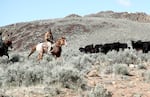
Fourth-generation rancher Nick Wilkinson moves a herd of cows from one grazing area to another in Southeast Oregon near the Nevada state line on April 4, 2025. He is opposed to exploratory drilling in the area because he says it would threaten his ranch operations and the sage grouse he's been working to protect.
Cassandra Profita / OPB
Wilkinson said he sees a threat from this project both to his ranch and to sage grouse he’s been trying to help in recent years as part of a conservation agreement. Over the past 30 years, he’s cut his herd in half and leased more grazing land to protect habitat for declining sage grouse and Lahontan cutthroat trout.
Now, he said, he’s watching Jindalee Resources and its contractors damage roads and fail to clean up their drilling sites in the McDermitt Caldera, and he’s not convinced they will be good stewards of the land.
“We’ve been protecting that caldera … we’re just going to destroy it?” he said.
Rodger said Jindalee has avoided doing any work in sage grouse mating areas and has narrowed its drilling window to avoid potential impacts during mating season.
“We’re working closely with the Oregon officials to ensure any potential impact on sage grouse is properly managed,” he said. “We’ve done a bunch of work around exploration and trying to design that to have the smallest footprint possible.”