Oregon’s economy is in rough shape.
On Monday, economic and political leaders pitched their vision for a path forward to steer the state’s economy back to relative stability, when they gathered for the annual Oregon Leadership Summit.
They have their work cut out for them.

FILE — The price of food and other goods has increased this year, especially for imports hit with tariffs imposed by the Trump administration. An undated image provided image shows containers at the Port of Portland’s Terminal 6.
Courtesy of the Port of Portland
Unemployment has steadily ticked up from 4% to 5% over the last year. During the same time, the state has shed nearly 25,000 jobs, and the workforce has dropped to fewer than 2 million people. Population growth has stalled. Some Oregonians fear going to work or school due to federal immigration enforcement activity.
Meanwhile, the cost of food, utilities and housing is going up. And a stubbornly persistent housing shortage and affordability crisis continue to force a shocking number of Oregonians into homelessness or housing insecurity.
Now, Democratic Gov. Tina Kotek is seeking to make attracting business a key pillar of her reelection campaign. She told attendees at the Oregon Leadership Summit that spurring economic growth was key to Oregon having a prosperous decade.
“That means being honest about where we stand today,” Kotek said. “We must address our economic headwinds, sluggish job growth, elevated unemployment, and declining population trends. Some of our homegrown businesses have left, and bureaucratic red tape blocks critical investments.”
Kotek also pointed to federal policies like tariffs that are driving up costs for businesses and consumers alike.
Echoing Kotek’s focus, U.S. Sen. Ron Wyden, D-Ore., told OPB that rising prices are the main concern for Oregonians.
“The reality is I’ve had more than 1,100 town hall meetings open to all,” Wyden told OPB ahead of Monday’s summit. “The number one issue is where the second word is cost – it might be medical costs, it might be energy costs, it might be housing costs. But Oregonians are just getting clobbered by some of these costs.”
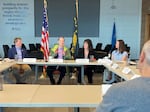
Sen. Ron Wyden (center) discusses the affects of tariffs with Trey Winthrop, CEO of Bob’s Red Mill (left), Tia Sandberg, president of Columbia River Customs Brokers & Forwarders Association (right), and Erica Mitchell, chief financial officer at Hood River Distillers, and others at the Port of Portland on April 21, 2025.
Kyra Buckley / OPB
This year’s event took place in Portland at the Oregon Convention Center. It came as near-stagnant population and economic growth have put pressure on state leaders to attract more business opportunities to Oregon.
“For much of the past five decades, Oregon outpaced the U.S. in population and job growth, buoyed by steady in-migration and a reputation for livability and opportunity,” reads an Oregon Business Plan report purposefully released ahead of the summit. “But that momentum has slowed. Job growth now trails national averages, in-migration has fallen sharply, and population forecasts have been cut in half since 2019.”
Leaders from major Oregon industries — such as health care, computer chips and artificial intelligence, and food and agriculture — made presentations to lawmakers and other attendees. Top officials from Oregon schools and universities also discussed their ideas for training workers in high-paying industries that leaders hope will power the state’s future, like semiconductors and artificial intelligence.
Wyden said if Oregon wants to turn its economic future around, investments in rural education and health care will be key. The senior senator also echoed what nearly every elected official said: The state must build more housing and bring down the cost of living.
“Never bet against Oregon,” Wyden said. “There’s no question that we’ve got work to do. We’ve got work to do in terms of mental health, we’ve got work to do in terms of downtown Portland. But what we consistently do – you stay at it and you get results.”