Oregon regulators are about to make a pivotal decision about how people can use groundwater in the southeast corner of the state.
On Thursday, the Oregon Water Resources Commission will meet in Salem to vote on a proposal on whether to designate the Harney Basin a critical groundwater area.
That designation would give the state more authority to rein in water use in a basin that has long been known to be in decline.
But underlying this upcoming vote are hundreds of thousands of state dollars spent and hundreds of hours of meetings with domestic well owners, environmental groups, policy officials, irrigators and ranchers who worked to come up with a different, community-led solution to the problem.
It was an effort some people expected would carry over to the recommendations that will be considered on Thursday. The recommendations being considered instead have generated strong pushback from some irrigators, local community members and elected officials.
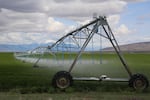
FILE - An irrigation pivot in Harney County, May 27, 2019. Farms here raise alfalfa.
Emily Cureton Cook / OPB
Right now, the water resources department has proposed cutting back on water use by up to 70% in some parts of the basin over the next 30 years. But opponents to that plan say it will harm a community whose economy largely depends on agriculture. If fully implemented, the proposed rules could take a $41 million bite out of the local economy.
A coalition of irrigators, elected officials and tribes has proposed a different vision that would put strict restrictions on only the most depleted areas of the basin. They’re hoping the Oregon Water Resources Commission will consider their plan instead of the state government’s proposal, but they’re not counting on it.
Now a question looms.
What does collaboration mean in a community that has grown frustrated and distrustful of the government, as regulators consider a plan to keep more water from dying up?
“It’s a situation where there are no easy choices,” said Jason Cox, a spokesperson for the Oregon Water Resources Department. “The commission is facing a big decision that affects a lot of people, and that’s clearly going to generate strong opinions.”
Lush green irrigated fields in the high desert
The Harney Basin in southeast Oregon sits in a semi-arid high desert.
For the last three decades, groundwater pumping for mainly large-scale commercial agricultural irrigation — which accounts for close to 97% of the region’s groundwater use — has increased to unsustainable levels. Outflow from the Harney Basin is more than can naturally be replenished by rain and snowmelt from the mountains.
That’s because, for years, the state over-allocated the right to water drawn from natural underground reservoirs.
In one area of the basin, groundwater levels have declined by more than 100 feet and continue to drop by as much as eight feet per year. Groundwater levels in other parts of the basin are also in decline, but at much lower rates.
Some 70 residential and livestock wells have gone dry, forcing people to dig deeper for water.
In 2016, the Oregon Water Resources Department put a pause on issuing new groundwater rights in the basin, but it didn’t cut back on existing groundwater permits.
At that time, the department began engaging with local residents to come up with a plan to address critical water resources in the area.
Laurie O’Connor was one of the local residents involved in the collaborative group.
She is not an irrigator, but she has a private well and a stockwater well that provides water to a small herd of cattle at her property.
O’Connor spent six years representing domestic private well owners. She said she felt the effort to address water challenges wasn’t perfect, but that it was done in good faith. Still, she felt the process was too slow, and the concerns of domestic well owners weren’t heard.
“Commercial [agriculture] interests had a much stronger voice in the collaboration than did the private citizens,” she said.
While the community group O’Connor was part of worked to develop a voluntary plan for addressing groundwater challenges, the water resources department convened a new group. This second group, made up of local residents, water users and environmentalists, was asked to weigh in on rules that would be enforced by the state, as opposed to voluntary guidelines.
“There was an expectation, even from our point of view, that the department understood, acknowledged and was going to honor the collaborative spirit that we had built in this community for multiple years on water,” said state Rep. Mark Owens, R-Crane.
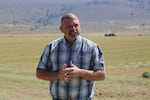
FILE - Rep. Mark Owens, R-Crane, pictured in Harney County on August 27, 2021.
Emily Cureton Cook / OPB
Owens represents much of Southeast Oregon and Harney County. He also grows hay in the Harney Basin.
Owens said the state seemed to rush through its process, instead of engaging with the community, like it did with the initial collaborative group. He and some community members are frustrated with the state’s proposal — and with the process that led to it.
In response to those frustrations, the water resources department extended its process, added more meetings and hired a third-party group to facilitate discussions with community members. But that was only after Owens and other community members requested it.
“We’ve made a lot of adjustments throughout, really a decade of engagement in the basin on a lot of issues,” water resources department spokesperson Cox said. “We shaped our processes as much as possible around what we heard over that decade.”
But, Owens said, people still didn’t feel listened to.
“I’ve been told by the [Water Resources Department] director’s office, ‘Don’t worry, we want to work with your community…’” Owens said. “I’m not buying it.”
Owen said for him, and some community members, collaboration ultimately felt more like window dressing.
“No matter what occurs at the commission meeting, we still have to figure out how to work together,” Owens said. “There’s a lot of my community members that probably don’t feel the same way.”
But in this small rural community, this issue is not black and white, and not everyone is going to agree on what needs to happen.
“There’s gonna be winners, there’s gonna be losers, and I’m afraid the more the local power brokers interfere in this, I think it’ll have less to do with science than it does with personal outcomes and gains,” O’Connor said.
As far as what collaboration will look like in the future, O’Connor said it only works if regulators stay the course on the department’s official proposals.
“If the commission has to honor the requests on that petition, if the water resources department has to write and rewrite and readjust and be even more tolerant [of irrigators], I say collaborations don’t work,” she said. “And I would suggest never having another collaborative process again anyway, or start this one all over.”
Cox, with the state water resources department, said the department ultimately did everything it could to engage with people.
“There’s disagreement within the community. It’s not a monoculture,” Cox said, “We have really felt like we’ve done everything we know to do to help people feel heard and have opportunities to engage meaningfully on this, even if ultimately they’re not 100% on the same page with the outcome.”
On Thursday, the Oregon Water Resources Commission can either adopt the state government’s proposal, the community petition or a combination of both.
If the proposed department rules are adopted, starting in 2028, the state will introduce a series of steps to reduce local groundwater use every six years over the next 24 years.