If you hop on the No. 35 bus in downtown Portland, within 15 minutes you’ll reach the entrance to Tryon Creek State Natural Area — a 647-acre pocket of calm tucked at the edge of the city. For park ranger Rhett Wilkins, that forested canyon is his daily workplace.
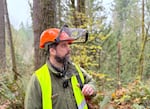
“I would say there is no normal, being a ranger here, at least,” said Oregon state park ranger Rhett Wilkins. Wilkins is pictured during a snag cutting at Tryon Creek Natural Area on Nov. 19, 2025. Activities could be clearing vegetation from the park’s 13 miles of trails, constructing a bridge, removing invasive species, teaching school children, or leading a nature walk. “We get pulled in a lot of different directions,” he said.
Mia Estrada / OPB
OPB’s ‘Weekend Edition’ Host Lillian Karabaic hiked the trails with Wilkins for the latest installment of ‘At Work With’ to learn what it’s like to care for one of Oregon’s state natural areas.
What does a typical day look like for a state park ranger?
“I would say there is no normal, being a ranger here, at least,” Wilkins said. Activities could be clearing vegetation from the park’s 13 miles of trails, constructing a bridge, removing invasive species, teaching school children, or leading a nature walk. “We get pulled in a lot of different directions,” he said.
“It is far busier in the summer,” he said. “We have so many seasonals,” Wilkins said, referring to seasonal workers. Statewide, Oregon hires about 250 temporary workers in its parks each summer.
The winter is the busy season for year-round rangers at Tryon, though. “The truth is with projects — whether we’re doing trail maintenance or construction — we usually do that in the winter,“ said Wilkins, because they’ve got fewer visitors on the trails.
Where is your big ranger hat?
The iconic broad-brimmed ranger hat is actually officially an interpretive hat, so they only wear it for larger presentations or hikes, not when doing trail work. “We do an annual bat chat in the summer, that’s when rangers kind of put on the big show,” Wilkins said. With an audience of up to 100 people, “That’s a little more formal, so we’ll put on the interp hat.”
What education or background do you need to be a state ranger?
There’s no single background or education that makes a ranger, and a degree is not required. Once hired, rangers eventually take ‘post’, an in-depth training on protocols, rule-enforcement and de-escalation for commissioned officers.
“You do not have to have a degree to get into this field,” said Wilkins. “Work experience can serve you really well. Combination of the two is ideal of course,” he said. “We get people from all walks of professions. We might hire someone fresh out of college with a degree and almost no experience. We might hire somebody who’s been in construction their whole life and doesn’t have a degree.”
Wilkins recommends anyone interested in becoming a ranger to apply for seasonal work, as it can help with getting hired and figuring out if you like the day-to-day of working in the state park.
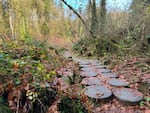
State park ranger Rhett Wilkins said one of his proudest projects Tryon Creek State Natural Area was building this natural bridge from a fallen tree. It took a few months of on-and-off work to build.
Lillian Karabaic / OPB
Many people start as volunteers with Friends of Tryon Creek. “I started coming here as a visitor in 2009, and I worked here for [the] Oregon Parks and Recreation Department as a seasonal in 2010 and 2011,” he said.
How many trees do you have to cut down?
Wilkins estimates the rangers at Tryon cut down about seven trees a month, only when they are threatening human safety.

Oregon state park ranger Nikolas Eie prepared to cut a snag tree branch at Tryon Creek State Natural Area on Nov. 19, 2025.
Mia Estrada / OPB
Do you ever get lost on the trails?
“You learn ‘em pretty well. It’s kind of a maze of a trail system, like the trails intersect each other quite a bit,” said Wilkins. “It takes working here for maybe a year before you just know ‘em like the back of your hand,” he said.
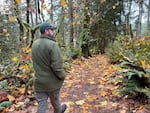
Oregon state park ranger Rhett Wilkins has been visiting Tryon Creek State Natural Area for over 15 years. He can’t always believe he gets to work here now. “I’m super happy to be here now and I kind of have to pinch myself like once a week that I’m here,” he said.
Mia Estrada / OPB
“And the really cool thing is that you sort of develop a language with your coworkers where you can reference a tree literally and not a species, an individual tree, and not even have to say the trail name, and they know where you’re talking about,” Wilkins said.
“And so we will often talk about certain places in the park and not even have to say the name of the trail,” he said.
What’s the difference between a state natural area and a state recreation area?
The primary focus at the state natural areas is protecting flora and fauna. Foraging and fishing are not allowed in natural areas, but might be at state recreation areas. “At other parks with different designations, there’s going to be a limit, like one gallon of berries,” Wilkins said
“We’re all about protecting the flora and fauna here,” Wilkins said. To protect the wilderness, “staying on the trail is mandatory here,” he said. “Even though you have 13 miles of trail, it only cuts through so much of that 647 acres.”
Do you ever see the beavers at work dragging their branches?
“That happens at night. I’ve run into one beaver, and it was broad daylight, 1:00 p.m., and it was sleeping under reed canary grass,” said Wilkins. “The beavers in Tryon Creek don’t make a lodge. They burrow into the bank,” said Wilkins. “When we go through their habitat, you’re in it because you start seeing beaver chews floating and you see big holes in the bank,” he said.
“They go in through the water and then they come out on land. In fact, when you’re walking on land in the summertime along the creek, you need to be really careful not to fall into a beaver hole. They grow over with vegetation,” said Wilkins.
Wilkins knows — he fell into a beaver burrow once. “They do weird things to the land,” he said.
Do you know your regular hikers?
“I think if you’ve worked here for a couple years, you feel like you almost know everybody on the slow weekdays,” Wilkins said.
“There’s a lot of people that have been coming here for years and years and years. They either just love hiking it or walking their dog here, or some of them are even volunteers, and they visit all the time. But you get to know the regulars really well,” he said.
How many people work at your park?
There are four permanent staff members at Tryon Creek State Natural Area. “Three rangers and one ranger supervisor,” said Wilkins. “In the summer, we usually get three additional seasonal rangers. So they would be on staff between May and early September, usually or late September.”
Are you always at this park or do you move between state parks?
“Ninety percent of the time I’m at Tryon Creek, and that goes for all of our staff,” Wilkins said. “We do have a satellite property on Sauvie Island called Wapato Access Greenway, and we go out there once a week, sometimes twice a week,” he said. “And we do that to collect trash, make sure the trails are clear for visitors. We also have a boat landing there called Hadley’s Landing so people can boat in and tie up.”
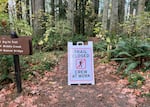
The primary focus at the state natural areas is protecting flora and fauna. Foraging and fishing are not allowed in natural areas, but might be at state recreation areas. “At other parks with different designations, there’s going to be a limit, like one gallon of berries,” Wilkins said.
Lillian Karabaic / OPB
Are you usually hiking? What’s your normal mode of transport around the park?
“There’s some trails that our [all-terrain-vehicles] ... don’t go on. They just can’t safely be operated on those trails. And those are the more rustic trails that involve box steps, or they’re really narrow,” said Wilkins. “When we need to access that trail for whatever reason, we’re on foot.”
“Depending on the project, some days that can mean we’re on foot a lot and covering a lot of ground on rough terrain,” Wilkins said. “Otherwise, we usually do take our vehicles for the sake of time on the handful of trails that allow that.”
Do you have to balance native plant species with what people find aesthetically pleasing for a public park?
“Parks are definitely prioritizing [native species],” said Wilkins. “When projects are happening within view of the public eye, sometimes we balance it with aesthetics,” he said.
“Sometimes it simply makes sense to put in the native species so that everything kind of looks like it should look or looks like what’s adjacent to it. And hopefully that’s aesthetically pleasing if you are enjoying the park you came to,” Wilkins said.
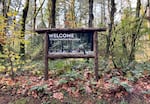
The winter is the busy season for year-round rangers at Tryon Creek State Natural Area. “The truth is with projects — whether we’re doing trail maintenance or construction — we usually do that in the winter,“ said Wilkins, because they’ve got fewer visitors on the trails.
Lillian Karabaic / OPB
“There are some areas where we’ll go out of our way to make it more aesthetically pleasing. A good example of this is a High Bridge. That is an intersection of three trails and it’s kind of central in the park,” said Wilkins.
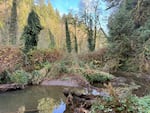
Tryon Creek State Natural Area
Mia Estrada / OPB
“It was so overgrown with Blackberry, we took the blackberry out. We added red flowering currant to be really pretty — it’s a native plant. It’s not like we threw in some weird rose that’s not native here, we wouldn’t do that,” said Wilkins.
“We do make efforts here and there to make things beautiful,” he said.
What’s the worst part of the job?
“When you have a rule-enforcement situation where hostility and safety is coming into play, and the police need to get involved, that’s hard,” he said.
“You can see some really emotional things,” he said. “You might see an animal being abused, you might see another human being abused, your safety might be threatened. That kind of stuff is the worst day.”
Which invasive species is worse: English Ivy or Himalayan Blackberry?
“Blackberry might be the greater evil of the two,” Wilkins said. “They do different things, but the blackberry is really going rampant in certain areas of the park where the canopies opened up, and it’s simply harder to work any day of the week,” he said.
“We can take volunteers out and pull ivy, easy peasy. But taking volunteers out to get blackberry root balls out of the ground with all the thorns and stuff, it’s a beast,” said Wilkins.
Oregon state park ranger Nikolas Eie prepared to cut a snag tree branch at Tryon Creek State Natural Area on Nov. 19, 2025.
Mia Estrada / OPB
Are there any rules you hate enforcing?
“I think they’re all pretty sound. There are rules that we sometimes wish didn’t exist because we have to enforce them all the time,” Wilkins said. “The number one rule-enforcement issue we have at this park ... is dogs off leash.”
Cats on a leash are allowed in the park as well, but Wilkins reminds cat owners they need to stay on the trail and — on the ground.
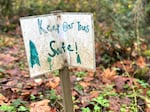
Tryon Creek State Natural Area hosts Friends of Tryon Creek's education programs, where kids will design some of the warning signs.
Mia Estrada / OPB
“One busy summer day ... I heard some scratching on the tree,” he said. “I look up to see what woodpecker is up there, and there’s a cat about 15 feet up in the tree on a long, thin leash.”
How does it feel to work here every day?
Wilkins has been visiting Tryon Creek State Natural Area for over 15 years. He can’t always believe he gets to work here, though. “I’m super happy to be here now and I kind of have to pinch myself like once a week that I’m here,” he said.