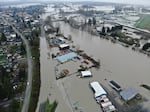
A view looking upstream on the Snohomish River with the city of Snohomish on the left and Harvey Airfield on the right. Snohomish County officials shared the image on Friday afternoon.
Courtesy of Snohomish County Department of Emergency Management)
While overflowing rivers were beginning to recede across western Washington on Friday, officials said it could be days or even weeks before residents can safely return to areas swamped by this week’s historic flooding.
Thousands of people remained under evacuation orders as reports of flood damage continued to emerge from around the state.
Federal support is on the way. The federal government on Friday approved Washington’s request for aid to respond to ongoing record flooding.
Gov. Bob Ferguson said he received a call from U.S. Homeland Security Secretary Kristi Noem to let him know that President Donald Trump had signed Ferguson’s request for an emergency declaration. This will allow the state to potentially seek federal funds in response to the flooding.
“It’s exactly the kind of call the people of the state of Washington or the American people would want between a cabinet member and a governor when there’s a crisis like this,” Ferguson said Friday at a press conference standing atop a levee in Tukwila. “She was gracious. She asked how we were doing here in Washington state. I just deeply appreciate the call and their support.”
The declaration allows the Federal Emergency Management Agency to provide equipment and federal assistance, with the feds covering 75% of those costs. That’s standard in these situations, officials said.
Ferguson said the state would be moving “as quickly as we can” to access further federal aid to help individuals affected by the flooding in the aftermath. First, though, local and state officials will need to gather information to develop an estimate of the damages.
“There’s going to be massive impacts as we dig ourselves out from this,” the governor said. “That will take some period of time to gather that information to make our request as strong as possible.”
“We’ll make sure folks have the resources that they need right now,” he added.
Raging waters
Around midnight, the Skagit River crested at a record 37.7 feet near Mount Vernon, surpassing the mark set in 1990. The flooding didn’t quite hit the peaks in the city that some officials were warning of, and that could have toppled the city’s floodwall.
After thousands of Skagit County residents were directed to evacuate their homes on Wednesday and Thursday, authorities early Friday morning told thousands more in Burlington to leave immediately due to an overwhelmed slough.
Members of Washington’s National Guard were going door to door to let residents know they should evacuate from the city, though some were allowed to return hours later. Officials lifted evacuation orders in some other areas, as well, including Orting in Pierce County, which sits between the Carbon and Puyallup rivers.
The National Guard was also helping in swift water rescues in Burlington. In all, more than 300 members of the National Guard were assisting in Skagit County. California Gov. Gavin Newsom also deployed search and rescue teams to Washington to help.
No one has been reported dead in the flooding, Ferguson said.
“The situation is very dynamic, but we’re exceedingly grateful and thankful that our prayers have been answered,” he said.
The Snohomish River has also set a new flooding record. Both the Skagit and Snohomish were forecast to remain in the major flooding stage into Saturday. Rivers as far east as the Yakima in Benton County were flooding at least moderately.
Some major highways remain closed, including a long stretch of U.S. 2 between Skykomish and Leavenworth.
The state isn’t out of the woods. It’ll take a while for floodwaters to fully recede. And more rain could cause rivers to rise again next week, though likely not to the historic levels seen this week, said Robert Ezelle, director of the Military Department’s Emergency Management Division.
“It’s not over yet,” said Washington Sen. Maria Cantwell, but this is an “opportunity to take a deep breath and hopefully get this support out here to get more support to open these communities back up.”
Federal help
There were concerns Washington might have trouble accessing federal assistance to respond to the flooding, given Trump’s posture on disaster aid.
This year, he denied Washington’s request for federal aid in the aftermath of the devastating bomb cyclone windstorm that hit the state late last year.
On Wednesday, Ferguson, a Democrat, asked for an emergency declaration from the feds. The state’s entire congressional delegation, including two Republican representatives, urged Trump to approve the governor’s request.
This emergency declaration covers Benton, Chelan, Clallam, Grays Harbor, Jefferson, King, Kittitas, Lewis, Mason, Pierce, Skagit, Snohomish, Thurston, Wahkiakum, Whatcom and Yakima Counties, along with tribal nations in those areas.
Even with federal assistance, the state will rack up storm-related expenses that must be paid.
Washington has a disaster response and recovery account in the budget that is a potential source of funds.
There’s also the budget stabilization account, aptly referred to as the rainy day fund. It is the state’s savings account for unforeseen events such as big drops in tax collections or natural disasters. In some circumstances, it can be tapped to fill budget gaps. It contains $1.6 billion.
“At this point, the unknowns outweigh the knowns. No one has any idea of the extent of the damage or how much this will cost,” said Sen. Chris Gildon, R-Puyallup, the lead Republican budget writer.
House Speaker Laurie Jinkins, D-Tacoma, said she was pleased to see how quickly the federal government reacted. There will be costs to the state not covered by federal aid, she said.
“Obviously, the rainy day fund was created in part for emergencies like this,” she said. “It was never the first source to go to. But it is always one that we are aware of.”
This republished story is part of OPB’s broader effort to ensure that everyone in our region has access to quality journalism that informs, entertains and enriches their lives. To learn more, visit opb.org/partnerships.