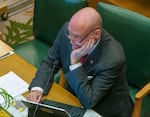
Oregon state Representative Greg Smith, R-Heppner, on Feb. 5, 2024, during the opening of the legislative short session at the Oregon state Capitol in Salem, Ore.
Kristyna Wentz-Graff / OPB
Oregon’s longest-serving state representative broke state ethics laws when he tried to secure a $66,000 raise for his work as an executive director at the Columbia Development Authority of Boardman, the state’s government ethics watchdog found Friday.
Seven members of the Oregon Government Ethics Commission on Friday unanimously found that Rep. Greg Smith, R-Heppner, a state legislator since 2000, used his position as a public official to secure a higher salary. He has long added onto his legislative salary with high-paying consulting contracts and side gigs supporting economic development efforts in eastern Oregon.
The commission on Tuesday voted during a special meeting to extend for 30 days its investigation into Smith and allow investigators to gather more information, but members decided on Friday that, given the evidence they’d reviewed, he was in violation of state ethics laws. Smith was not present for the meeting, and the next step in the process could be a hearing where he can contest the findings or any other orders, such as a fine.
Smith did not immediately respond to a text message from the Capital Chronicle seeking comment on Friday.
Smith has faced multiple ethics investigations during the last year, but Friday’s decision centered on whether he failed to disclose conflicts of interest and abused his position as a public official when he sought a raise through funding from the U.S. Department of Defense for his work at the authority that had not been pre-approved by the authority’s board.
The development authority is an intergovernmental organization meant to redevelop the site of a former military chemical depot, and it includes the Port of Umatilla, Umatilla County, Port of Morrow, Morrow County, and the Confederated Tribes of the Umatilla Indian Reservation. It receives federal grant funding from the Office of Local Defense and Community Cooperation.
“Executive Director Smith’s efforts as it relates to the pay increase were not only an attempt; rather, they resulted in an actual financial benefit to Executive Director Smith,” a new, 43-page investigation from the commission reads. “The evidence establishes that Executive Director Smith used his position as Executive Director to obtain a pay increase for himself that had not been previously approved by the CDA Board.”
Smith’s salary for running the authority was $129,000 in late 2023, an amount he wanted to increase to $238,000, according to a letter he sent to the Columbia Development Authority board’s chair in December 2023, though the investigation found no indication that the board took up such a raise for a vote.
Nevertheless, a 2024 grant application the authority sent to the defense department’s Office of Local Defense Community Cooperation included mention of “a significant board-approved increase” in existing salaries beginning on April 1, 2024.
That grant application called for a new salary for Smith of $195,000, the maximum pay allowed under the defense office’s salary cap for grantees. Under a cost-sharing agreement, the federal government would have paid $123,350 of the salary, and the local development authority would have paid $71,650. But after finding out about the raise retroactively, the development authority’s board revoked it and directed him to pay back the extra money he had received.
Oregon’s longest-serving state representative broke state ethics laws when he tried to secure a $66,000 raise for his work as an executive director at the Columbia Development Authority of Boardman, the state’s government ethics watchdog found Friday.
Seven members of the Oregon Government Ethics Commission on Friday unanimously found that Rep. Greg Smith, R-Heppner, a state legislator since 2000, used his position as a public official to secure a higher salary. He has long added onto his legislative salary with high-paying consulting contracts and side gigs supporting economic development efforts in eastern Oregon.
The commission on Tuesday voted during a special meeting to extend for 30 days its investigation into Smith and allow investigators to gather more information, but members decided on Friday that, given the evidence they’d reviewed, he was in violation of state ethics laws. Smith was not present for the meeting, and the next step in the process could be a hearing where he can contest the findings or any other orders, such as a fine.
Smith did not immediately respond to a text message from the Capital Chronicle seeking comment on Friday.
Smith has faced multiple ethics investigations during the last year, but Friday’s decision centered on whether he failed to disclose conflicts of interest and abused his position as a public official when he sought a raise through funding from the U.S. Department of Defense for his work at the authority that had not been pre-approved by the authority’s board.
The development authority is an intergovernmental organization meant to redevelop the site of a former military chemical depot, and it includes the Port of Umatilla, Umatilla County, Port of Morrow, Morrow County and the Confederated Tribes of the Umatilla Indian Reservation. It receives federal grant funding from the Office of Local Defense and Community Cooperation.
“Executive Director Smith’s efforts as it relates to the pay increase were not only an attempt; rather, they resulted in an actual financial benefit to Executive Director Smith,” a new, 43-page investigation from the commission reads. “The evidence establishes that Executive Director Smith used his position as Executive Director to obtain a pay increase for himself that had not been previously approved by the CDA Board.”
Smith’s salary for running the authority was $129,000 in late 2023, an amount he wanted to increase to $238,000, according to a letter he sent to the Columbia Development Authority board’s chair in December 2023, though the investigation found no indication that the board took up such a raise for a vote.
Nevertheless, a 2024 grant application the authority sent to the defense department’s Office of Local Defense Community Cooperation included mention of “a significant board-approved increase” in existing salaries beginning on April 1, 2024.
That grant application called for a new salary for Smith of $195,000, the maximum pay allowed under the defense office’s salary cap for grantees. Under a cost-sharing agreement, the federal government would have paid $123,350 of the salary, and the local development authority would have paid $71,650. But after finding out about the raise retroactively, the development authority’s board revoked it and directed him to pay back the extra money he had received.
Casey Fenstermaker, a compliance and enforcement coordinator with the commission, reviewed documents and conducted a number of interviews, but did not have complete interviews with Columbia Development Authority board member J.D. Tovey and Smith himself done by the meeting earlier this week.
In her latest report, she wrote that Smith failed to pay back the extra money as the board directed and that Smith has not returned it.
“Executive Director Smith did not indicate to the Board that the grant application included a pay increase for himself,” she wrote. “The Board eventually discovered that the OLDCC grant application included a pay increase for Executive Director Smith.”
The commission has already opened four previous investigations into Smith this year. One, in March, resulted in him receiving a letter of education for failing to list Harney County, where he was a director for a local development authority, as a source of income on the annual economic interest statement he must file as an elected official. Responding to a 2024 ethics investigation, Smith reported that his household’s gross annual income was more than $1 million.
That includes his salary from the Columbia Development Authority, his legislative stipend, his wife’s salary as his legislative assistant and income from his business.
Oregon Capital Chronicle is part of States Newsroom, a network of news bureaus supported by grants and a coalition of donors as a 501(c)(3) public charity.
Oregon Capital Chronicle maintains editorial independence.
Contact Editor Julia Shumway for questions: info@oregoncapitalchronicle.com. Follow Oregon Capital Chronicle on Facebook and Bluesky
This republished story is part of OPB’s broader effort to ensure that everyone in our region has access to quality journalism that informs, entertains and enriches their lives. To learn more, visit opb.org/partnerships.