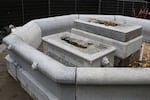
Work continues on the new base and fountain for the Thompson Elk statue in downtown Portland, Ore., on Wednesday, Dec. 17, 2025.
Kristian Foden-Vencil / OPB
Portland authorities are anxious to return the Thompson Elk statue to its rightful place in the middle of Southwest Main Street. It was damaged and then set on fire during the racial justice protests of 2020.
But an alphabet soup of organizations overseeing the project means it’s taking a long time. There’s the Portland Water Bureau, the Portland Office of Arts & Culture, the city attorney, the Portland Parks Foundation, the Bureau of Transportation, the Regional Arts & Culture Council, the contractor in charge of restoring it — the list goes on.
One issue is that the city wants the fountain to be filled with water for aesthetic reasons, and so that during any future protests people can’t set fire to the fountain again.
David O’Longaigh with the Portland Water Bureau said that requires power, watertight membranes and new carved granite.
“The original fountain ran almost 6 million gallons a year to drain into the river,” O’Longaigh said. “That will not happen anymore.”
Instead, the water will be recycled in the fountain over and over again.
Related: Putting Portland’s downtown elk statue back requires research and big bucks
The statue was donated by former Portland Mayor David Thompson in 1900, to commemorate the elk that once roamed the area and to honor the Oregon Humane Society, which he co-founded.
Standing at Southwest Main between 3rd and 4th Avenues, it was a popular spot for visitors and immigrants to stop and take in the city. And the fountain was a trough for horses that shuttled goods and people around downtown.
O’Longaigh said the statue will have a new reinforced foundation, new stonework sourced from the original quarry in Vermont, and more.
“A new modern plumbing system installed within the fountain to transmit the water,” he said. “Improved seismic attachment of the elk statue and finally improved lighting so the fountain can be seen and enjoyed at night.”
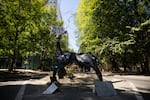
A makeshift elk statue stands between Chapman and Lownsdale squares Aug. 30, 2020, in Portland, Ore. The city removed the previous elk statue weeks prior amid nightly protests.
Bradley W. Parks / OPB
City crews removed the elk in July 2020, after someone sprayed it with graffiti and built fires in the fountain. The heat cracked the granite, and the city worried the structure was unsafe.
The bronze artwork depicts a bull elk with impressive antlers. For 120 years it looked up into Portland’s West Hills as if checking for danger. Over time, it has been surrounded by Portland City Hall, the federal building, the Multnomah County Courthouse and the Portland Police Bureau’s Central Precinct.
Darion Jones, with the city’s Office of Arts and Culture, summarized the feelings of many Portlanders.
“The elk is returning home and we’re all excited for its homecoming,” he said. “We’re looking forward to seeing it back on that fountain.”
Because the bronze is an image of an animal, and not a person, it doesn’t carry as much political baggage. Jones said it’s important for Oregonians to see the elk return.
“I can tell you that the elk has always been a monument that had little conversation in terms of protests against it,” Jones said. “Seeing that elk return, I do think it is hope returning back to our city.”
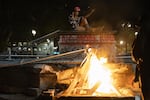
A protester sits where an elk statue used to stand during protests against racism and police violence in Portland, Ore., on July 16, 2020.
Jonathan Levinson / OPB
The statue has witnessed two world wars, two pandemics and an estimated 33 major political protests, from marches for women’s suffrage in the early 20th century to the months of protests for racial justice in 2020.
The statue was insured for $700,000. But all told, returning it to its former glory is likely to cost a lot more. A nonprofit has been set up to raise money for the restoration and the city has approved $1.8 million dollars.
The elk, which was sculpted by Roland Hinton Perry, wasn’t damaged as badly as it initially appeared, mostly because it had been covered in two layers of protective wax back in the 1990s. The statue has now been cleaned by fine art conservator Robert Krueger, using a jet of high-pressure, carbon-dioxide crystals that blasted away the wax and graffiti.
Before the elk was removed in 2020, a travel lane for vehicles ran on each side of it. Hannah Schafer, with the Portland Bureau of Transportation, said that one of those lanes has since become a bike lane, and it will stay that way.
“The addition of a bike lane has really served people who are cycling for a couple of years now and been very helpful,” Schafer said.
The statue is expected to be back in place by spring 2026, at a total cost of about $2.2 million.