The Trump administration is extending an olive branch to U.S. farmers in the form of a check.
But little of that money will likely make its way to Pacific Northwest growers. Some growers say even if it does, they much prefer reliable markets, not a “Band-Aid” fix.
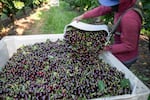
FILE - A worker dumps harvested cherries in collection bin at a cherry orchard in Wasco County, Ore., July 2, 2025.
Morgan Barnaby / OPB
Earlier this month, the U.S. Department of Agriculture announced it will provide $12 billion in financial aid to farmers hit with economic challenges caused by low crop prices and the administration’s ongoing international trade disputes.
The new Farmer Bridge Assistance program will provide a one-time payment exclusively to row-crop farmers who grow commodities such as corn, soybeans, wheat and oats. Much of the $11 billion allocated for those payments will likely make its way to Midwest soybean farmers, who were hit hard after China stopped buying American soybeans in response to U.S. tariffs.
The remaining $1 billion will be directed toward “specialty crops” growers — producers of fruits, vegetables and nuts. Oregon and Washington alone produce over 200 different varieties of crops like apples, pears, cherries, hops and potatoes.
And yet Northwest specialty crop growers are dealing with much of the same economic fallout as farmers across the country, including low crop prices and high fertilizer and equipment costs, along with the added strain of higher labor costs.
It hasn’t been a good year, said Lesley Tamura, chair of the Columbia Gorge Fruit Growers and a pear grower in Hood River.
“We’re all struggling in different ways,” Tamura said.
This year, not only was there a glut in cherries and pears during harvest, but prices at the grocery store were high too.
There was also a brief labor shortage. Earlier this summer, the Trump administration’s aggressive immigration enforcement kept many migrant farmworkers in California, who usually follow the cherry harvest season, from making their way north to Oregon and Washington. Some fruit was left to rot in the field.
The federal government’s trade feud with overseas buyers didn’t help either, Tamura said.
“The domestic market can only take so much,” she said, “This country can only eat so much of the food we grow. It’s got to go to other places for us to actually get paid for all of the crop.”
It’s not clear how exactly the Farmer Bridge Assistance program will work for specialty crop growers.
Details about when or how they might receive payment are still “under development,” according to a press release from the USDA. Row-crop producers, such as wheat farmers, will have to apply for the program. Payment limits will be $155,000 per farm and will begin to be distributed by February of next year.
But even if some money makes its way to growers, Lesley said, they’re not thinking it will save them from their broader challenges — although she appreciates all the help they could get.
“You can’t set policies that work against the agriculture industry and then come in with a one-time bailout assistance program, whatever you wanna call it. It doesn’t address the larger problem,” she said. “If policies don’t change, then we’re right back to square one, facing the exact same issues not very long down the road.”
On Dec. 19, U.S. Rep. Andrea Salinas, a Democrat from Oregon’s 6th Congressional District and a member of the House Agriculture Committee, sent a letter to USDA Secretary Brooke Rollins.
The letter claimed the agency is choosing winners and losers because of its lack of financial support for all farmers, such as specialty crop growers.
“The remaining $1 billion that may or may not go toward specialty crops, coupled with the lack of clarity surrounding eligibility, distribution, and timing, falls far short of the relief these farmers need,” read the letter. “This level of uncertainty and the disproportionate allocation itself are unacceptable for an industry already under significant strain.”
Oregon U.S. Sen. Ron Wyden called the bailout unavoidable.
“Now, the Trump Administration is using U.S. tax dollars to provide a bailout to farmers to fix the President’s mistakes,” Wyden said in a statement. “Unfortunately, for many family farms, it’s too late. Farmers are the latest to suffer at the hands of the Trump families-lose-and-billionaires-win agenda.”
The Trump administration, for its part, has blamed former President Joe Biden for the challenges farmers face today.