Subscribe to OPB’s First Look to receive Northwest news in your inbox six days a week.
Good morning, Northwest.
Beaverton’s annual Kwanzaa celebration is marking its fifth year — and it’s grown tremendously in that time.
OPB’s Saskia Hatvany leads off today’s newsletter with photos and stories from events over the weekend.
In other news this morning, a review led by Oregon Health & Science University shows some cannabis products may help in reducing chronic pain.
And scientists make progress in the study of sea star wasting.
Here’s your First Look at Monday’s news.
—Bradley W. Parks

African dance and drumming ensemble Nii Ardey and Ekomé perform at the annual Kwanzaa celebration at Tualatin Hills Athletic Center in Beaverton, Ore., on Saturday, Dec. 27, 2025.
Saskia Hatvany / OPB
Beaverton Kwanzaa celebrates 5th year
The sound of drums, dancing and bouncing basketballs filled the gymnasium of Tualatin Hills Athletic Center in Beaverton on Saturday, where the annual Community Kwanzaa Celebration took place for the fifth year in a row.
The event is held by the Beaverton Black People’s Union and began as a small gathering out of the organization’s offices in 2021.
This year’s event featured Kwanzaa storytelling, performances from local musicians, a line dancing tutorial and storytelling. The celebration took place on the second day of the seven-day Kwanzaa celebration, which honors the principle of self-determination. (Saskia Hatvany)
✉️ Are you enjoying First Look? Forward this email your friends.
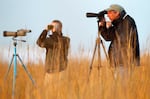
FILE - In this Dec. 22, 2010, file photo, Chris Brantley, right, of Mandiville, La., and Hans Holbrook, of LaPlace, La., look though monoculars for birds during the National Audubon Society's annual Christmas bird count on the Gulf Coast in Grand Isle, La.
Sean Gardner / AP
3 things to know this morning
- A systematic review, led by the Oregon Health & Science University, of studies evaluating cannabis as a pain treatment concluded that some cannabis products do likely work to reduce chronic pain a little bit. (Amelia Templeton)
- Small groups across Oregon are taking part in the National Audubon Society’s annual Christmas Bird Count, an increasingly popular nationwide event that continues through Jan. 5. (Bryce Dole)
- As the year comes to a close, Amy Lewin takes the helm at the Oregon Arts Commission and the Oregon Cultural Trust as it celebrates 50 years of the Percent for Art in Public Places Program. (Jacob Pander)

‘At Work With’ an Oaks Park ride operator, a traffic flagger and a rancher
In today’s episode, we bring you along to a day on the job with a ride inspector-operator at Oaks Amusement Park, a traffic control supervisor on construction sites and a rancher in Eastern Oregon’s Baker County. (Malya Fass, Lillian Karabaic and Jenn Chávez)
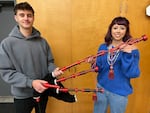
Students Timothy Taylor and Josephine Vorhauer pose with a set of 3D printed bagpipes at Weston-McEwen High School in Athena, Ore.
Photo courtesy of the Athena-Weston School District
Headlines from around the Northwest
- Eastern Oregon school district finds a new dimension to the bagpipes (Antonio Sierra)
- Mongolian scientists are studying the Klamath River for insights into the cost of dams (Justin Higginbottom)
- ODOT expects an increase in uncertified mover cases as new rules go into effect (Zac Ziegler)
- After the holidays, Eugene-area Gleaners keep neighbors connected through year-round food sharing (Kendra Schertell)
Listen in on OPB’s daily conversation
“Think Out Loud” airs at noon and 8 p.m. weekdays on OPB Radio, opb.org and the OPB News app. Today’s planned topics (subject to change):
- Inside ICE detention in Tacoma
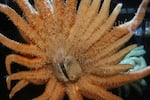
A sunflower sea star eats a clam inside its habitat at the Oregon Coast Aquarium in Newport.
Courtesy Oregon Coast Aquarium
2025: The year of the starfish (and the Pacific Northwest scientists trying to save them)
This year has been a banner year for scientists in the Pacific Northwest working to save sea stars from a mysterious wasting disease.
Research groups from several universities and institutes have been tackling the problem, each looking for ways to help these important apex predators recover. They’ve found success on many fronts.
The work to save sea stars is ultimately an effort to save coastal kelp forest ecosystems. These habitats have been in decline in many areas, in part, because sea stars are major predators of sea urchins, which eat kelp.
Without sea stars to help keep populations in check, urchin populations have exploded, leaving urchin barrens in their wake. (Jes Burns)
Subscribe to OPB’s First Look to receive Northwest news in your inbox six days a week.