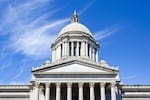
The Washington state Capitol on April 18, 2025.
Jacquelyn Jimenez Romero / Washington State Standard
Tax hikes on big business and rental cars. Unemployment benefits for workers on strike.
Those are just a few of the changes to state law taking effect in Washington on New Year’s Day.
Some bills passed in 2025 became law earlier in the year, while others will take years to go into effect. The next legislative session, lasting 60 days, begins Jan. 12.
Here’s a look at some of the new laws on the books starting Thursday.
Unemployment for striking workers
One of the most contentious laws legislative Democrats pushed through this year gives workers on strike access to state unemployment benefits.
After tense negotiations, lawmakers settled on giving striking workers up to six weeks of unemployment insurance, which is typically available for up to 26 weeks. The law also extends to employees forced off the job due to an employer-initiated lockout.
Workers are eligible for unemployment insurance starting two to three weeks after the strike launches. If it doesn’t last that long, they won’t get benefits. And if the strike ends up being barred under state or federal law, they’ll have to repay them.
Business groups and Republicans worry the policy will incentivize strikes, leading to higher business costs.
The law is set to expire at the end of 2035. New York and New Jersey have similar statutes.
Each year, Washington’s Employment Security Department must file a report on the prevalence of these strikes and their effect on the state’s unemployment insurance trust fund, which is funded by a tax on employers. In a few years, the fund could drop below a threshold that triggers an additional tax on businesses to keep the account healthy, according to projections.
Big business surcharge
To fill an operating budget shortfall some estimated as high as $16 billion, lawmakers approved a slew of new taxes and fees, largely focused on businesses.
One imposes an additional business and occupation tax on Washington companies with over $250 million in taxable income. The 0.5% tax is on income over that $250 million threshold. This surcharge is set to expire at the end of 2029.
Starting in fiscal year 2027, this is expected to raise $550 million per year for the state.
Legislators also made changes to the state’s tax on large technology companies. This “advanced computing surcharge” applies to businesses with worldwide gross revenue in excess of $25 billion. Until now, the tax those companies had to pay was limited to $9 million per year and the rate was 1.22%.
This year, the state raised the rate to 7.5% and upped the cap to $75 million, starting Jan. 1. The proceeds go toward higher education programs. This is predicted to bring in $394 million next fiscal year.
Lawmakers considered uncapping the tax entirely, but that idea didn’t have legs this year.
Tax preferences
Another part of this year’s tax package was repealing a number of tax preferences.
They include a tax exemption on precious metals. That will mean higher prices for coin and gold sales. Bipartisan bills have already sprung up before the 2026 legislative session begins, aiming to restore this tax break.
Other repealed preferences include tax credits for home energy assistance and for businesses that hire employees who provide services to people outside the U.S., as well as a tax deduction for firms that provide testing for public safety employees.
In total, Senate Bill 5794 is expected to raise about $50 million for the current two-year state budget by getting rid of these tax breaks, though taxes on self-storage leasing and rentals that are part of the law won’t take effect until April.
Transportation fees
The state’s transportation budget also faced a shortfall this year amid flagging gas tax revenue and skyrocketing construction costs.
To fill it, lawmakers passed a revenue package — most notably a rare increase in the state’s gas tax, which rose 6 cents in July. Some other tax and fee hikes take effect Jan. 1.
They include increasing truck and passenger vehicle weight fees, rental car taxes, vehicle sales tax, and applying a new luxury vehicle levy.
The combined vehicle weight fee hikes are expected to bring in roughly $450 million over a half-dozen years.
The additional sales tax assessment on cars is going up from 0.3% to 0.5% to raise over $250 million over six years. The state is also imposing an 8% tax on the portion of a luxury vehicle’s sale price over $100,000. This doesn’t apply to commercial vehicles. It’s expected to bring over $200 million into state coffers over six years.
The state’s rental car tax is going up from 5.9% to 11.9% for one year, before dropping down to 9.9% in 2027.
The tire replacement fee is increasing from $1 to $5, raising an estimated $117 million in six years. A fee on RV sales, meant to cover the cost of dealing with abandoned recreational vehicles, is also rising, from $6 to $8, a move expected to bring in $3 million.
The $4.50 registration filing fee for vehicles is going up to $6 and the $5.50 title filing fee is rising to $6.50. Counties will retain most of the proceeds from this increase, but $5 million is set aside for statewide highway safety efforts.
Other transportation fee hikes will go into effect later in 2026.
Nicotine tax
As part of the suite of tax hikes passed this year, the state is beginning to tax certain nicotine products, like Zyn pouches.
Senate Bill 5814 extends Washington’s existing tax on the sale of miscellaneous tobacco products. Lawmakers said the goal was to capture emerging products that are exempt from excise taxes.
This is expected to raise over $55 million in fiscal year 2027, rising to $67 million by fiscal year 2031.
Legislators pondered banning flavored tobacco products, like vapes, and increasing cigarette taxes to curb use, but the Legislature stubbed out that idea. The proposal would have also prohibited the sale of nicotine pouches, like Zyn, to people under age 21.
Plastic bags
For years, the state has worked to reduce waste from single-use plastics. A 2020 law sets out to make plastic shopping bags thicker so they are more reusable. It also raised the price for these bags.
The price has been 8 cents. But starting Jan. 1, it will increase to 12 cents per bag. The fee for paper bags will remain 8 cents.
About 80,000 businesses are estimated to be affected by the policy.
The change comes as a study out of Washington State University raises questions about the efficacy of the state’s approach. It says that while plastic bag use has dropped, the thickness of the bags has meant more overall plastic waste, though state officials note the data backing the report is incomplete.
The state was also set to increase the required thickness of plastic bags from 2.25 mils to 4 mils on Jan. 1, but a bill passed this year punts that shift to 2028.
Right to repair
Washington is joining a growing list of states trying to tear down barriers for consumers who want to repair their electronics rather than buy new ones.
It took years to get “right to repair” legislation like House Bill 1483 across the finish line in the Legislature. The law requires manufacturers to make tools, parts and documentation needed for diagnostics and maintenance available to independent repair businesses. The requirement applies to digital electronics, like computers, cellphones and appliances, that were first sold in Washington after July 1, 2021.
The state attorney general’s office can enforce violations of the new law under the Consumer Protection Act.
Though it had strong bipartisan support, opponents argued the law could harm businesses’ reputations if repairs aren’t completed correctly, and potentially leave users’ personal information unsecured. But some tech giants, including Google and Microsoft, backed the legislation.
Blood type
Starting Jan. 1, Washingtonians can choose to include their blood type on their driver’s license or identification card. They’ll have to provide documentation verifying their blood type.
The state Department of Licensing can charge a $2 administrative fee to include this on an applicant’s ID.
The hope is this will allow first responders to quickly identify what type of blood the person needs in an emergency.
Movie captions
Washington movie theaters will be required to provide closed captioning technology. And those with more than five theaters in the state have to run a certain number of screenings with open captioning on the screen, if available.
Smaller theater chains have to host an open-caption screening if requested.
House Bill 5486 takes effect amid a boom in caption use in home viewings, not just for people who are hard of hearing or deaf.
Washington State Standard is part of States Newsroom, a network of news bureaus supported by grants and a coalition of donors as a 501(c)(3) public charity.
This republished story is part of OPB’s broader effort to ensure that everyone in our region has access to quality journalism that informs, entertains and enriches their lives. To learn more, visit opb.org/partnerships.