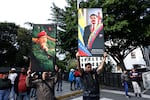
Supporters of Venezuela's current and former president, Nicolas Maduro and the late Hugo Chavez, hold posters with their images in Caracas on Saturday.
Jesus Vargas / Getty Images
President Donald Trump said the U.S. would “run” Venezuela, following a stunning military operation on Caracas early Saturday in which the country’s President, Nicolás Maduro, was captured by U.S. military forces. Trump said Maduro and his wife were being taken to New York to face criminal charges.
Attorney General Pam Bondi said in a statement that the couple, whom she described as “alleged international narco traffickers,” had been indicted in the Southern District of New York.
“They will soon face the full wrath of American justice on American soil in American courts,” she added.
Meanwhile, Trump said Venezuela’s Vice President, Delcy Rodríguez, was “sworn in” as president on Saturday afternoon. Rodríguez, whose location remains unknown, said Saturday that Maduro was her country’s only president, adding Venezuela was ready to defend its natural resources.
Questions are swirling about the legality of the U.S.’ actions in Venezuela and what it means for both countries.
Here’s what we know so far.
The strikes happened in the middle of the night

A person walks near a burnt missile interceptor vehicle at La Carlota air base in Caracas on Saturday.
Juan Barreto / AFP via Getty Images
A series of explosions went off in Venezuela around 2 a.m. local time (1 a.m. ET), according to Gen. Dan Caine, chairman of the Joint Chiefs of Staff.
Vanessa Silva, a journalist in Caracas, told NPR’s Carrie Kahn that she woke up to two explosions at La Carlota military airbase near her home. Silva saw two fires on the runway that were quickly put out, and reported hearing similar detonations and planes flying low over Caracas for at least an hour.
The Venezuelan government says that military targets in the states of Miranda, Aragua and La Guaira were also hit.
Venezuela’s Defense Minister Vladimir Padrino López said strikes also hit civilian neighborhoods, and that a tally of injuries and deaths was underway. Separately, Venezuela’s vice president, Delcy Rodríguez, said both civilians and service members had been killed, but did not give a number.
Trump told Fox and Friends on Saturday morning that there were some U.S. injuries suffered during the operation, but no fatalities. He also said the U.S. was prepared with a second wave of troops that was not ultimately needed.
Trump posted a picture on Truth Social that he said was Maduro aboard the U.S.S. Iwo Jima en route to New York. The photo shows Maduro in a grey tracksuit, handcuffed and blindfolded.
The Trump administration accuses Maduro of running a cartel, stealing U.S. oil
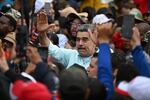
Maduro greets supporters upon his arrival at a rally in Caracas on December 10.
Federico Parra / AFP via Getty Images
The U.S. is one of many Western countries who see Maduro’s government as illegitimate, citing widespread fraud in the 2024 election.
The Trump administration has long accused Maduro of running a criminal narco-trafficking organization called Cartel de los Soles, which experts say is shorthand for a system of corruption rather than a single hierarchical group. The U.S. declared it a foreign terrorist organization in November.
On Saturday, U.S. Attorney General Pam Bondi said Maduro, Flores, and senior Venezuelan face charges related to alleged “drug trafficking and narco-terrorism conspiracies,” according to an unsealed indictment Bondi posted on X.
The indictment alleges that, starting in 1999, Maduro and others partnered with international drug trafficking organizations to transport thousands of tons of cocaine into the United States.
Maduro has repeatedly denied accusations against him and pointed the finger at the U.S., accusing the country of attempting to remove him from power in order to gain access to Venezuela’s vast oil reserves.
“They invented an accusation that the United States knows is as false as that accusation of weapons of mass destruction, which led them to an eternal war,” Maduro said in an interview that aired on state TV on Thursday, adding that he was open to U.S. talks on drug trafficking.
The Trump administration claims that Venezuela “stole” oil and assets from the U.S., after its government nationalized them in the late 1990s, which Maduro’s government denies.
Last month, Trump ordered a blockade against Venezuelan oil and sanctioned tankers. And on Saturday morning, Vice President JD Vance tweeted that Trump had been clear to Maduro: “the drug trafficking must stop, and the stolen oil must be returned to the United States.”
The U.S. has been ramping up pressure on Maduro’s government in recent months, conducting military strikes on dozens of small boats in the Caribbean and Pacific that it claims were transporting drugs toward the U.S. And the U.S. — specifically the CIA— conducted a drone strike last week at a docking area believed to be used by Venezuelan drug cartels, marking its first direct operation on Venezuelan soil since the strikes began in September.
U.S. oil companies are going to head to Venezuela and operate in their oil reserves, Trump said Saturday. The president did not say which oil companies and it is unclear if any U.S. oil companies have made plans to do so.
“We’re going to have our very large United States oil companies, the biggest anywhere in the world, go in, spend billions of dollars, fix the badly broken infrastructure, the oil infrastructure, and start making money for the country,” Trump said. “The biggest beneficiary are going to be the people of Venezuela.”
Who will lead Venezuela down the line?
Despite Trump’s announcement that Vice President Rodríguez has been sworn in, it’s unclear who will take over Maduro’s duties long term.
“I’m not sure there’s going to be a power vacuum, because so many of his cronies apparently were left behind,” Todd Robinson, former acting U.S. ambassador to Venezuela during President Trump’s first term, told NPR.
“There are a lot of questions about what exactly is left behind now, and what more the United States is willing to do to ensure that a potential legitimate person takes over,” Robinson added.
Trump on Saturday did not outline a clear plan on next steps but said that the U.S. will run Venezuela until a “proper transition can take place.”
“We’re going to run the country right. It’s going to be run very judiciously, very fairly,” he said during Saturday’s press conference after Maduro was captured.
It’s also not clear whether Maduro loyalists will stay behind and try to defend the country, or similarly flee.
Other contenders include opposition leaders who are also living outside the country’s borders for their safety.
In a letter posted on social media, Venezuelan opposition leader María Corina Machado, who was recently awarded the Nobel Peace Price, said that Edmundo Gonzalez, who is widely regarded as the legitimate winner of the 2024 Venezuelan elections, should assume the presidency. Gonzalez is currently living in exile in Spain.
“Venezuelans, the HOUR OF FREEDOM has arrived!” she wrote on X, reacting to Maduro’s removal.
As for Machado’s own political ambitions, Trump said it would be “very tough for her to be the leader.”
“She doesn’t have the support within or the respect within the country. She’s a very nice woman, but she doesn’t have the respect,” he said during the press conference.
The president also said Rubio spoke with Rodríguez, who Trump said indicated to the US secretary of state that she is “willing to do what we think is necessary to make Venezuela great again.”
“I think she was quite gracious, but she really doesn’t have a choice,” Trump said.
World reactions are mixed

Venezuelans living in Chile celebrate Maduro's capture in Santiago on Saturday.
Javier Torres / AFP via Getty Images
Leaders — both in the U.S. and across the world — are alternately praising and denouncing the administration’s actions in Venezuela.
Several Democrats in Congress are calling it illegal, saying Trump did not get Congressional authorization ahead of time.
“The Constitution is clear that the U.S. doesn’t engage in military action or war without a vote of Congress except in cases of imminent self-defense," Democratic Sen. Tim Kaine, D-Va, told NPR Sunday.
“Maduro is a disaster and he’s been disastrous for the country. And we could say the same thing, about 150 leaders of countries around the world. But our Constitution is very, very clear that we don’t order servicemen and women into harm’s way, risking their lives unless there is a congressional debate and vote about whether the war is in the national interest here.”
“Trump rejected our Constitutionally required approval process for armed conflict because the Administration knows the American people overwhelmingly reject risks pulling our nation into another war,” Sen. Andy Kim, D-N.J., wrote on X.
But many Congressional Republicans are praising Trump’s actions, including Senate Majority Leader John Thune, R-S.D., who says he expects senators to be briefed when Congress returns from its two-week recess on Monday.
Many Latin American leaders have expressed concern about the attack and what it could mean for stability in the region — including those of Cuba, Chile, Mexico and Columbia, which is mobilizing troops to its border with Venezuela over concerns about an influx of refugees fleeing.
But Argentina’s President Javier Milei, a Trump ally, has publicly praised the operation.
Elsewhere, the reaction has been more cautious.
Kaja Kallas, the vice president of the European Commission, reiterated the EU’s view that “Maduro lacks legitimacy” but also called for restraint and the respect of “principles of international law.” U.K. Prime Minister Keir Starmer said Britain was not involved and expressed his support for upholding international law.