
The U.S. Mint, overseen by Treasury Secretary Scott Bessent (left), rolled out designs for new coins marking the United States' 250th birthday. In some cases, the recommendations from a citizens advisory committee were rejected.
Alex Wong
New coins begin to circulate today, commemorating the 250th anniversary of the United States’ founding. The coins feature pilgrims and early presidents — George Washington, Thomas Jefferson and James Madison. But other coins honoring civil rights figures and suffragettes won’t be minted.
In a break with tradition, the U.S. Mint is also considering issuing a $1 coin with the face of the current president, Donald Trump, a move usually shunned as a symbol of monarchy.
That has sparked pushback from some lawmakers and members of an advisory committee whose design recommendations were overruled.
The special coins were authorized back in 2021 in anticipation of this year’s big semiquincentennial celebration. That launched a lengthy design process that involved lots of focus groups and public outreach.
“In a democracy and a country as vast as this, the only way to do this is exactly the way Congress decided it should be done, which is to form a committee of people from different regions of the country, different perspectives, and let them talk it through,” says Donald Scarinci, who has served on the Citizens Coinage Advisory Committee for two decades.
The committee ultimately recommended five commemorative quarters to roll out during the year. One would feature Frederick Douglass, to mark the abolition of slavery. Another would highlight the 19th Amendment, which gave women the right to vote. A third coin would have shown 6-year-old Ruby Bridges, to celebrate school desegregation and the civil rights movement.
The idea of the series was to honor not only the 250-year-old Declaration of Independence but also some of the battles fought in the centuries that followed to help realize that founding creed.
“We struggled as a nation with civil rights,” Scarinci says. “We struggled as a nation with women’s suffrage. But we persevered and we’ve made, at least in some situations, some progress.”
But when the Trump administration unveiled the new anniversary coins a few weeks ago, the Frederick Douglass, Ruby Bridges and suffragette quarters had been scrapped, replaced by coins featuring pilgrims, the Revolutionary War and the Gettysburg Address.

The first of the new anniversary quarters features the Mayflower Compact. The Treasury secretary rejected designs featuring Frederick Douglass, Ruby Bridges and women's suffrage.
U.S. Mint
“We saw designs we’d never seen before,” says Scarinci, who boycotted the unveiling ceremony.
A spokeswoman for the Mint says the new designs were selected by the Treasury Secretary, but that all had been reviewed at some point either by the citizens advisory committee or the Commission of Fine Arts.
The Mint has also floated the idea of marking the nation’s 250th birthday with an unprecedented $1 coin featuring Trump’s likeness.
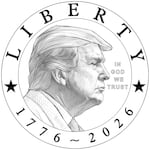
The U.S. Mint has proposed issuing a commemorative coin featuring President Trump. That would be a break from tradition in the U.S., which has generally resisted putting living presidents on money.
U.S. Mint
“It’s an absolute break from tradition,” says Douglas Mudd, curator and director of the Money Museum, run by the American Numismatic Association. “This would be a first to have a sitting president on a coin that’s intended for circulation.”
George Washington’s face didn’t appear on a coin until 1932, more than a century after his death. The nation’s first president was strongly opposed to that kind of personal aggrandizement.
“He expressly said, I, George Washington, will not have my portrait on United States coins. We are done with kings,” Scarinci says. “And for 250 years, around the world, the only nations that placed images of their rulers on coins are monarchs and dictatorships.”
Nine Democratic senators have written to the Treasury secretary, urging him to reject the Trump coin and avoid the appearance of a “cult of personality.”
“This is not just a coin,” Scarinci says. “It is American history that will last for an eternity. These coins that we produce reflect the values of a nation.”