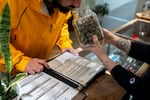
A customer smells a strain of cannabis at Bridge City Collective in Portland, Ore., on Jan. 6, 2026.
Eli Imadali / OPB
Oregon’s cannabis industry continues to see falling prices amid rising production and stagnant demand. The latest numbers from the state on the cannabis industry come as the federal government looks to make it marginally easier for marijuana businesses to operate.
For the last two years the state’s retail cannabis industry has contended with some of the lowest prices ever seen for flower at less than $4 per gram, according to the Oregon Liquor and Cannabis Commission. In December, the median price per gram sat at a measly $3.33.
In 2025, overall sales declined by 3.5% for a total of $925 million, according to the OLCC. In 2025, Oregon growers harvested more than 13 million pounds — up from just over 12 million pounds the previous year.
Industry experts largely blame low retail prices, not lack of demand, for the falling sales numbers. And they expect low retail prices to persist through 2026, mostly thanks to record setting production for the last cannabis season.
“I think it’s going to continue for some time because we had such a massive harvest in October, which is historically the big Oregon outdoor cannabis harvest month,” Vince Sliwoski, a Portland business attorney specializing in cannabis, told OPB. “It was the largest ever recorded, and I don’t think you’ll see prices increase at all any time in the near future. In fact, they may keep coming down.”
Cannabis sales skyrocketed during the depths of the pandemic, fueled by stimulus checks and Covid lockdowns. OLCC data shows sales hit $1.1 billion in 2020 and $1.2 billion in 2021. But since 2022, sales have fallen short of $1 billion.
“When the world went back to work, and everyone started spending their money like they used to, there was a huge amount of whiplash,” David Alport, craft cannabis farmer and owner of Bridge City Collective retail stores in Portland, said. “The demand went back to where it was before (Covid), and there was a massive amount of oversupply.”
Alport’s two dispensaries have been open for more than 10 years. He was also one of the first licensed growers in the state, and continues to cultivate small batches of cannabis flower to sell on the wholesale market.
Covid was a boon for Oregon’s industry, he said, but now there’s a huge correction taking place.
“That’s forced price compression,” Alport said. “It’s forced everybody to lose money across the supply chain. And now we’re trying to get through that. The reality is, there’s way too many stores, there’s way too much supply, and so it’s a matter of the market hopefully working itself out.”
Alport said his cannabis farm operated at a loss for the entirety of 2025. On the retail side, he’s had to cut staffing hours at his dispensaries and cut costs wherever possible to stay afloat. For the self-described marijuana advocate, the struggle is worth it — but Alport acknowledges how tough it is for small shops to keep their doors open.
Some of the headwinds facing Oregon’s cannabis businesses are normal for a young industry. However, marijuana’s inconsistent legal status between states, and its federal status as an illegal substance, create headaches absent in other sectors of the economy.

A budtender puts out cannabis products at Bridge City Collective in Portland, Ore., on Jan. 6, 2026.
Eli Imadali / OPB
“One classic example is we don’t have access to normal business loans,” Jesse Bontecou, executive director of the trade group Cannabis Industry Alliance of Oregon, said.
While other retailers may take out a loan to build a new facility, start a new marketing campaign, or fund another strategy to grow business, cannabis retailers are barred from doing so. Bontecou said that makes it challenging for cannabis businesses to expand, innovate or develop efficiencies — all things companies look to do when faced with a competitive market characterized by low prices and oversupply.
Still, Bontecou said the industry has made huge strides since 2014 when Oregon legalized marijuana for consumption and sales. He points to the more than $1.3 billion in tax revenue the industry has sent to the state since legalization, and the more than 6,000 Oregonians working full-time in the marijuana industry.

Price tags are displayed for a gram of different cannabis strains at Bridge City Collective in Portland, Ore., on Jan. 6, 2026.
Eli Imadali / OPB
But Bontecou and other industry advocates say more needs to be done, both at the state and federal level, to ease the regulatory burden on retailers and suppliers.
Cannabis attorney Sliwoski said federal changes could be coming in the next year or two that will ease some tax burdens for cannabis companies. In December, President Donald Trump ordered the Department of Justice to consider rescheduling marijuana as a less harmful substance. The move could allow companies to make standard business deductions when filing taxes, something they’re currently barred from doing.
“They’ll be able to deduct all sorts of things, and it should have a very helpful impact on margins almost overnight,” Sliwoski said, but cautions that the move is still up in the air. Even if marijuana is rescheduled, it may not go into effect for the 2026 tax year.
Meanwhile, suppliers, retailers and growers hope to weather the tough economic times. Gabe Patron Lee is with the cannabis-infused gummies company Wyld. The business sells products in many legal markets, but Lee said Oregon is home. It’s where Wyld is headquartered, and all the founders are Oregonians.
“For us, we are really hopeful that this market continues to thrive — but we’ve seen the sales numbers,” Lee said. “They’ve gone down year over year for the last couple of years, and it’s a reflection of a more difficult industry to compete in, and those margins get slimmer and slimmer. Ultimately, any sort of sign of progress at the federal level is a breath of fresh air for everybody that’s operating within the regulated industry.”

A dispensary sign glows in the windows of Bridge City Collective in Portland, Ore., on Jan. 6, 2026.
Eli Imadali / OPB