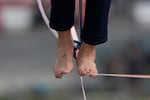
FILE - A French slackliner balances on a 230-foot slackline in Paris in 2021. The little-known extreme sport, also called highlining, has grown in popularity, including in the U.S. On Jan. 2, 2026, four Oregonians died after the helicopter they were in likely collided with a slackline strung across a canyon in Arizona, according to local authorities. The NTSB is investigating.
Francois Mori / AP
A recreational tightrope strung across a remote Arizona canyon likely triggered a helicopter crash that killed four Oregonians from the same family. The tragedy has drawn scrutiny of a little-known extreme sport with scant oversight, even as participants rig longer slacklines across public lands, heightening the risk to aircraft.
An eyewitness and local law enforcement have said the helicopter appeared to collide with a slackline hanging 600 feet in the air south of Superior, Arizona on Jan. 2.
Everyone on board died, including 59-year-old pilot David McCarty and his three nieces, Rachel McCarty, 23, Faith McCarty, 21, and Katelyn Heideman, 21.
The slackline reportedly spanned more than half a mile. No one was balancing on it when the helicopter went down, according to a statement from the International Slacklining Association, which also said the line had aviation markers. Who installed the rigging isn’t clear. Public records show they warned pilots of the tightrope hazard through a Federal Aviation Administration system.
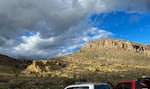
An undated image posted to the social media account for Pinal County Sheriff’s Office in Arizona near Telegraph Canyon, south of the town of Superior, where a helicopter crash took the lives of four Oregonians, Jan. 2, 2026.
Pinal County Sheriff’s Office via X
But that system — the FAA Notice to Airmen or NOTAM — “is broken and has been for a long while,” one aviator close to the tragedy told thousands of slackline enthusiasts this week.
“I feel like had there been an open channel between slackliners and local pilots there may have been a chance four people would still be alive,” wrote DJ Vegh, a manager of Pegasus Airpark, where the helicopter took off before the fatal crash.
“The pilot was a neighbor and a friend,” Vegh wrote in a Jan. 6 post to the Facebook group, SlackChat. “Please help me make this tragic event a catalyst for change that benefits slackliners and pilots and helps my friend and his nieces’ deaths not be for nothing.”
More unofficial communication is needed, he said, because the FAA’s flight safety warning system buries safety issues like obstacles “within hundreds of nearly meaningless” notices.
The FAA did not immediately respond to requests for comment Tuesday.
The National Transportation Safety Board expects to have a preliminary report detailing the facts of the crash within 30 days of the incident.
Vegh’s post went out to nearly 26,000 members of an online forum for a sport that’s gained popularity on public land over the last decade. Its message resonated with Corbin Kunst of Bend.

Corbin Kunst of Bend, walking a slackline at Rocky Gulch in Central Oregon in 2020.
Courtesy of Kyle Rhodes
For more than a decade, the 34-year-old has been honing his skills at walking calmly across high-elevation slacklines, known as highlining. Central Oregon’s Smith Rock is an epicenter for the sport globally, he said, with around 30 highline routes. Participants usually work with a team, using specialized equipment to install rigging before walking across webbed ropes while wearing harnesses that catch them if they fall.
“The appeal of it is that your body knows how to do it, you know you’re safe, but the mind still kind of tricks you, like, ‘Oh wait, I’m high up.’” he said. “To overcome that fear is part of the magic. You can turn that fear into enjoyment.”
Kunst is also a pilot and operations manager for an experimental aircraft company.
“I’m a pilot and I know what it’s like,” he said, “And I walk really long lines and I’ve kind of seen the sport get really transformed.”
A few years ago, a slackline as long as the one likely involved in the Arizona helicopter crash would have been “unfathomable,” Kunst said.
But as interest in slacklining has grown, and more people install rigging to support longer lines, the potential for collisions with aircraft has increased, he said.
“At any given time, somewhere around the world, there’s multiple kilometer-long highlines now, and that’s only going to continue to grow,” Kunst said.
He agreed with Vegh that the NOTAM system for alerting pilots of danger is “quite broken.”

Corbin Kunst of Bend, walking a slackline in Squamish, British Columbia in 2018.
Courtesy of Kyle Rhodes
When pilots look at the FAA airspace notices before taking off, Kunst said, “there are so many garbage NOTAMs that there’s hundreds or even thousands of them for a given area, there’s no way you can look at all of them.”
Kunst said that outside of the NOTAM system, he wasn’t aware of federal regulations governing slacklines and aircraft. He said it’s standard for high-elevation slacklines to run flags and lights alongside the webbing someone actually walks on. He encouraged fellow highliners to be proactive in using flight tracking apps and websites, have radios that can reach aircraft, know the common traffic advisories for an area, “and if you see an aircraft, try and talk to them in real time,” he said.
“We are a very safety oriented community,” Kunst said of his fellow highliners, “just like aviation.”
After the Arizona crash, people in Vegh’s community were angry with slackliners, the airport manager said in an interview, but he’s focused on opening up communication that could prevent another tragedy.
Vegh said the FAA should elevate slackline placements to the status of Temporary Flight Restriction, a designation more easily noticed by pilots.
He said he’s already set up a meeting with the International Slackline Association and is hoping it will lead to more conversations.
“I need to make sure that these people didn’t die for nothing,” Vegh said.
The International Slackline Association’s Thomas Buckingham said in an email that the Arizona crash marks “the first time this has happened in more than 40 years of highlining around the world.”
“Every country around the world has their own standards and safety measures,” he said, “in other words, solutions have to be found specifically for the US.”

FILE - A slackliner on a tightrope in Istanbul, Turkey in 2024. The little-known extreme sport, also called highlining, has grown in popularity, including in the U.S. On Jan. 2, 2026, four Oregonians died after the helicopter they were in likely collided with a slackline strung across a canyon in Arizona, according to local authorities. The NTSB is investigating.
Emrah Gurel / AP
The federal investigation to officially determine the cause of the crash could take a year or more.
“NTSB does not determine or speculate on the cause of an accident during the on-scene phase of the investigation,” according to a statement from the agency.
OPB’s Antonio Sierra contributed to this report.