This story was originally published by The Lund Report, an independent nonprofit health news organization based in Oregon. It is republished with permission. You can reach Joanne Zuhl at joanne@thelundreport.org.
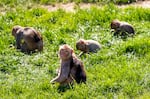
Japanese macaques at OHSU’s Oregon National Primate Research Center in Beaverton, Ore., April 17, 2025.
Kristyna Wentz-Graff / OPB
Oregon Health & Science University officials say closing its primate research center would cost the institution more than $241 million over eight years — and would also cost more than $100 million each year in lost research funding.
The analysis represents the latest development in the high-profile debate over the center. It was developed at the request of state lawmakers,who — in what amounted to a footnote to the state budget — directed the university to study different scenarios if the National Institutes of Health were to reduce funding for the center by 25%. The university retained a consultant to help.
Released this week, the report outlines several scenarios for the Oregon National Primate Research Center’s future, including closing it and relocating its nearly 5,000 Rhesus macaques. Continuing operations with a reduced number of primates would cost $50 million to $70 million annually over eight years, the report concludes.
“Ultimately, our analyses show that both continuing to operate the primate center and closing the primate center are expensive — more so to close it,” according to a statement issued by OHSU leadership. “This is because about 80% of the operating costs are animal care and administration. Therefore, if the science and funding for it were to end abruptly, those costs would remain without revenue to support them.”
The $241 million figure represents the estimated cost over eight years if the university were to immediately move to stop research and operations. It would be contingent on being able to relocate all the primates within 8 years. That figure could climb if it took longer to relocate the animals, according to the report.
A lower cost option, at $118 million over eight years, would be to continue current grant-funded research and phase out operations gradually as the grants expire.
Still another option — retaining the animals and converting the center to a sanctuary — could cost up to $291 million over eight years, according to OHSU.
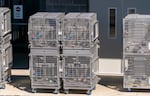
Empty animal cages at OHSU’s Oregon National Primate Research Center in Beaverton, Ore., April 17, 2025.
Kristyna Wentz-Graff / OPB
The closure costs do not include the cost of refunding the federal government for its part-ownership of the land the primate center sits on, as well as the costs of relocating other programs sited on the OHSU West Campus. Those costs would run between $316 million and $583 million, according to the report.
Critics blast report
Rep. David Gomberg, D-Otis, — who has called for greater oversight and ultimately closure of the center — said he wrote the legislative directive to learn OHSU’s plans to protect staff, care for primates, and transition their research model, should funding became unsustainable.
That, he told The Lund Report via email, is not what lawmakers received, calling the report a “shameful justification for keeping the primate center in the business of experimenting on monkeys rather than a serious closure proposal.”

Japanese macaques at OHSU’s Oregon National Primate Research Center in Beaverton, Ore., April 17, 2025.
Kristyna Wentz-Graff / OPB
Gomberg said that only six months ago, primate center staff were told to expect “devastating reductions” in research funding, but OHSU is “in denial” and doesn’t address the possible impact of those cuts in the report, or how it might use NIH research dollars to transition the primates to sanctuary environments. He also questioned OHSU’s projection that continuing the research center would cost the University $70 million over the next eight years, but closing will cost even more.
“We need a plan that takes care of workers, refocuses science on more effective, non-animal methods, and deals humanely with 5,000 surplus monkeys,” Gomberg wrote. “It’s hard to take this response seriously as it comes from people who clearly want to continue profiting from experiments on primates. It’s not what the Legislature asked for.”
In May, Gomberg joined Reps. Farah Chaichi and Mark Gamba to introduce legislation to phase out the center’s operations. That bill failed.
Kathy Guillermo, a senior vice president of the People for the Ethical Treatment of Animals, a long-standing opponent to the center, dismissed OHSU’s report as a piece of “nonsense,” in a comment to The Lund Report. She said the report was a “financial fantasy plan in which closing the fiscally-unsound primate center would cost more than building a new hospital for Oregonians.”
Uncertain future for the macaques
The center is one of seven federally funded primate research centers conducting medical experiments in the United States. It has been funded by NIH grants since 1960, and has already been approved for OHSU’s full request of $13.7 million for 2026, according to OHSU.
Financially, the center is operating in the red, which the report calls the result of rising personnel costs and flat federal funding. OHSU reported a loss of $12 million for the center on expenses of $80 million in 2025, according to the report. The center does not receive state general funding and relies on federal grants for most of its income.
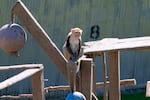
Japanese macaques at OHSU’s Oregon National Primate Research Center in Beaverton, Ore., April 17, 2025.
Kristyna Wentz-Graff / OPB
OHSU officials have repeatedly defended the center, located in Washington County, as essential to medical research and integral to OHSU’s work. Supporters hail the center’s role in medical advancements for humans, while animal rights activists and medical ethicists have called the treatment of the animals “torture,” and say the research could be conducted in better ways. The center has been the subject of complaints and federal fines over its care of the primates, including injuries and death.
Animal rights activists’ longstanding campaign to close the center reached a fever pitch after OHSU announced plans to acquire Legacy Health. That merger was scrapped, but not before Gov. Tina Kotek said OHSU should shut down the center.
If the center closes, the future of the more than 4,700 macaques in its care would depend on who is willing to take them. The report outlines possible scenarios, including selling them to zoos, universities or sanctuaries, but also to other research centers and even private industry, where they could continue to be used in medical experiments. The large number of primates would require multiple options for placement, according to the report, and could take 10 years or more.
The center employs 267 people full-time, the vast majority represented by AFSCME or the Research Workers Union, an AFSCME affiliate. Most of the people there manage animal care with specialized skills that won’t easily be transferred to other positions at OHSU, according to the report.
Jennie Olson, president of the AFSCME Local 328, said in a statement to The Lund Report that the center produced life-saving research, including breakthroughs in AIDS and muscular dystrophy, among others, and should be funded. If the center were to lose federal funding, the best option would be to convert it into a sanctuary where workers would continue to care for the animals, Olsen said.
OHSU’s board of directors will review the report in a meeting later this month, according to the university.
This republished story is part of OPB’s broader effort to ensure that everyone in our region has access to quality journalism that informs, entertains and enriches their lives. To learn more, visit opb.org/partnerships.