
Governor Tina Kotek sits for an interview with OPB reporter Monica Samayoa in the State Library of Oregon, Salem, Ore., Jan. 29, 2025.
Anna Lueck for OPB
After spending much of the summer struggling to push through a transportation funding bill, Gov. Tina Kotek wants to send the entire thing to the scrap heap.
The striking pivot comes after a Republican-led campaign successfully waylaid the heart of House Bill 3991: tax increases meant as a stopgap to fund the Oregon Department of Transportation.
As lawmakers prepare to wrestle with a $242 million funding gap at ODOT, Kotek announced Wednesday that she now favors a “redirect, repeal and rebuild” approach.
The “redirect”: passing a bill to free up money within ODOT’s budget that is currently dedicated to specific projects. That money could instead go toward basic road maintenance. State funding for public transit would not be touched.
The “rebuild”: come back to the Legislature in 2027 with a more comprehensive plan for funding ODOT. Kotek vowed to lead work on that effort this year.
And, potentially the most controversial, the “repeal”: asking Democratic lawmakers to pass a bill scrapping the entirety of the bill she muscled through in a special session over the summer. That move would render moot a vote, scheduled for November, on whether tax increases in the bill can move forward. But it would also do away with other changes in the bill, like a long-sought shift in how freight haulers are taxed.
“These decisions won’t be easy,” Kotek said in a statement after unveiling her plans at a transportation event in Portland. “There will be tradeoffs and consequences. Hundreds of people will be laid off this spring if we are not successful. Giving up is not an option.”
Kotek’s approach is in line with what unions representing ODOT workers are advocating. Service Employees International Union Local 503, a long-time political ally of the governor, told OPB this week that redirecting spending away from projects and repealing HB 3991 were in its members’ interests.
But the proposal is certain to catch flak from some who supported Kotek’s bill. The Oregon Trucking Associations, the state’s freight industry lobby, has long advocated simplifying the complex system of weight-mile taxes its members are liable for. The organization supported House Bill 3991 because it contained those changes, and did not take an active role in referring pieces of the bill to voters.
“When this package was put together, it was the only piece that wasn’t controversial,” OTA President Jana Jarvis told OPB this week, saying her organization would oppose the repeal effort.
Also against the idea: state Rep. Ed Diehl, a Republican from Scio who was a leader of the campaign that delayed tax hikes within the bill by collecting hundreds of thousands of signatures from across the state.
“They’re just trying to escape responsibility in the election,” said Diehl, adding that an unpopular suite of tax hikes — including increases to the state’s gas tax, and vehicle registration and titling fees — could sour Oregonians on Kotek and other Democrats on the ballot. “I want the voters to weigh in.”
But Kotek argued Wednesday it is irresponsible to take on new costs spurred by HB 3991 without the new money provided by tax increases. Those costs include creating a new system for charging drivers of electric vehicles and hybrids for the miles they drive.
“Leaving the law in place forces ODOT to bear implementation costs without new resources, prolongs instability, and delays the real conversation we need to have about long-term solutions,“ Kotek told those gathered for the Oregon Transportation Forum in Portland, according to prepared remarks.
The new development is the latest twist in a legislative boondoggle that has dominated lawmakers’ attention for more than a year.
Democrats came into last year’s session determined to shift Oregon’s paradigm for funding roads. They pledged to find new money for long-promised highway projects, but also to steer long-term funding toward nuts-and-bolts maintenance.
But the enterprise was plagued by mismanagement by Democrats, who hold a supermajority in both chambers of the Legislature and hold the governor’s office.
Democratic leaders did not unveil a bill until the final weeks of session, and then could not find enough of their own members — or any Republicans — to support the proposal.
When the session ended without meaningful action, Kotek vowed to pass a stopgap bill over the summer. She did so only after a shambolic special session that saw major delays and cost taxpayers $270,000. The governor now wants to scrap the product of that effort.
In total, HB 3991 was expected to raise more than $4 billion in its first decade. The majority of that money came from a 6-cent increase to the state’s 40-cent-per-gallon gas tax, and big increases to the fees drivers would pay to register and title their vehicles. Lawmakers also approved a temporary doubling of a payroll tax that subsidizes public transit.
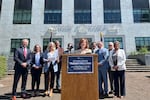
House Minority Leader Christine Drazan, R-Canby, and other GOP lawmakers address reporters in front of Oregon Department of Transportation headquarters.
Dirk VanderHart / OPB
But none of those took effect as planned. A campaign led by Diehl and Senate Minority Leader Bruce Starr, R-Dundee, quickly collected enough signatures to refer the new taxes to voters. They cannot be implemented until after that November 2026 vote.
The proposal to redirect ODOT spending away from projects could come with drawbacks. The state has set aside hundreds of millions of dollars to complete long-planned highway megaprojects, including an expansion of Interstate 5 through Portland’s Rose Quarter and a replacement of the Interstate Bridge between Oregon and Washington.
While opponents of those projects have called on Oregon to spend money on other priorities, advocates argue that they will only become more expensive if they’re delayed. The state could also lose out on federal matching funds if it pulls money from projects to pay for basic road maintenance.
Republicans, like state Sen. Christine Drazan of Canby, were quick to mock the gubernatorial pivot.
Drazan, who hopes to win her party’s nomination for governor in May, shared a meme on social media criticizing Kotek’s reversal and implying the governor was copying her party’s talking points.
“Sound familiar?” she wrote. “It’s because Republicans introduced the Transportation Stabilization Plan nearly a year ago which would have avoided these massive tax hikes and redirected existing funds to keep our roads safe.”
Diehl and other Republicans have long said they want to redirect ODOT spending from areas they disagree with, and Diehl said he agrees in principle with that notion. But Kotek reiterated Wednesday that she opposes a major feature of the Republican plan: gutting state spending on public transit.
“We cannot gut transit districts by redirecting existing payroll tax revenue,” Kotek said in her prepared remarks to the transportation forum. “That would devastate service and harm those who can least afford it.”
It’s not currently clear how much money lawmakers will be required to identify if they want to avert layoffs at ODOT. While the agency says it has a $242 million hole in its current two-year budget, it also has more than 600 vacant full-time positions, following a rush of departures since July.