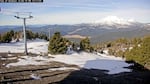
FILE - A screenshot from a Mt. Bachelor webcam on Dec. 11, 2025, shows minimal snow. Oregon’s Mt. Bachelor, Timberline Lodge, and Mt. Ashland are still awaiting enough snow to open lifts.
Courtesy of Mt. Bachelor website
Nearly all of Oregon has less than 50% of its normal snowpack, with western and central Oregon having percentages largely in the 30s.
That’s according to the latest data from the U.S. Department of Agriculture.
The lack of snow comes as the area sees a year that is typical for total precipitation, with precipitation across the state falling above 80% of average this water year.
The reason may be another weather phenomenon: unusually warm temperatures.
“When we’re really wanting to receive and retain that snowpack, above-normal temperatures are not only going to allow precipitation to fall as rain rather than snow, but any snow that does fall is likely going to melt out relatively soon,” said Oregon Water Resources Department Hydrologist Cameron Greenwood.
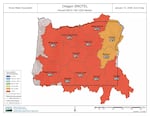
Nearly all of Oregon has less than 50% of its normal snowpack by mid-January of 2025.
Snapshot of USDA Snotel map / KLCC
Average temperatures across most of Oregon were above normal by five degrees or more in December, according to a recent drought report from OWRD.
That report noted areas of abnormally dry conditions in parts of Lane, Deschutes and Douglas counties and an area of “moderate drought” in Douglas County.
Greenwood said it is “fair to assume” that there would not be any drought in western Oregon this time of year given historical trends, but there is precedent for times when the state still had spots of drought through the winter and spring.
He said that there is still time for snowpack to increase, which would make conditions less dire for river flows this spring and summer.
Zac Ziegler is a reporter with KLCC. This story comes to you from the Northwest News Network, a collaboration between public media organizations in Oregon and Washington.
It is part of OPB’s broader effort to ensure that everyone in our region has access to quality journalism that informs, entertains and enriches their lives. To learn more, visit our journalism partnerships page.