Slackliners whose valley-stretching cable led to a deadly helicopter crash in Arizona earlier this month said they saw the aircraft fly into their line, pitch upward and slowly reverse — before crashing hundreds of feet.
A second helicopter almost made the same fatal mistake an hour later, witnesses told investigators with the National Transportation Safety Board, but managed to dip under a separate line by about 10 feet.
Those are among the few, new details about the Jan. 2 crash that killed four members of an Oregon family near Superior, Arizona. The NTSB released their preliminary investigation Friday.
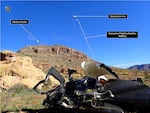
Images from the preliminary report show the crashed fuselage and remnants of the slackline.
NTSB report
The five-page report is a first look into the crash investigation, which drew headlines across the country and raised questions about aviation safety protocols and the niche extreme sport involved. The safety board’s probe is not a criminal investigation, officials told OPB.
The crash killed 59-year-old pilot David McCarty and his three nieces: Rachel McCarty, 23; Faith McCarty, 21; and Katelyn Heideman, 21. McCarty owned Columbia Basin Helicopters, based in La Grande, and was flying an MD-brand helicopter.
Slacklining involves people walking narrow cables from one point to another. Its “highlining” subculture ratchets up the adrenaline by establishing slacklines at dizzying elevations.
According to the report, the slackline first appeared on Dec. 26. It stretched about three-quarters of a mile between two high points, 600-feet above the valley floor at its highest point. The line was made of a synthetic fiber webbing just a couple inches thick.
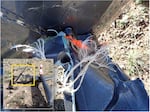
Pieces of the slackline webbing wrapped around pieces of the wrecked helicopter.
NTSB Report
The slackliners, who are not identified in the report, had also hooked up a “signalization line” that held up windsocks and 10 LED lights. They also set up backup lines between the anchor points.
Weather conditions had been spotty, the report said. On Dec. 30, the slackliners took the line down because of forecasted rain and high winds. By Jan. 2, the morning of the crash, the weather had improved and the slackliners once again began to re-string the mainline and backup line.
The line had been drawn partway up when McCarty’s helicopter came into view, one slackliner told investigators. It flew “toward the set of lines suspended between the anchors,” NTSB investigator Kathryn Whitaker wrote.
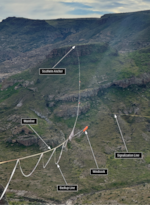
The slackline, strung across the valley, was 600 feet off the ground at its highest point.
NTSB report
“The witness reported that the helicopter impacted the lines and appeared to slow or even reverse direction,” Whitaker wrote. “The helicopter pitched nose up and yawned to the right.”
The report noted that at least some of the helicopter’s tail — called a “tailboom” in the report — separated from the fuselage, the central body of the aircraft. The fuselage “became inverted” and then crashed.
“The tailboom and fuselage subsequently impacted terrain about 150 and 350 feet from the lines,” Whitaker wrote.
Investigators noted the slackline’s webbing was found wrapped around parts of the helicopter at the crash site. The helicopter was left with a “weave pattern” on the paint and marks on its rotor blades from the twisting nylon lines.
A second helicopter took a similar flight over the valley about an hour later, first responders told investigators. While it neared the signalization line, it missed it by about 10 feet, the report said.
According to NTSB officials, criminal investigations are generally handled by the Federal Aviation Administration or local law enforcement. FAA officials declined to comment Friday and the Pinal County Sheriff’s Office did not immediately respond to questions.
The preliminary report is not conclusive. It does state, as OPB previously reported, that the FAA had published information about the slackline in a database pilots check before taking off. The “Notice to Airmen,” or NOTAM, noted the slackline would be “active between Dec. 26, 2025, and January 6, 2026.”