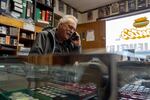
Monte Mensing, owner of Monte’s Coins and More, laughs as he talks with a customer on the phone in the Stayton, Ore., shop on Jan. 14, 2026.
Eli Imadali / OPB
If you’ve been paying in cash recently, you might have noticed the loose change in your pocket is starting to feel a little bit different.
The pennies aren’t there.
In November, the U.S. Treasury stopped minting pennies after more than 230 years because the coins cost more than three times their own value to make.
A nationwide penny shortage followed, leading many of the people running the Northwest’s cash registers to round down change to the nearest 5 cents. In Clark County, officials are asking people who pay in cash at government agencies to pay exact change.

Old coins and other items, including a cent at center, fill the back room at Monte’s Coins and More in Stayton, Ore., on Jan. 14, 2026.
Eli Imadali / OPB
The end of the penny is also a nostalgic goodbye for longtime coin collectors. It was a rare penny that started Monte Mensing’s love for coins.
Decades later, Mensing is a cornerstone of the Northwest’s coin collecting communities, and leads multiple coin clubs throughout the region that celebrates their history. He owns Monte’s Coins and More in Stayton, Oregon.
OPB’s “All Things Considered” producer Donald Orr recently paid a visit to Mensing’s coin shop to pour one out to the penny. But as Mensing will tell you, the U.S. has never actually minted a penny.
This conversation has been edited for length and clarity.
Monte Mensing: Well, first off, I’m somewhat of a coin snob. I’ve been doing coins for 57 years. I will tell you the United States has never made a penny.
If you look at the coins in your pocket, you’ll see on the back, they say “One Cent.” So the United States of America, starting in 1793, has made one-cent pieces. Other countries, Great Britain, for example, on theirs it says “One Penny.”
But the United States and Canada make cents, one-cent pieces. So we’re not going to discontinue the penny. We never made them. We’re going to discontinue the cent.
Donald Orr: So, penny for your thoughts — or one cent for your thoughts. Is getting rid of the Lincoln cent a good thing?
Mensing: I believe it is.
But there are literally billions and billions and billions of cents out there in coffee cans and shoe boxes and penny banks. I had lunch today a couple of blocks from here. One of the men at lunch with me said he had a 70 pound box of cents at home that he’s had for years.
And the collectible ones will probably become more collectible. So the cent will be around. It just won’t be used in trade anymore.

A 1955 Doubled Die Obverse Lincoln cent, considered the king of error coins, is shown at Monte’s Coins and More in Stayton, Ore., on Jan. 14, 2026. The text on the date, “Liberty” and “In God We Trust” is doubled due to a production error.
Eli Imadali / OPB
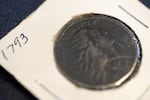


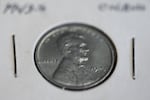
Orr: You’ve brought out some cool coins for us to talk through today. Can you tell me more about them and what makes them significant?
Mensing: I’ve got a Wreath cent here. 1793 was the first year the United States made one-cent coins. This is the large cent type. They made large cents from 1793 to 1857. And this is the first year they made them. 1793, George Washington lived until 1799. Prove to me this was never in George Washington’s hand. I can’t say that it was, but you can’t say that it wasn’t.
I’ve got a 1972 doubled die. The most popular is the ‘55 doubled die. Doubled die means it was multi-struck. And if you take a look at the coin, you will see where the “In God We Trust” was doubled. And so it kind of looks blurry where one “In God We Trust” is stamped over the top of another one and the same with the United States of America and so on. It’s considered an error coin.
I also have a 1943 steel cent during World War II, they needed the copper from cents for other uses, military uses.
And I have a slabbed 1909-S VDB. That is the cent that I started talking about. It was the first year of the Lincoln cent in 1909. This particular coin was minted in San Francisco and on the reverse, on the very bottom, it has this very small “VDB” for Victor David Brenner. He was the designer of the Lincoln cent.
Orr: This is the coin that started it all for you.
Mensing: When I was in third grade, so 1968, there was a Weekly Reader article about a cent that was worth $90. It was discussing the 1909-S VDB cent.
So when I read that article about a cent that was worth $90, I thought, “You know what? I’ll find one of those. I’ll sell it and I’ll retire. I’m living on 50 cents a week anyway.”
That was 1968, Klamath Falls, Oregon. And I started doing what today they call roll sorting. I go to the banks, go through rolls, sort out the wheat cents.
I had a relationship with the school lunch lady. At the end of the day, she’d let me go through the change that she took in for lunch.
The young lady that ran the concession stand at the municipal swimming pool in Klamath Falls let me go through the change there, and the people that owned the skating rink.
I developed a relationship with the coin dealer in Klamath Falls, Earl Seibert. He was paying me two cents a piece for wheat cents so I could double my money and I could find sometimes as many as 500 a week.
Well, $5 was a lot of money for a nine year old in 1968. That was a lot of money.
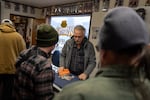
Monte Mensing, owner of Monte’s Coins and More, looks through silver rounds brought in by customers to the Stayton, Ore., shop on Jan. 14, 2026.
Eli Imadali / OPB
Orr: I want to take a moment to mention here, you’ve been in coins for a long time. You also happen to be blind. What’s kept you in the hobby all these years?
Mensing: Well, I started in coins when I was sighted and I did coins for around, I’m going to say 25 years as a sighted person. I accumulated an awful lot of knowledge during that period of time and I am legitimately interested in coins and history — and being blind doesn’t change that interest. I’m still interested.
I now enjoy certain coins vicariously through my sighted assistant. Then I can call up in my catalog, in my brain, a picture of a Mint State 65, 1938-D Buffalo Nickel with the full horn, where you can see the fur on the buffalo’s shoulders and things like that, or the split in the buffalo’s tail. I can remember that.
So the work part, I need the assistance of a sighted person. The enjoyment part, all of the things are still in the brain that were there.
Orr: What brings you the most joy about coins?
Mensing: Well this morning, my 30-month-old granddaughter was here and she is my assistant manager in charge of hospitality. She’s in charge of “Hi’s and Bye-byes” when she’s here. But when she came through the door, she said she was at “Pop’s Shop” to help with coins. Nothing’s going to be better than that.
But I also love it when my assistant says, “Hey Monte, a car pulled up out front, they’re getting in the back seat, they’re getting out a box, it looks heavy.” Because it’s a treasure hunt.
We don’t leave the shop necessarily to go hunt for treasure, but when people bring in boxes, we never know if they’re bringing in a box that weighs 30 pounds and is worth $30, or if they’re bringing in one coin that’s worth $100,000.
To see truly rare, truly amazing coins. For me, I enjoy that.
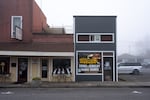
The Monte’s Coins and More neon sign glows on a foggy day in Stayton, Ore., on Jan. 14, 2026.
Eli Imadali / OPB