
Maxim Naumov performs in exhibition after being named to the 2026 U.S. Olympic Figure Skating Team at the Enterprise Center in St. Louis on Jan. 11.
Brian Munoz
Want more Olympics updates? Get our behind-the-scenes newsletter for what it’s like to be at these Games.
At the U.S. Figure Skating Championships in January, almost exactly a year after he lost his parents — who were also his coaches — Max Naumov won a bronze medal and a spot on the Olympic team.
“Fulfilling the dream that we collectively had as a family since I first was on the ice at five years old … It means absolutely everything,” Naumov, now 24, said from nationals in St. Louis. “And I know they’re looking down, smiling, and proud.”
Last January, when Naumov placed fourth at nationals for the third year in a row, he joined his parents, Vadim Naumov and Evgenia Shishkova, for a heart-to-heart in their hotel room in Wichita, Kan. to talk strategy. He remembers not being able to hug his mom. She was sick and did not want him to fall ill so close to his next competition.
“It was a very productive, emotional and just inspiring conversation,” said Naumov. “My dad said that we have to change our mindset, we have to get more consistent in the areas that we talked about and just overall have a resilient attitude to the entire approach of the season.”
That was one of the last times they spoke.
Naumov flew home to Massachusetts after the event ended. His parents — renowned Russian-born pairs skaters who coached at the Skating Club of Boston — stayed a few extra days in Wichita for an invitation-only development camp for promising young skaters and their support systems.
Many of those skaters, relatives and coaches, including Naumov’s parents, were among the 67 people who died on Jan. 29, 2025, when a U.S. Army Black Hawk helicopter collided with an American Airlines regional jet on its landing at the Ronald Reagan Washington National Airport. The tragedy killed 28 members of the tight-knit figure skating community, many of them based in the Boston and D.C. areas.
The loss of the rising skating stars, beloved parent volunteers and longtime coaches is felt acutely at their home rinks and throughout the entire skating world, especially as the anniversary of the crash approaches. It comes just a week before the start of the Winter Olympics, when Naumov’s story — and the sport itself — will come under an even brighter spotlight.

Maxim Naumov holds a photo of his parents while he waits for his scores after competing in the men's short program competition during the 2026 U.S. Figure Skating Championships in St. Louis on Jan. 8. His parents were killed last year when an American Airlines regional jet <a href="https://www.npr.org/series/g-s1-45759/d-c-plane-and-helicopter-crash"target="_blank" >collided with a U.S. Army Blackhawk helicopter</a> over the Potomac River, near Washington, D.C.
Brian Munoz
“They were truly just really good people that we respect, family of choice,” said Doug Zeghibe, the CEO of the Skating Club of Boston, which lost two teenage skaters and their moms, in addition to Naumov’s parents. “And I think we’re at the point now where missing them is turning into: what can we do to honor them and remember them and make sure we carry them forward.”
Many in the skating community told NPR that, a year on, there is a continued focus on honoring the victims’ legacies both on and off the ice. Tributes include makeshift memorials and poignant performances, as well as financial and mental health resources for other young skaters — many of whom have Olympic dreams of their own.
“We’re all feeling a greater sense of purpose,” Zeghibe said.
How skaters are channeling their grief
Those interviewed recalled the days after the crash as a painful blur.
“We were all just in shock and nobody knew what to do,” said Heather Nemier, president of the Washington Figure Skating Club, which has some 1,400 members at roughly half a dozen rinks across the D.C. area. “A lot of kids came to the rink and left because they just felt like they couldn’t skate.”
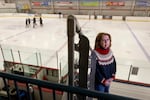
Heather Nemier, president of the Washington Figure Skating Club at the Ashburn Ice House in Ashburn, Va., where a number of the figure skaters trained who were victims in the air crash last January.
Tyrone Turner for NPR
The Washington Figure Skating Club lost seven members: three skaters — Franco Aparicio and sisters Everly (Evy) and Alydia (Liddy) Livingston — their coach, and three of their parents. Nemier said the unofficial spots at the Virginia rink where those skaters usually left their stuff sat empty for weeks, since no one wanted to occupy them.
But over the course of the year, she said, their fellow skaters have found ways to process that grief, with help from mental health counselors, therapy dogs, friendship bracelets, letter writing, public memorials and quiet spaces for reflection.
And many have returned to the ice with a newfound motivation. (That was also the case for Naumov, who was unsure if he would skate again until he returned to competition in the summer.)
“I’ve heard a number of [D.C.-area skaters] say, ‘You know, Evy can’t skate anymore but I can, and I’m going to get out there and do my best,’” Nemier said.

At the Ashburn Ice House, a memorial was created with photos and information honoring a coach, three skaters and their parents who died in the crash.
Tyrone Turner for NPR
Sofia Bezkorovainaya, now 15, did just that. The Virginia-based skater moved the crowd — and the internet — at January’s U.S. Figure Skating Championships in St. Louis with her "Over the Rainbow" short program, a tribute to Everly Livingston, her best friend of nearly a decade.
“If there were flies on the ice, she’d pick them up and bring them to the heater so that they could come back to life,” Bezkorovainaya told NPR after competing in St. Louis. “She always cared about everybody, and she was such an amazing skater.”
For months after the crash, Bezkorovainaya said she was “sad all the time” and feared she would never feel better. She even switched to another Virginia rink because of how empty her old one felt without the familiar faces.
Then she decided to learn Livingston’s choreography and compete with it in her memory.
In the opening and closing moments of the program, Bezkorovainaya said, “I look up to the bright lights up there and I hug myself and I imagine her hugging me.” Her long program is dedicated to her late longtime coach, Inna Volyanskaya, whose distinctive corrections she says she can still hear in her head while practicing.
“Doing these programs was like having them with me this season,” she said. “And before I got on the ice, I could always pray to Inna and Evy and everyone else who I was friends with on that plane … like, ‘Please help me do a clean program today.’”
Bezkorovainaya was one of three skaters at nationals whose program explicitly paid tribute to loved ones lost in the crash. Others, including Naumov, held up photos as they waited for their scores.

Sofia Bezkorovainaya skates during the "Legacy On Ice" U.S. Figure Skating Benefit at Capital One Arena in Washington, D.C., on March 2, 2025. She <a href="https://usfigureskating.org/news/2026/1/5/remembering-skating-family-three-athletes-skate-in-tribute.aspx"target="_blank" >one of three skaters</a> at nationals whose program explicitly paid tribute to loved ones lost in the crash.
Scott Taetsch
“I think it’s admirable that they’ve come up with ways of coping with such a terrible loss that is meaningful to them and is meaningful to other people, too,” Nemier said. “And to be able to share that with the public and with the skating community, I think is really important.”
Boston-based Patrick Blackwell, 17, skated to honor his friend Spencer Lane, even including a clip of the music Lane had planned to compete with this season. Blackwell ultimately won gold at the junior level, which he said was “not just for me but the ones who passed a year ago.”
“It’s kind of my gift to Spencer, his dad and every other family member, being able to bring gold home to a place where a lot of lives were lost,” he said.
Clubs look to keep legacies alive
Local and national figure skating organizations are working on more permanent ways to honor the victims’ memories.
And in early March, the U.S. figure skating community came together in Washington, D.C. for "Legacy on Ice," a benefit show that raised $1.2 million for first responders and victims’ loved ones. It featured moving performances by a huge roster of Olympians, past and present, as well as several young skaters directly affected by the crash, including Naumov.
More recently, the focus has shifted to the next generation of skaters: making sure they remember those who were lost, and making it easier for them to pursue the dreams they shared.
The Skating Club of Boston, for example, has created the "Always Champions Campaign" to fund two permanent scholarships, one in honor of each of the two skaters it lost, with criteria set by their families.
The campaign also aims to rename one of the rinks in Boston and create a memorial wall in honor of the six victims.

Flowers and remembrances are displayed for the six athletes, coaches and family members who perished in a plane crash, at The Skating Club of Boston in Norwood, Mass., on March 25, 2025.
Charles Krupa
“They were all examples — the skaters, the parents, the coaches — of people who we saw, if not six, seven days out of the week,” said club director Mia Corsini Bailey. “Their commitment to the sport on multiple levels is something that we’re carrying forward.”
In the D.C. area, the Washington Figure Skating Club has endowed trophies in memory of the three skaters it lost, with plans to add the winners’ names to a ringside plaque updated every year.
The club is also using its existing foundation to support young figure skaters through the "Livingston Family Dream Fund‚" which was set up by relatives of the family of four. The club used the money to give $1,000 grants to the skaters who participated in this year’s national development camp, according to Nemier. There were eight of them, she said, compared to about a dozen last year.
Another painful dimension of the tragedy, one increasingly top of mind in an Olympic year, is where the skaters returning from last year’s development camp were in their careers: right on the brink of making it to nationals, and beyond.
“Those were some of the kids that could have made it to the next Olympics or the Olympics after that,” said Bezkorovainaya, the junior skater.
Corsini Bailey, of Boston, recalls sitting down with 16-year-old Spencer Lane and his parents to talk about that very prospect just before the national development camp last year, and said she saw a similarly bright future for 13-year-old Jinna Han.
“The talent was there, the star power was there, and they truly were that next generation,” she said. “And now we look to: how are their legacies inspiring that next generation … whether they were their peers or they were the younger skaters who were looking up to them. Again, we carry them with us every single day.”