
In a photo provided by Central Oregon Community College, Victor Hedeen uses a vertical milling machine to remove material on a project during a manufacturing processes class in the manufacturing technology lab in Redmond, Ore., in November 2024.
Rosie Day
Central Oregon Community College has received a $2.2 million grant from the U.S. Department of Education to boost its Redmond-based degree and certificate programs in manufacturing technology. The school is one of 22 to receive the Fund for the Improvement of Post Secondary Education grant.
The federal money, along with $8 million of funding from the state and the community college, will help revitalize the manufacturing program — a key goal for the college. It will also provide training for Redmond’s growing manufacturing industry in new skills for today’s workplace. Students should be able to start working toward a short-term certificate this fall. The rest of the program updates will be rolled out over the next four years.
Manufacturing is a “growing, good wage job in Central Oregon,” said Amy Ward, the college’s Redmond campus director.
Redmond in particular is a growing destination for traded-sector manufacturing, said Steve Curley, Redmond Economic Development Inc. executive director. BASX Solutions is Redmond’s top employer and a program partner along with Nosler, a Central Oregon business that makes ammunition, firearms and related equipment and is in the process of relocating to Redmond from Bend.
Redmond is also a state enterprise zone, which means new business investments receive a tax break for a certain period of time, according to Business Oregon. The city invested $35 million to connect services to eastside manufacturing locations and is working with the state to develop 775 acres of large industrial sites, Mayor Ed Fitch said.
The community college will use the federal grant to purchase more equipment, hire more staff and offer short-term certificates that qualify for the Workforce Pell Grant, a new type of Pell Grant created by the One Big Beautiful Bill Act.
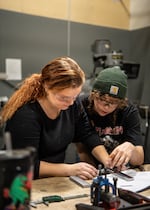
In a photo provided by Central Oregon Community College, Avery Smith (left) and Sydon Kofal use a micrometer to measure a part in a manufacturing processes class in the manufacturing technology lab in Redmond, Ore., in November 2024.
Rosie Day
Fitch predicts 10,000 new manufacturing jobs will be created in Redmond over the next 20 years as the industry gains popularity as a faster way to get into the workforce than a traditional four-year college program.
The program will also help existing workers upgrade their knowledge, he said.
“As more automation comes into the manufacturing space, you see upskilling to where someone who maybe was doing welding is now programming a robot that’s doing welding,” said Curley with Redmond Economic Development.
Nosler is one of the local businesses working with the community college program and is contributing to the curriculum, said Zach Waterman, a Nosler spokesperson. The company wants to help train students for potential roles in computer numerical control machines and precision manufacturing, he said.
COCC Instructional Outreach Dean Cindy Lenhart agrees there’s a growing demand for short-term workforce training in the region and the state.
Maxim Stensel is one of those driving that demand. The 39-year-old former writer had a number of career pivots before enrolling in COCC’s machining program last fall. It’s job security, he says.
“There’s always going to be stuff where people need things fixed or need things custom made,” he said.