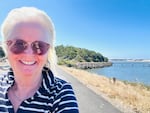
Novelist Holly Goldberg Sloan at the mouth of Siuslaw River on the Oregon Coast. Her new novel "Finding Lost" centers on a young girl who lost her father in a boating accident on the river.
Courtesy Holly Goldberg Sloan
In the summer of 2020, Kyle and Amber Novelli died when their crab boat got caught in rough water at the mouth of the Siuslaw River on the Oregon Coast.
The news had a big effect on the writer Holly Goldberg Sloan. She spent a lot of time in the nearby town of Florence as a kid.
The tragedy got her thinking about the connections we have to beautiful — but deadly — places, even when they take someone we love.
“I started imagining what would be like for the people who were left behind,” Goldberg Sloan said.
In her new novel “Finding Lost,” the people left behind are a young girl — the narrator of the story — her mother and brother. They have to navigate the loss of their family member after he died in a fishing boat accident on the Siuslaw.
Goldberg Sloan now lives in Southern California. She spoke with “All Things Considered” co-host Geoff Norcross.
Geoff Norcross: The Novellis had kids, and your protagonist in the book is a young girl named Cordy who lost her dad in a fishing boat accident on the Siuslaw. I was wondering if you could talk about the connections between how Cordy, your fictional girl, and the real-life Novellis responded to those tragedies.
Holly Goldberg Sloan: I started this book with a place, the Oregon Coast. It’s such a dynamic, incredible place, and it’s also a place that’s somewhat dangerous. I started reading the Siuslaw News, and I saw the crab fishing boat capsizing. And from that, I started imagining what it would be like for the people who were left behind.
The real people who died on the Siuslaw that day, their children were adults. But I write primarily for young people, and “Finding Lost” begins with that place, the natural world around Florence, and the loss that was experienced when there was an accident.
But what I’m really interested when I write about loss is, I’m interested in recovery. How do we get over something that’s really a catastrophe? And we do.
Norcross: Cordy is trying to navigate life without her father, but it’s clear she doesn’t want to leave the place that took him. Can you talk about the tension that that creates with her mom?
Goldberg Sloan: Her mom is a single mother. She works at a restaurant in Old Town. It’s modeled somewhat after the restaurant Mo’s, which is a place people would go to get clam chowder when I was a kid.
Her mom’s looking for a way to leave this place that took her husband and the father of her kids, and that brings a lot of fear into her daughter. She doesn’t want to leave what she’s known.
Norcross: Can you tell me more about your personal connection to Florence and the Siuslaw? What was it like to spend time there as a kid?
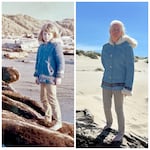
Writer Holly Goldberg Sloan recreates a childhood photo in Florence, Ore., where she spent a lot of time as a kid. Her new novel "Finding Lost" is set there.
Courtesy Holly Goldberg Sloan
Goldberg Sloan: My father was a professor at the University of Oregon. My parents wanted a place we could go to camp, so we bought a very small lot on Collard Lake, which is just north of Florence. I would say many of my best memories of being a child are on the Oregon coast.
They’re on the lake, walking up the channel by the Siuslaw River, which empties right into the ocean there. So I think things that get inside you, they form you. When people ask where I’m from — even though I was born in Michigan, I’ve lived in many places — I tell everybody I’m from Oregon, because I believe that.
Norcross: I was struck when reading your book, how rich with sense of place it is. I was reading it and it just felt like I was there. I’m just wondering how you were able to convey that on the page.
Goldberg Sloan: Frank Herbert came up with the idea for “Dune” by visiting Florence, by looking at those dunes there and wondering about the dunes. And of course, Ken Kesey, in “Sometimes A Great Notion,” they’re going down the Siuslaw River. That place is still there.
I think it’s interesting that my kids always think that at some point I may go back to Oregon. And maybe they’re right, because I’ve never left being somebody from Oregon.