If conditions don’t change, Oregon is on track to experience its lowest snowpack on record this winter, as a snow drought grips the West.
The state is already experiencing its lowest snowpack for this time of year.
And while nearby states are also struggling, Oregon appears to be worse off, with statewide snowpack numbers averaging around 30% of normal.
Without more mountain snow in the coming weeks, wildlife, farmers and ranchers could all face hardship this summer. Ski resorts are already struggling. And while there’s hope for a better season next year, the current snow drought fits a pattern of declining slow levels that’s likely to continue as the climate warms.
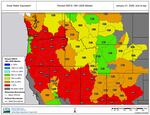
A U.S. Department of Agriculture map of snow drought in the West as of Jan. 31, 2026.
Map via U.S. Department of Agriculture Natural Resources Conservation Service
Weather and snow experts say there are still weeks of winter left. And, some weather modeling is forecasting snowfall in the near future.
“This weekend, we might get some precipitation,” said Larry O’Neill, Oregon’s state climatologist and an associate professor at Oregon State University. “Within two weeks, there’s a chance that we’ll actually get quite a bit more snow.”
O’Neill cautioned that weather models change day-by-day, but as of early February, he said with “moderate confidence” that Oregonians could see snowfall sometime after Valentine’s Day, even in low-lying valley areas.
“This is the first time that we’ve had this really strong signal that we’re going to get regular winter weather again,” he said.
That snowfall is direly needed, not just for fish and wildlife, but also humans. Mountain snow retains water that will gradually melt through spring and summer, feeding into rivers and drinking water reservoirs.
Fresh, mountain snow also brings down water temperatures. When temperatures are too high, water can turn into breeding grounds for algae and bacteria, harming fish and wildlife, and making it more expensive to treat.
Farmers and ranchers could also take a hit if there’s not enough snow soaking into soil and into underground aquifers. Groundwater wells pull water from these aquifers for farms, livestock, and businesses. Some cities also rely on groundwater wells.
“A lot of our basins, a lot of U.S. West, a lot of Oregon depends critically on snow melting in the spring, so people can irrigate their fields and irrigate their livestock,” O’Neill said.
Snow can prevent flooding, as it slowly releases water over time instead of all at once. And it staves off drought, ensuring plants stay green and don’t turn into wildfire fuel. A low snowpack year can sometimes be an indicator of a bad wildfire season ahead.
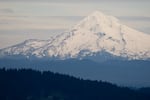
Poor snowpack covers Mt. Hood on a warmer than average day, reaching 56 degrees Fahrenheit, in Portland, Ore., on Feb. 3, 2026.
Eli Imadali / OPB
Low snow dampens skiing season
Low snowpack can be a major bummer to skiers and snowboarders.
Greg Pack, the president and general manager of Mt. Hood Meadows, says his staff are making do by salvaging snow from the ski resort’s parking lots.
“Our team’s done an amazing job of putting the mountain back together every night, hauling snow from all corners of the resort and every pocket we can possibly find,” he said.
The ski resort opened on Dec. 23 — the latest opening day in the company’s history.
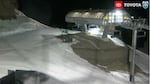
A screenshot from a Mt. Hood Meadows webcam on Jan. 23, 2026, shows minimal snow.
Courtesy of Mt. Hood Meadows
Pack says the resort has done fairly well, all things considered. As of early February, the company was operating its upper mountain lifts, including Vista Express and Cascade Express. But there were some barren areas on lower areas of the mountain, so some lifts are closed.
“We can’t control Mother Nature,” Pack said. “We can control our attitudes and how we deal with it, and how creative we get. So, it has been challenging, but I’m just excited to be open.”
In Central Oregon, the Mt. Bachelor Mountain Resort had about half of its trails and lifts open. In far Southern Oregon, the Mt. Ashland Ski Area paused all ski operations for the season due to warm weather.
But just because this year has been a drag, doesn’t mean there isn’t hope for next year.
“People get a little bit discouraged,” David Hill, an Oregon State University professor who studies snowpack. “They start thinking it’s the end of the world. The point to make about snow is that it is extremely variable from year to year.”

Hikers walk across a frozen Trillium Lake on a sunny, warm day near Mount Hood near Government Camp, Ore., on Jan. 24, 2026.
April Ehrlich / OPB
Oregon could break a decade-old record
While annual snowfall can be difficult to predict, there is one thing that most scientists are certain of: As global temperatures continue to rise as a result of climate change, snowpack will continue to decline.
Hill says locally, snowpack levels have trended downward in recent decades. That decline has accelerated in the past 15 years.
“When temperatures in Oregon go up 3, 4, 5 degrees, because our mountains are fairly low and fairly warm, that change in temperature means that you can’t freeze water,” Hill said.
Oregon last had a record-breaking low snowpack year in 2015. It could break winter records again this year if it doesn’t get more snow before the end of March. That’s usually when regions hit their peak snowpack of the season.
That last drought was driven by warm temperatures. Because temperatures weren’t cold enough, precipitation fell as rain instead of snow. Researchers have correlated that snow drought to climate change, which is primarily caused by humans burning fossil fuels for energy, transportation and manufacturing.
A similar trend is happening this year: Temperatures haven’t been cold enough for snow.
“We definitely know climate change is changing the snowpack to our detriment,” said O’Neill, the state climatologist. “The projections are pretty grim in terms of what our snowpack will do in the coming decades.”